Wu Yalun, Yuan Qianqian, Yang Yongfu, Liu Defei, Yang Shihui, Ma Hongwu
State Key Laboratory of Biocatalysis and Enzyme Engineering, School of Life Sciences, Hubei University, Wuhan, 430062, Hubei, China.
Biodesign Center, Key Laboratory of Systems Microbial Biotechnology, Tianjin Institute of Industrial Biotechnology, Chinese Academy of Sciences, Tianjin, 300308, China.
Synth Syst Biotechnol. 2023 Jul 6;8(3):498-508. doi: 10.1016/j.synbio.2023.07.001. eCollection 2023 Sep.
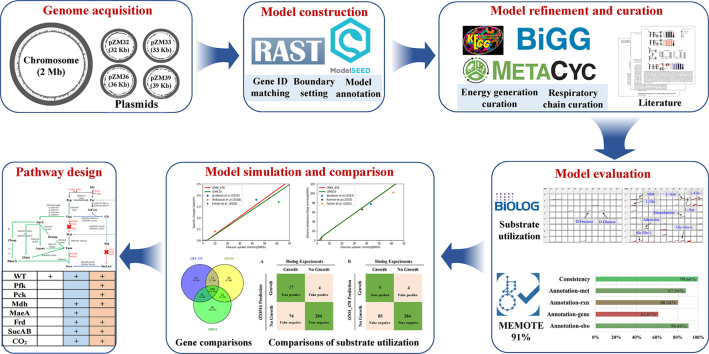
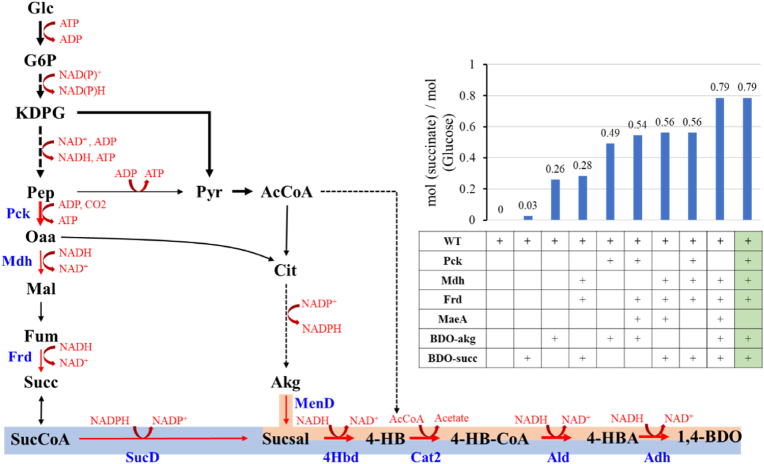
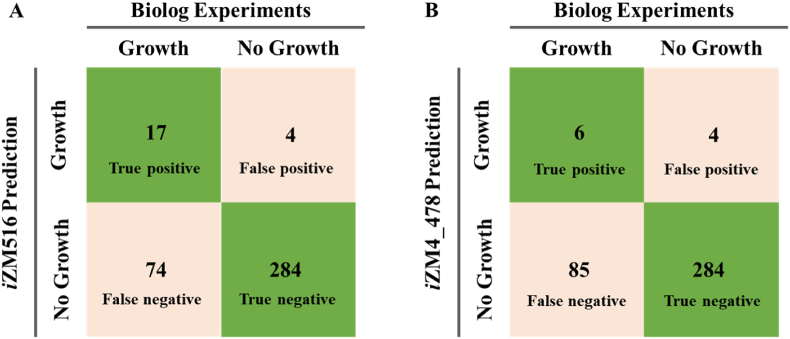
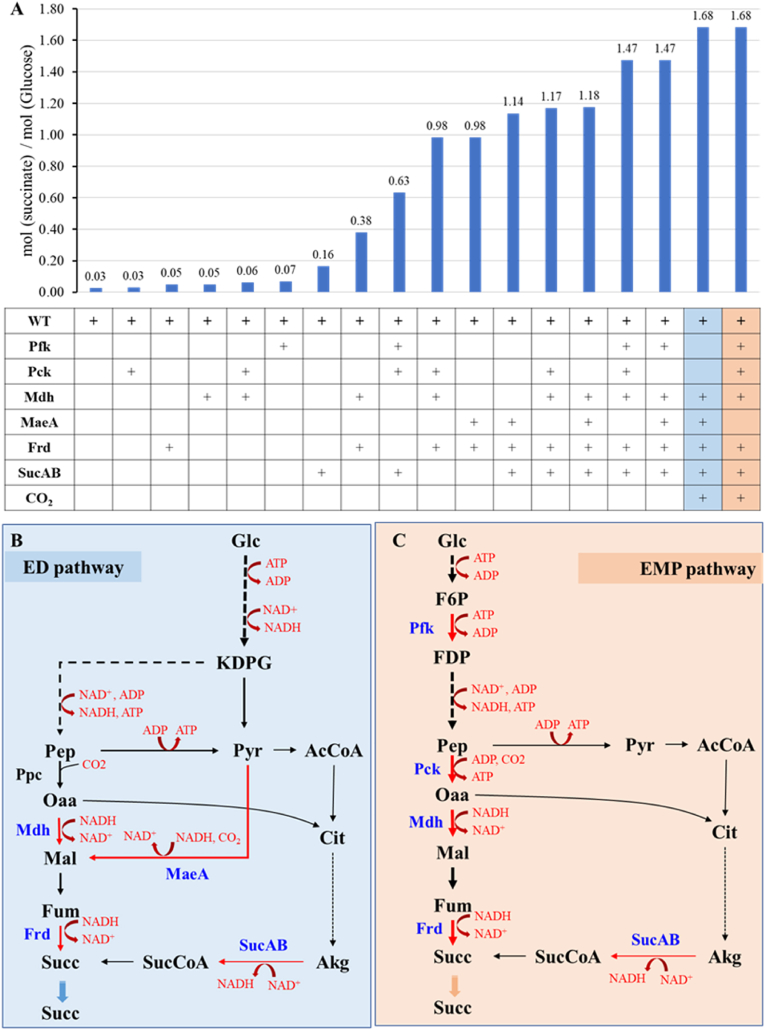
High-quality genome-scale metabolic models (GEMs) could play critical roles on rational design of microbial cell factories in the classical Design-Build-Test-Learn cycle of synthetic biology studies. Despite of the constant establishment and update of GEMs for model microorganisms such as and , high-quality GEMs for non-model industrial microorganisms are still scarce. subsp. ZM4 is a non-model ethanologenic microorganism with many excellent industrial characteristics that has been developing as microbial cell factories for biochemical production. Although five GEMs of have been constructed, these models are either generating ATP incorrectly, or lacking information of plasmid genes, or not providing standard format file. In this study, a high-quality GEM ZM516 of ZM4 was constructed. The information from the improved genome annotation, literature, datasets of Biolog Phenotype Microarray studies, and recently updated Gene-Protein-Reaction information was combined for the curation of ZM516. Finally, 516 genes, 1389 reactions, 1437 metabolites, and 3 cell compartments are included in ZM516, which also had the highest MEMOTE score of 91% among all published GEMs of Cell growth was then predicted by ZM516, which had 79.4% agreement with the experimental results of the substrate utilization. In addition, the potential endogenous succinate synthesis pathway of ZM4 was proposed through simulation and analysis using ZM516. Furthermore, metabolic engineering strategies to produce succinate and 1,4-butanediol (1,4-BDO) were designed and then simulated under anaerobic condition using ZM516. The results indicated that 1.68 mol/mol succinate and 1.07 mol/mol 1,4-BDO can be achieved through combinational metabolic engineering strategies, which was comparable to that of the model species Our study thus not only established a high-quality GEM ZM516 to help understand and design microbial cell factories for economic biochemical production using as the chassis, but also provided guidance on building accurate GEMs for other non-model industrial microorganisms.
高质量的基因组规模代谢模型(GEMs)在合成生物学研究经典的设计-构建-测试-学习循环中,对微生物细胞工厂的合理设计可能发挥关键作用。尽管针对诸如[具体微生物1]和[具体微生物2]等模式微生物的GEMs不断建立和更新,但针对非模式工业微生物的高质量GEMs仍然稀缺。嗜糖假单胞菌亚种ZM4是一种具有许多优良工业特性的非模式产乙醇微生物,已被开发用作生化生产的微生物细胞工厂。尽管已经构建了嗜糖假单胞菌的五个GEMs,但这些模型要么ATP生成错误,要么缺乏质粒基因信息,要么没有提供标准格式文件。在本研究中,构建了嗜糖假单胞菌ZM4的高质量GEM ZM516。将来自改进的基因组注释、文献、Biolog表型微阵列研究数据集以及最近更新的基因-蛋白质-反应信息整合起来用于ZM516的编目。最终,ZM516包含516个基因、1389个反应、1437个代谢物和3个细胞区室,在所有已发表的嗜糖假单胞菌GEMs中,其MEMOTE得分也最高,为91%。然后通过ZM516预测细胞生长,其与底物利用的实验结果有79.4%的一致性。此外,通过使用ZM516进行模拟和分析,提出了嗜糖假单胞菌ZM4潜在的内源性琥珀酸合成途径。此外,设计了生产琥珀酸和1,4-丁二醇(1,4-BDO)的代谢工程策略,然后在厌氧条件下使用ZM516进行模拟。结果表明,通过组合代谢工程策略可实现1.68 mol/mol琥珀酸和1.07 mol/mol 1,4-BDO,这与模式物种相当。因此,我们的研究不仅建立了高质量的GEM ZM516,以帮助理解和设计以嗜糖假单胞菌为底盘用于经济生化生产的微生物细胞工厂,而且为构建其他非模式工业微生物的精确GEMs提供了指导。