Guzman-Echavarria Gisel, Middel Ariane, Vanos Jennifer
School of Geographical Sciences and Urban Planning, Arizona State University, Tempe, AZ, USA.
School of Arts, Media and Engineering, Arizona State University, Tempe, AZ, USA.
Temperature (Austin). 2022 Dec 18;10(3):358-378. doi: 10.1080/23328940.2022.2149024. eCollection 2023.
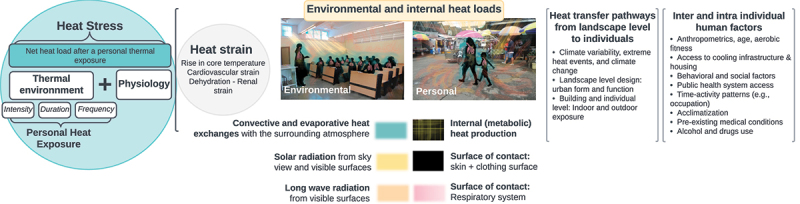
Fine-scale personal heat exposure (PHE) information can help prevent or minimize weather-related deaths, illnesses, and reduced work productivity. Common methods to estimate heat risk do not simultaneously account for the intensity, frequency, and duration of thermal exposures, nor do they include inter-individual factors that modify physiological response. This study demonstrates new whole-body net thermal load estimations to link PHE to heat stress and strain over time. We apply a human-environment heat exchange model to examine how time-varying net thermal loads differ across climate contexts, personal attributes, and spatiotemporal scales. First, we investigate summertime climatic PHE impacts for three US cities: Phoenix, Miami, and New York. Second, we model body morphology and acclimatization for three profiles (middle-aged male/female; female >65 years). Finally, we quantify model sensitivity using representative data at synoptic and micro-scales. For all cases, we compare required and potential evaporative heat losses that can lead to dangerous thermal exposures based on (un)compensable heat stress. Results reveal misclassifications in heat stress or strain due to incomplete environmental data and assumed equivalent physiology and activities between people. Heat strain is most poorly represented by PHE alone for the elderly, non-acclimatized, those engaged in strenuous activities, and when negating solar radiation. Moreover, humid versus dry heat across climates elicits distinct thermal responses from the body. We outline criteria for inclusive PHE evaluations connecting heat exposure, stress, and strain while using physiological-based methods to avoid misclassifications. This work underlines the value of moving from "one-size-fits-all" thermal indices to "fit-for-purpose" approaches using personalized information.
精细尺度的个人热暴露(PHE)信息有助于预防或尽量减少与天气相关的死亡、疾病以及工作效率降低。常见的热风险评估方法无法同时兼顾热暴露的强度、频率和持续时间,也未纳入影响生理反应的个体间因素。本研究展示了新的全身净热负荷估算方法,以将个人热暴露与随时间变化的热应激和热应变联系起来。我们应用一个人与环境热交换模型,来研究时变净热负荷在不同气候背景、个人属性和时空尺度下是如何不同的。首先,我们调查了美国三个城市(凤凰城、迈阿密和纽约)夏季气候性个人热暴露的影响。其次,我们针对三种人群特征(中年男性/女性;65岁以上女性)对身体形态和适应情况进行了建模。最后,我们使用天气尺度和微观尺度的代表性数据对模型敏感性进行了量化。对于所有情况,我们比较了基于(不可)补偿热应激可能导致危险热暴露的所需蒸发热损失和潜在蒸发热损失。结果表明,由于环境数据不完整以及假定人与人之间生理和活动等效,导致热应激或热应变出现误判。对于老年人、未适应环境者、从事剧烈活动的人以及忽略太阳辐射的情况,仅个人热暴露最不能准确反映热应变。此外,不同气候下的湿热与干热会引起身体不同的热反应。我们概述了在使用基于生理学的方法以避免误判的同时,将热暴露、应激和应变联系起来进行全面个人热暴露评估的标准。这项工作强调了从“一刀切”的热指数转向使用个性化信息的“量身定制”方法的价值。