Parikh Niki, Aro-Lambo Mazeed, Vencill Jennifer A, Collins C Scott, Helo Sevann, Kohler Tobias, Ziegelmann Matthew
Department of Urology, Mayo Clinic, Rochester, MN, USA.
Mayo Clinic Alix School of Medicine, Rochester, MN, USA.
Transl Androl Urol. 2023 Jul 31;12(7):1071-1078. doi: 10.21037/tau-22-793. Epub 2023 Jul 3.
To determine effects of sexual health curriculum (SHC) in medical school and mentorship on future specialty/subspecialty selection, we sought to evaluate the experiences of urology trainees and practicing urologists.
Residents, fellows, and practicing urologists completed a 15-question survey regarding their exposure to a SHC during medical school, topics covered, and the influence of mentors in their career choice. Summary statistics were used to identify trends based on survey responses.
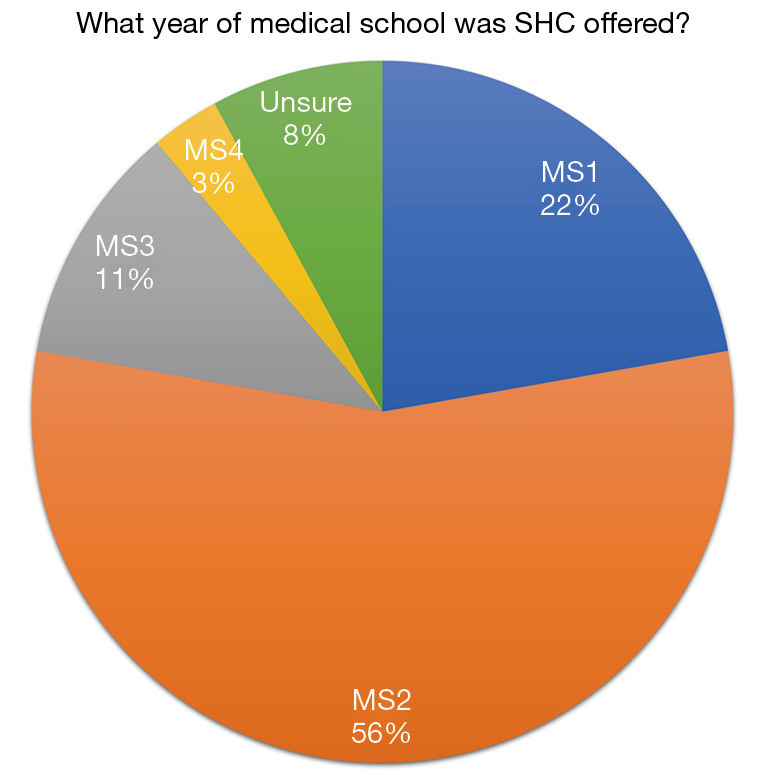
Ninety-four respondents, primarily post-graduate training year 4 and 5 (46%), completed the survey. Approximately 50% recalled a dedicated SHC during medical school with 46% planning to pursue fellowship training in sexual medicine/reconstruction. Topics commonly covered included reproductive anatomy/physiology and sexual history-taking, while respondents rarely recalled topics such as sexual aids/toys and pornography. Only 25% felt their SHC provided an adequate fund of knowledge to address sexual health concerns in patients, and only 14% felt that exposure to a SHC influenced their decision to pursue urology. Individuals intending to pursue fellowship were more likely to have an attending mentor, a mentor with expertise in sexual dysfunction, and considered their mentor as important or very important in their decision to subspecialize (P<0.05).
Most urology trainees do not have strong exposure to a SHC during medical school and cite mentorship as a more important role in the decision to pursue subspecialty training. These data support the need for a standardized formal SHC and continued exposure to sexual health experts during training to ensure continued interest in sexual medicine/reconstruction fellowship.
为了确定医学院性健康课程(SHC)及导师指导对未来专业/亚专业选择的影响,我们试图评估泌尿外科住院医师和执业泌尿外科医生的经历。
住院医师、专科培训学员和执业泌尿外科医生完成了一项包含15个问题的调查,内容涉及他们在医学院期间对性健康课程的接触情况、涵盖的主题以及导师对其职业选择的影响。汇总统计数据用于根据调查回复确定趋势。
94名受访者完成了调查,其中主要是研究生培训第4年和第5年的学员(46%)。约50%的受访者回忆起医学院有专门的性健康课程,46%的人计划接受性医学/重建方面的专科培训。常见涵盖的主题包括生殖解剖学/生理学和性病史采集,而受访者很少回忆起诸如性辅助器具/玩具和色情制品等主题。只有25%的人认为他们的性健康课程提供了足够的知识储备以解决患者的性健康问题,只有14%的人认为接触性健康课程影响了他们选择泌尿外科的决定。打算接受专科培训的人更有可能有一位主治导师、一位在性功能障碍方面有专长的导师,并且认为他们的导师在其选择亚专业的决定中很重要或非常重要(P<0.05)。
大多数泌尿外科住院医师在医学院期间并未充分接触性健康课程,他们认为导师指导在决定接受亚专业培训方面发挥着更重要的作用。这些数据支持需要有标准化的正式性健康课程,并在培训期间持续接触性健康专家,以确保对性医学/重建专科培训持续保持兴趣。