Sarhaddi Fatemeh, Azimi Iman, Niela-Vilen Hannakaisa, Axelin Anna, Liljeberg Pasi, Rahmani Amir M
Department of Computing, University of Turku, Turku, Finland.
Department of Computer Science, University of California, Irvine, CA, United States.
JMIR Form Res. 2023 Aug 9;7:e47950. doi: 10.2196/47950.
Maternal loneliness is associated with adverse physical and mental health outcomes for both the mother and her child. Detecting maternal loneliness noninvasively through wearable devices and passive sensing provides opportunities to prevent or reduce the impact of loneliness on the health and well-being of the mother and her child.
The aim of this study is to use objective health data collected passively by a wearable device to predict maternal (social) loneliness during pregnancy and the postpartum period and identify the important objective physiological parameters in loneliness detection.
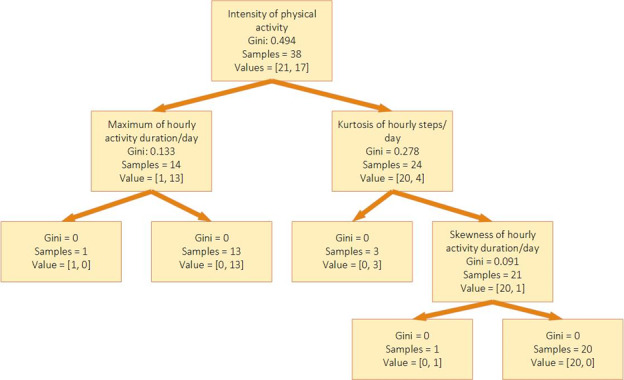
We conducted a longitudinal study using smartwatches to continuously collect physiological data from 31 women during pregnancy and the postpartum period. The participants completed the University of California, Los Angeles (UCLA) loneliness questionnaire in gestational week 36 and again at 12 weeks post partum. Responses to this questionnaire and background information of the participants were collected through our customized cross-platform mobile app. We leveraged participants' smartwatch data from the 7 days before and the day of their completion of the UCLA questionnaire for loneliness prediction. We categorized the loneliness scores from the UCLA questionnaire as loneliness (scores≥12) and nonloneliness (scores<12). We developed decision tree and gradient-boosting models to predict loneliness. We evaluated the models by using leave-one-participant-out cross-validation. Moreover, we discussed the importance of extracted health parameters in our models for loneliness prediction.
The gradient boosting and decision tree models predicted maternal social loneliness with weighted F-scores of 0.897 and 0.872, respectively. Our results also show that loneliness is highly associated with activity intensity and activity distribution during the day. In addition, resting heart rate (HR) and resting HR variability (HRV) were correlated with loneliness.
Our results show the potential benefit and feasibility of using passive sensing with a smartwatch to predict maternal loneliness. Our developed machine learning models achieved a high F-score for loneliness prediction. We also show that intensity of activity, activity pattern, and resting HR and HRV are good predictors of loneliness. These results indicate the intervention opportunities made available by wearable devices and predictive models to improve maternal well-being through early detection of loneliness.
母亲的孤独感与母亲及其孩子的不良身心健康结果相关。通过可穿戴设备和被动传感技术无创检测母亲的孤独感,为预防或减少孤独感对母亲及其孩子的健康和幸福的影响提供了机会。
本研究的目的是利用可穿戴设备被动收集的客观健康数据,预测孕期和产后母亲的(社交)孤独感,并确定孤独感检测中的重要客观生理参数。
我们进行了一项纵向研究,使用智能手表在孕期和产后持续收集31名女性的生理数据。参与者在孕36周和产后12周时完成了加州大学洛杉矶分校(UCLA)孤独感问卷。通过我们定制的跨平台移动应用程序收集对该问卷的回答以及参与者的背景信息。我们利用参与者在完成UCLA孤独感问卷之前7天和当天的智能手表数据进行孤独感预测。我们将UCLA问卷中的孤独感得分分为孤独(得分≥12)和非孤独(得分<12)两类。我们开发了决策树和梯度提升模型来预测孤独感。我们使用留一参与者交叉验证来评估模型。此外,我们讨论了模型中提取的健康参数在孤独感预测中的重要性。
梯度提升模型和决策树模型预测母亲社交孤独感的加权F值分别为0.897和0.872。我们的结果还表明,孤独感与白天的活动强度和活动分布高度相关。此外,静息心率(HR)和静息心率变异性(HRV)与孤独感相关。
我们的结果显示了使用智能手表被动传感技术预测母亲孤独感的潜在益处和可行性。我们开发的机器学习模型在孤独感预测方面取得了较高的F值。我们还表明,活动强度、活动模式以及静息HR和HRV是孤独感的良好预测指标。这些结果表明,可穿戴设备和预测模型通过早期检测孤独感为改善母亲幸福感提供了干预机会。