Department of Genetics, University of North Carolina at Chapel Hill, Chapel Hill, NC, United States.
School of Public Health, University of California, Berkeley, Berkeley, CA, United States.
JMIR Mhealth Uhealth. 2024 May 2;12:e54622. doi: 10.2196/54622.
Postpartum depression (PPD) poses a significant maternal health challenge. The current approach to detecting PPD relies on in-person postpartum visits, which contributes to underdiagnosis. Furthermore, recognizing PPD symptoms can be challenging. Therefore, we explored the potential of using digital biomarkers from consumer wearables for PPD recognition.
The main goal of this study was to showcase the viability of using machine learning (ML) and digital biomarkers related to heart rate, physical activity, and energy expenditure derived from consumer-grade wearables for the recognition of PPD.
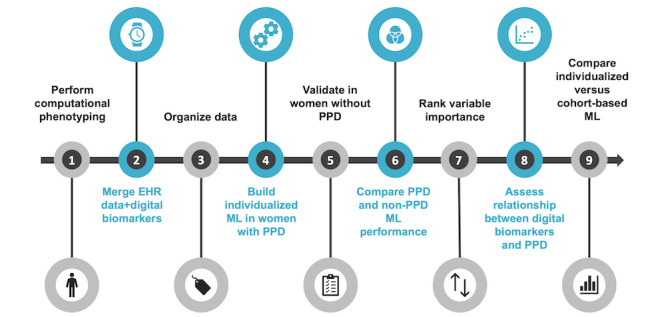
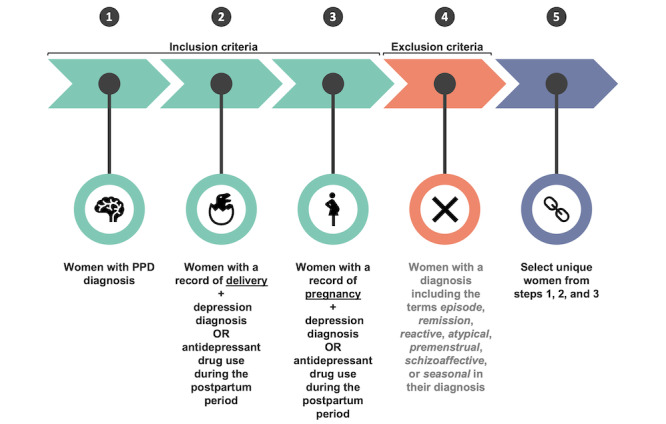
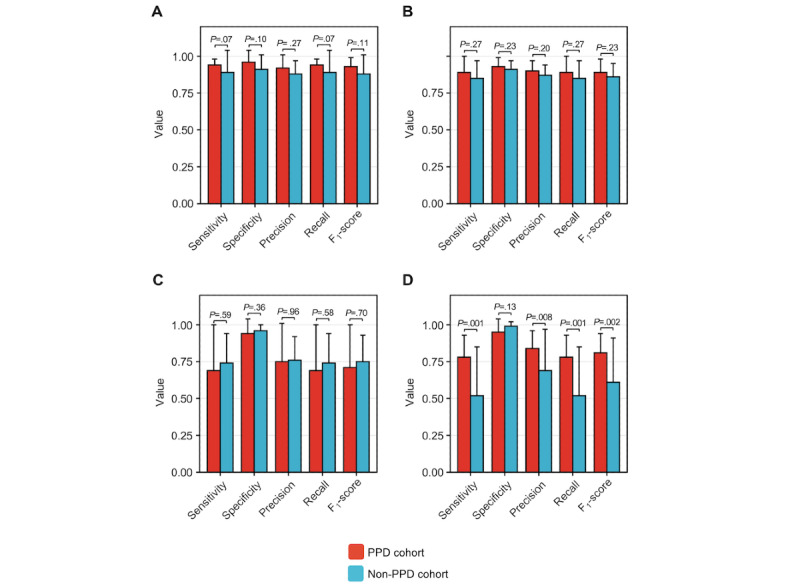
Using the All of Us Research Program Registered Tier v6 data set, we performed computational phenotyping of women with and without PPD following childbirth. Intraindividual ML models were developed using digital biomarkers from Fitbit to discern between prepregnancy, pregnancy, postpartum without depression, and postpartum with depression (ie, PPD diagnosis) periods. Models were built using generalized linear models, random forest, support vector machine, and k-nearest neighbor algorithms and evaluated using the κ statistic and multiclass area under the receiver operating characteristic curve (mAUC) to determine the algorithm with the best performance. The specificity of our individualized ML approach was confirmed in a cohort of women who gave birth and did not experience PPD. Moreover, we assessed the impact of a previous history of depression on model performance. We determined the variable importance for predicting the PPD period using Shapley additive explanations and confirmed the results using a permutation approach. Finally, we compared our individualized ML methodology against a traditional cohort-based ML model for PPD recognition and compared model performance using sensitivity, specificity, precision, recall, and F-score.
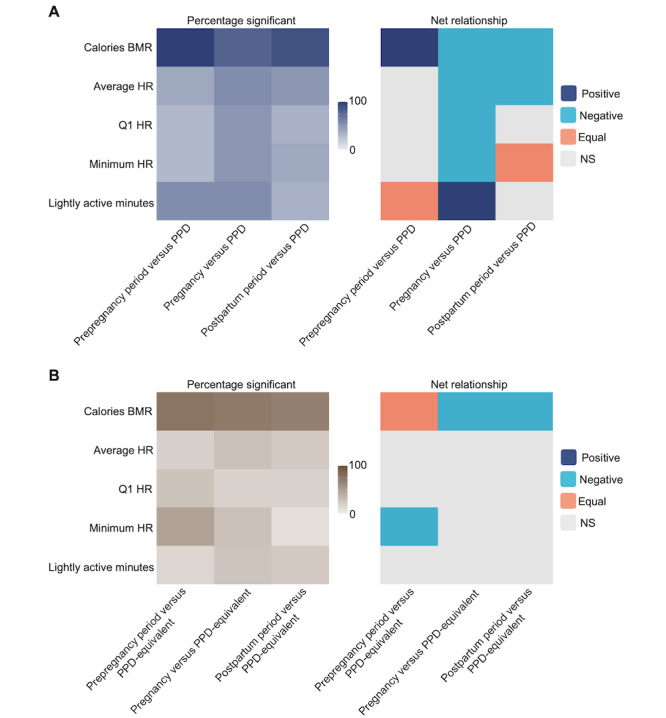
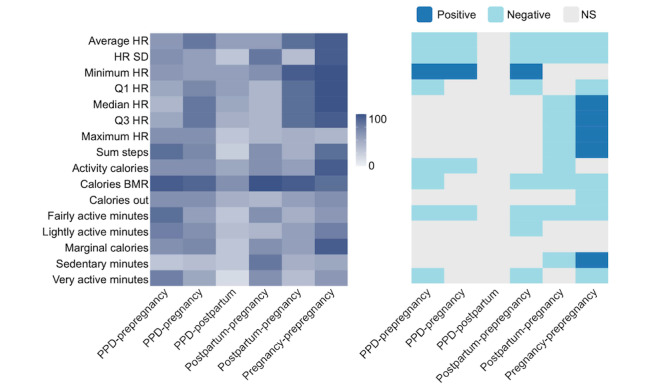
Patient cohorts of women with valid Fitbit data who gave birth included <20 with PPD and 39 without PPD. Our results demonstrated that intraindividual models using digital biomarkers discerned among prepregnancy, pregnancy, postpartum without depression, and postpartum with depression (ie, PPD diagnosis) periods, with random forest (mAUC=0.85; κ=0.80) models outperforming generalized linear models (mAUC=0.82; κ=0.74), support vector machine (mAUC=0.75; κ=0.72), and k-nearest neighbor (mAUC=0.74; κ=0.62). Model performance decreased in women without PPD, illustrating the method's specificity. Previous depression history did not impact the efficacy of the model for PPD recognition. Moreover, we found that the most predictive biomarker of PPD was calories burned during the basal metabolic rate. Finally, individualized models surpassed the performance of a conventional cohort-based model for PPD detection.
This research establishes consumer wearables as a promising tool for PPD identification and highlights personalized ML approaches, which could transform early disease detection strategies.
产后抑郁症(PPD)对产妇健康构成重大挑战。目前检测 PPD 的方法依赖于产后访视,这导致了漏诊。此外,识别 PPD 症状具有挑战性。因此,我们探索了使用来自消费者可穿戴设备的数字生物标志物来识别 PPD 的可能性。
本研究的主要目标是展示使用机器学习(ML)和与心率、身体活动和能量消耗相关的数字生物标志物从消费者级可穿戴设备识别 PPD 的可行性。
我们使用 All of Us Research Program Registered Tier v6 数据集,对产后患有和不患有 PPD 的女性进行计算表型分析。使用 Fitbit 的数字生物标志物开发个体内 ML 模型,以区分孕前、孕期、产后无抑郁和产后有抑郁(即 PPD 诊断)期。使用广义线性模型、随机森林、支持向量机和 k-最近邻算法构建模型,并使用κ统计量和多类接收器操作特征曲线下的面积(mAUC)评估模型,以确定性能最佳的算法。我们在未经历 PPD 的分娩女性队列中验证了我们个体化 ML 方法的特异性。此外,我们评估了既往抑郁史对模型性能的影响。我们使用 Shapley 加法解释来确定预测 PPD 期的变量重要性,并使用置换方法确认结果。最后,我们将我们的个体化 ML 方法与传统的基于队列的 PPD 识别 ML 模型进行比较,并使用敏感性、特异性、精度、召回率和 F 分数比较模型性能。
具有有效 Fitbit 数据的分娩女性患者队列中,PPD 患者<20 例,无 PPD 患者 39 例。我们的结果表明,使用数字生物标志物的个体内模型能够区分孕前、孕期、产后无抑郁和产后有抑郁(即 PPD 诊断)期,随机森林(mAUC=0.85;κ=0.80)模型优于广义线性模型(mAUC=0.82;κ=0.74)、支持向量机(mAUC=0.75;κ=0.72)和 k-最近邻(mAUC=0.74;κ=0.62)。无 PPD 的女性的模型性能下降,说明该方法具有特异性。既往抑郁史并不影响模型对 PPD 识别的效果。此外,我们发现预测 PPD 的最具预测性的生物标志物是基础代谢率期间消耗的卡路里。最后,个体化模型在 PPD 检测方面优于传统的基于队列的模型。
本研究确立了消费者可穿戴设备作为 PPD 识别的有前途的工具,并强调了个性化 ML 方法,这可能改变早期疾病检测策略。