Graduate Institute of Linguistics, National Chengchi University, Taipei, Taiwan.
Faculty of Science and Engineering, Waseda University, Tokyo, Japan.
Cereb Cortex. 2023 Sep 9;33(18):10013-10027. doi: 10.1093/cercor/bhad261.
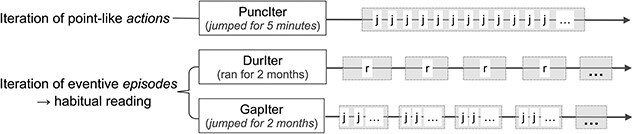
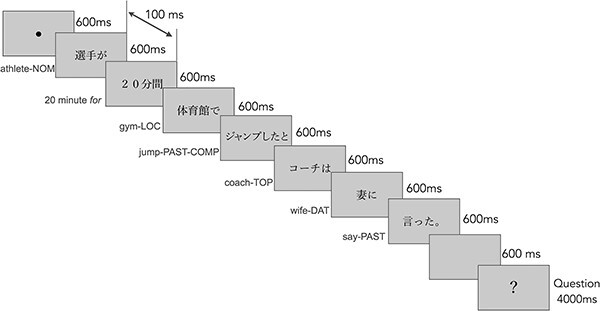
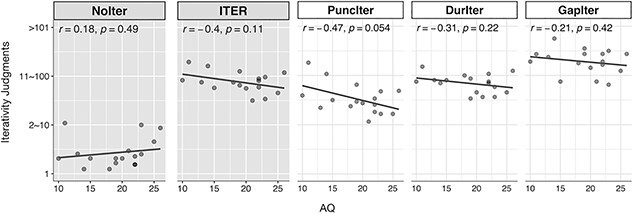
We investigated the neurocognitive mechanisms underlying the processing of combinatorial unstated meaning. Sentences like "Charles jumped for 5 minutes." engender an iterative meaning that is not explicitly stated but enriched by comprehenders beyond simple composition. Comprehending unstated meaning involves meaning contextualization-integrative meaning search in sentential-discourse context. Meanwhile, people differ in how they process information with varying context sensitivity. We hypothesized that unstated meaning processing would vary with individual socio-cognitive propensity indexed by the Autism-Spectrum Quotient (AQ), accompanied by differential cortical engagements. Using functional magnetic resonance imaging, we examined the processing of sentences with unstated iterative meaning in typically-developed individuals and found an engagement of the fronto-parietal network, including the left pars triangularis (L.PT), right intraparietal (R.IPS), and parieto-occipital sulcus (R.POS). We suggest that the L.PT subserves a contextual meaning search, while the R.IPS/POS supports enriching unstated iteration in consideration of event durations and interval lengths. Moreover, the activation level of these regions negatively correlated with AQ. Higher AQ ties to lower L.PT activation, likely reflecting weaker context sensitivity, along with lower IPS activation, likely reflecting weaker computation of events' numerical-temporal specifications. These suggest that the L.PT and R.IPS/POS support the processing of combinatorial unstated meaning, with the activation level modulated by individual cognitive styles.
我们研究了组合未明意义处理的神经认知机制。像“查尔斯跳了 5 分钟。”这样的句子产生了一种迭代的意义,这种意义不是明确陈述的,而是由理解者在简单的组合之外丰富的。理解未明意义涉及意义语境化——在句子——话语语境中进行综合意义搜索。同时,人们在处理具有不同语境敏感性的信息时存在差异。我们假设,未明意义的处理会因自闭症谱系商数(AQ)所索引的个体社会认知倾向而有所不同,同时伴随着皮质差异参与。使用功能磁共振成像,我们检查了在典型发展个体中具有未明迭代意义的句子的处理,发现了额顶网络的参与,包括左三角(L.PT)、右顶内(R.IPS)和顶枕沟(R.POS)。我们认为 L.PT 用于语境意义搜索,而 R.IPS/POS 则支持在考虑事件持续时间和间隔长度时丰富未明的迭代。此外,这些区域的激活水平与 AQ 呈负相关。较高的 AQ 与较低的 L.PT 激活相关,可能反映了较弱的语境敏感性,以及较低的 IPS 激活,可能反映了对事件的数值——时间特征的较弱计算。这些表明 L.PT 和 R.IPS/POS 支持组合未明意义的处理,其激活水平受个体认知风格的调节。