CNRS, MCC, PACEA, UMR5199, Université de Bordeaux, 33615, Pessac, France.
Department of Archaeology, History, Cultural Studies and Religion, Centre for Early Sapiens Behaviour (SapienCE), University of Bergen, 5020, Bergen, Norway.
Sci Rep. 2023 Aug 9;13(1):12895. doi: 10.1038/s41598-023-39897-7.
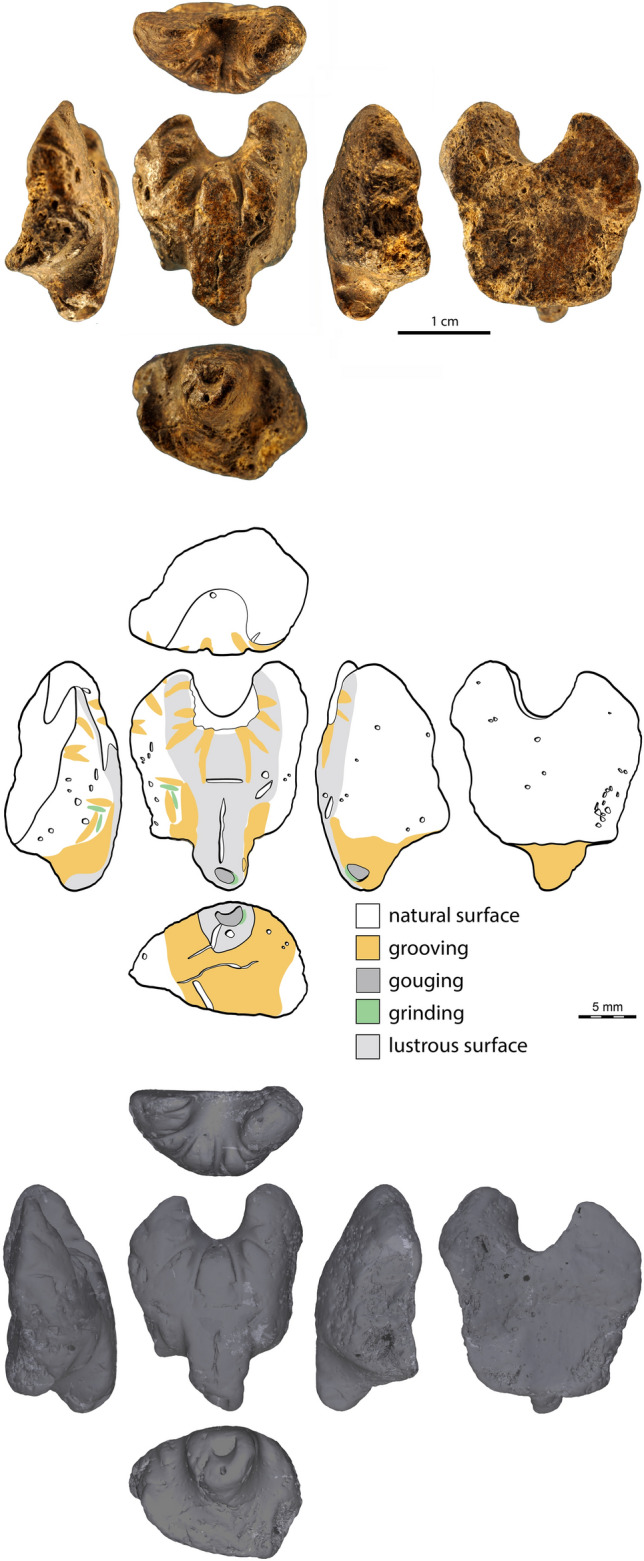
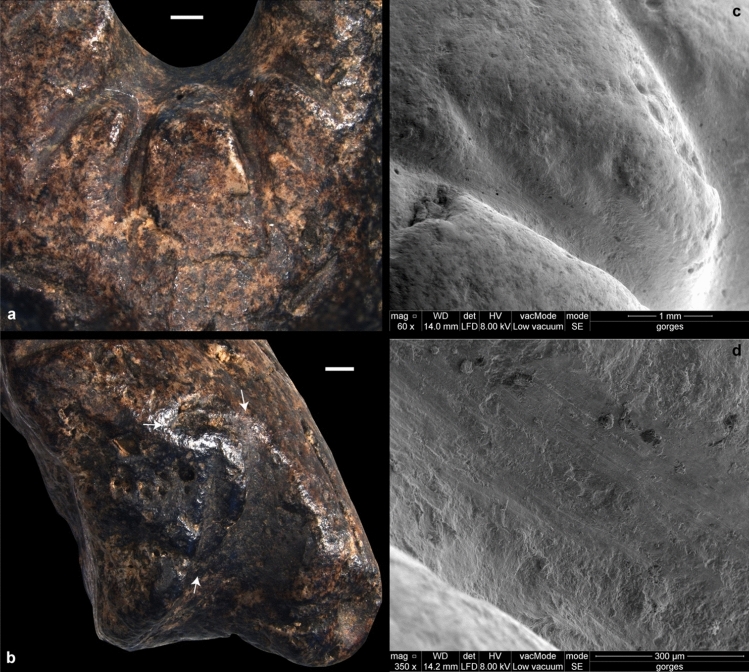
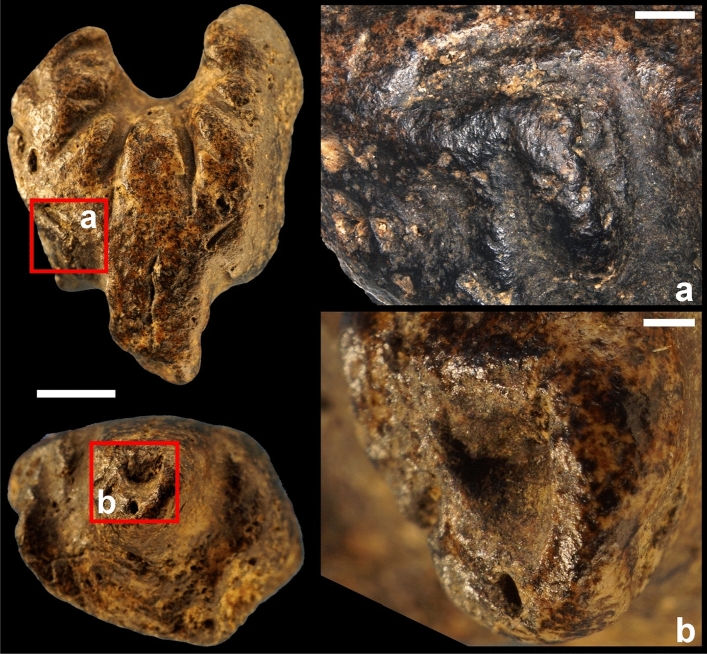
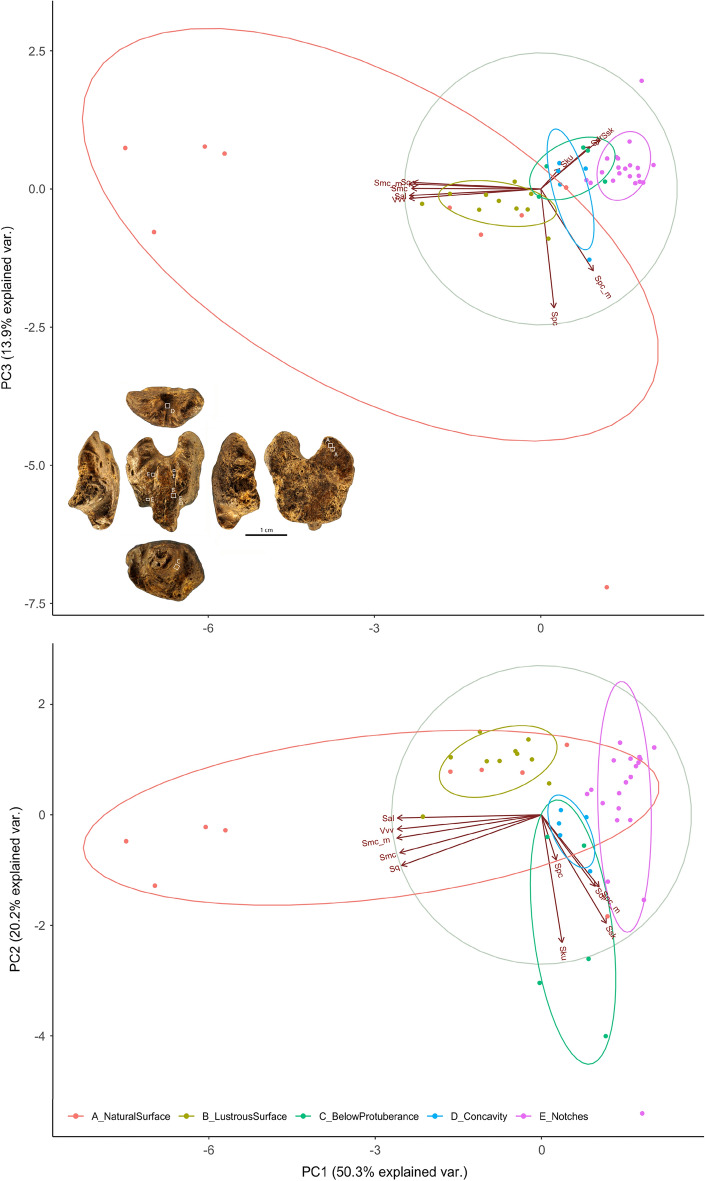
The earliest European carvings, made of mammoth ivory, depict animals, humans, and anthropomorphs. They are found at Early Aurignacian sites of the Swabian Jura in Germany. Despite the wide geographical spread of the Aurignacian across Europe, these carvings have no contemporaneous counterparts. Here, we document a small, intriguing object, that sheds light on this uniqueness. Found at the Grotte des Gorges (Jura, France), in a layer sandwiched between Aurignacian contexts and dated to c. 36.2 ka, the object bears traces of anthropogenic modifications indicating intentional carving. Microtomographic, microscopic, three-dimensional roughness and residues analyses reveal the carving is a fragment of a large ammonite, which was modified to represent a caniformia head decorated with notches and probably transported for long time in a container stained with ochre. While achieving Swabian Jura-like miniaturization, the Grotte des Gorges specimen displays original features, indicating the craftsman emulated ivory carvings while introducing significant technical, thematic, and stylistic innovations. This finding suggests a low degree of cultural connectivity between Early Aurignacian hunter-gatherer groups in the production of their symbolic material culture. The pattern conforms to the existence of cultural boundaries limiting the transmission of symbolic practices while leaving space for the emergence of original regional expressions.
最早的欧洲象牙雕刻描绘了动物、人类和拟人的形象,它们发现于德国斯瓦比亚侏罗纪的早期阿瑞纳文化遗址。尽管阿瑞纳文化在欧洲广泛传播,但这些雕刻品没有同时代的对应物。在这里,我们记录了一个小而有趣的物体,它揭示了这种独特性。这个物体在法国的峡谷洞穴(汝拉,法国)发现,位于阿瑞纳文化层之间的一层,年代约为 36.2 千年前,物体上有人类有意雕刻的痕迹。微断层扫描、微观、三维粗糙度和残留物分析显示,雕刻是一块大型菊石的碎片,经过修改后代表了一个具有缺口的犬形头部,可能在一个被赭石染色的容器中长时间运输。虽然达到了斯瓦比亚侏罗纪的小型化,但峡谷洞穴的标本显示出原始特征,表明工匠在模仿象牙雕刻的同时,引入了重要的技术、主题和风格创新。这一发现表明,在制作象征性物质文化方面,早期阿瑞纳文化的狩猎采集群体之间的文化联系程度较低。这种模式符合文化边界的存在,限制了象征实践的传播,同时为原始的区域表达留出了空间。