Wild Holly, Gasevic Danijela, Woods Robyn L, Ryan Joanne, Wolfe Rory, Chen Yuquan, Govindaraju Thara, McNeil John J, McCaffrey Tracy, Beilin Lawrence J, Ilic Dragan, Owen Alice J
School of Public Health and Preventive Medicine, Monash University, Melbourne, VIC 3004, Australia.
Centre for Global Health, Usher Institute, The University of Edinburgh, Edinburgh EH1 2QZ, UK.
Nutrients. 2025 Jan 17;17(2):323. doi: 10.3390/nu17020323.
BACKGROUND/OBJECTIVES: Egg consumption in adults has been linked with a modestly increased risk of all-cause and CVD mortality. However, evidence on adults aged 65 y+ is limited. The objective of this study was to investigate the association between egg intake and mortality in community-dwelling older adults.
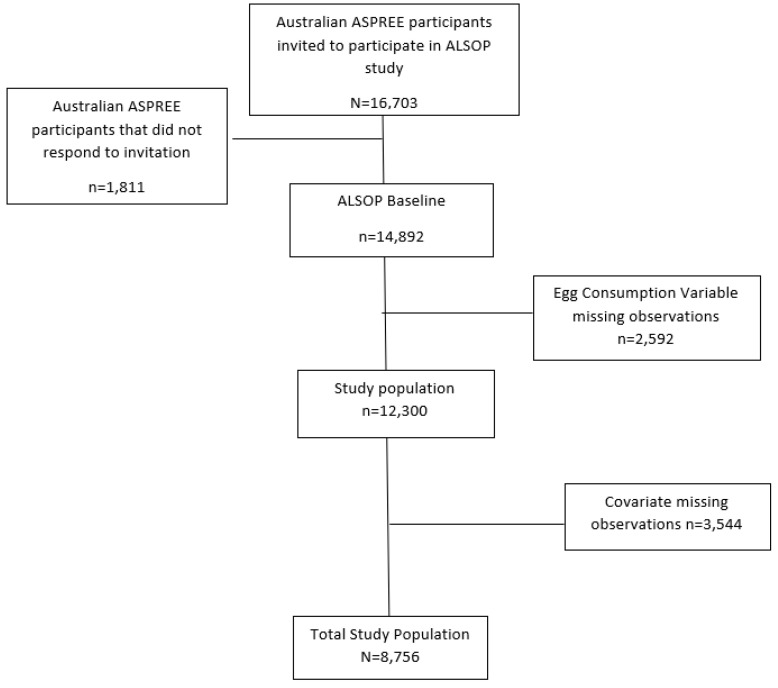
In this prospective cohort study, 8756 adults aged 70+ years, participants in the ASPirin in Reducing Events in the Elderly (ASPREE) Longitudinal Study of Older Persons, self-reported the frequency of their total egg intake: never/infrequently (rarely/never, 1-2 times/month), weekly (1-6 times/week), and daily (daily/several times per day). All-cause and cause-specific (cardiovascular disease [CVD] and cancer) mortality was established from at least two sources: medical records, death notices, next of kin, or death registry linkage. The association between egg intake and mortality was assessed using Cox proportional hazards regression analysis, adjusted for socio-demographic, health-related, and clinical factors and overall dietary quality.
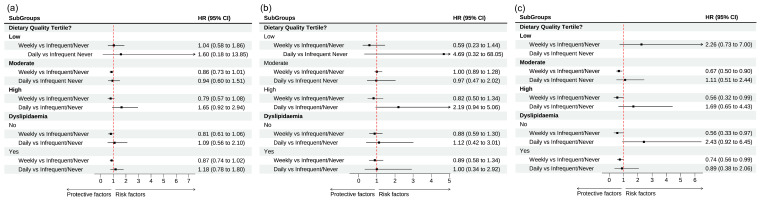
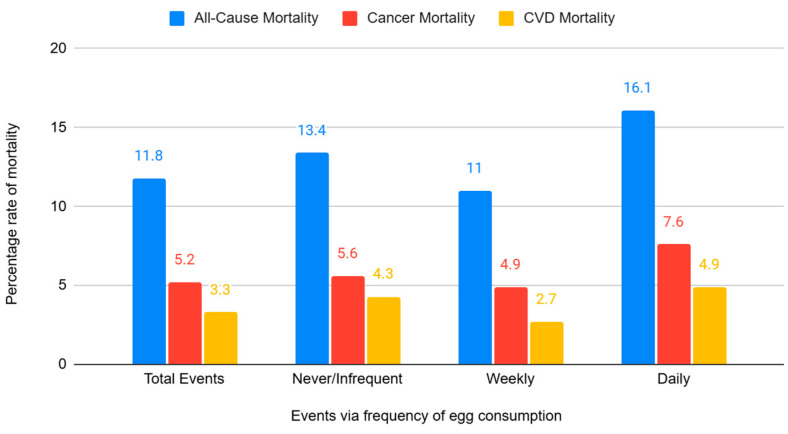
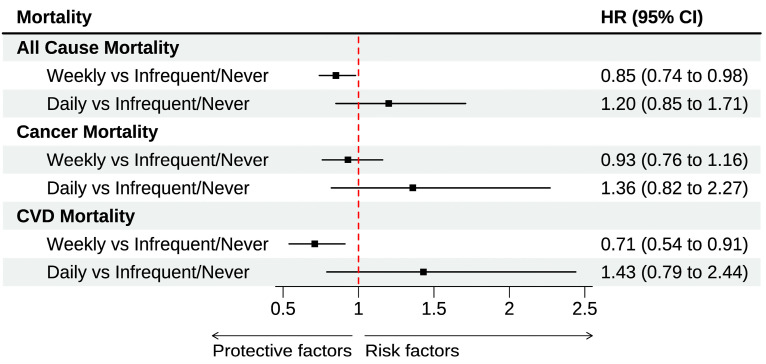
Over the median 5.9-year follow-up period, a total of 1034 all-cause deaths (11.8%) were documented. A 29% lower risk of CVD mortality (HR (95% CI): 0.71 [0.54-0.92]) and a 17% (HR (95% CI): 0.83 [0.71-0.96]) lower risk of all-cause mortality were observed among those who consumed eggs weekly, compared to those who consumed eggs never/infrequently; no statistically significant association was observed for weekly consumption and cancer mortality. In contrast, compared to those that never or infrequently consumed eggs, daily consumption had slightly higher odds of mortality, though these results did not reach statistical significance.
The consumption of eggs 1-6 times per week was associated with a lower risk of all-cause mortality and CVD mortality in community-dwelling adults aged 70 years and over. These findings may be important to inform the development of evidence-based guidelines for egg consumption.
背景/目的:成年人食用鸡蛋与全因死亡率和心血管疾病(CVD)死亡率适度增加有关。然而,关于65岁及以上成年人的证据有限。本研究的目的是调查社区居住的老年人鸡蛋摄入量与死亡率之间的关联。
在这项前瞻性队列研究中,8756名70岁及以上的成年人,即老年人阿司匹林减少事件(ASPREE)纵向研究的参与者,自行报告了他们总鸡蛋摄入量的频率:从不/很少(很少/从不,每月1 - 2次)、每周(每周1 - 6次)和每天(每天/每天几次)。全因死亡率和特定病因(心血管疾病[CVD]和癌症)死亡率由至少两个来源确定:医疗记录、死亡通知、近亲或死亡登记链接。使用Cox比例风险回归分析评估鸡蛋摄入量与死亡率之间的关联,并对社会人口学、健康相关和临床因素以及总体饮食质量进行了调整。
在中位5.9年的随访期内,共记录了1034例全因死亡(11.8%)。与从不/很少食用鸡蛋的人相比,每周食用鸡蛋的人CVD死亡率风险降低29%(HR(95%CI):0.71[0.54 - 0.92]),全因死亡率风险降低17%(HR(95%CI):0.83[0.71 - 0.96]);每周食用鸡蛋与癌症死亡率之间未观察到统计学上的显著关联。相比之下,与从不或很少食用鸡蛋的人相比,每天食用鸡蛋的人死亡率略高,尽管这些结果未达到统计学显著性。
每周食用1 - 6次鸡蛋与70岁及以上社区居住成年人的全因死亡率和CVD死亡率较低有关。这些发现可能对制定基于证据的鸡蛋消费指南很重要。