Yang Meng-Yuan, Zhong Jia-Dong, Li Xin, Tian Geng, Bai Wei-Yang, Fang Yi-Hu, Qiu Mo-Chang, Yuan Cheng-Da, Yu Chun-Fu, Li Nan, Yang Ji-Jian, Liu Yu-Heng, Yu Shi-Hui, Zhao Wei-Wei, Liu Jun-Quan, Sun Yi, Cong Pei-Kuan, Khederzadeh Saber, Zhao Pian-Pian, Qian Yu, Guan Peng-Lin, Gu Jia-Xuan, Gai Si-Rui, Yi Xiang-Jiao, Tao Jian-Guo, Chen Xiang, Miao Mao-Mao, Lei Lan-Xin, Xu Lin, Xie Shu-Yang, Li Jin-Chen, Guo Ji-Feng, Karasik David, Yang Liu, Tang Bei-Sha, Huang Fei, Zheng Hou-Feng
School of Life Sciences, Zhejiang University, Hangzhou, Zhejiang, China.
Center for Health and Data Science (CHDS), the Second Affiliated Hospital of Soochow University, Suzhou, Jiangsu, China.
Nat Commun. 2024 Dec 30;15(1):10839. doi: 10.1038/s41467-024-55147-4.
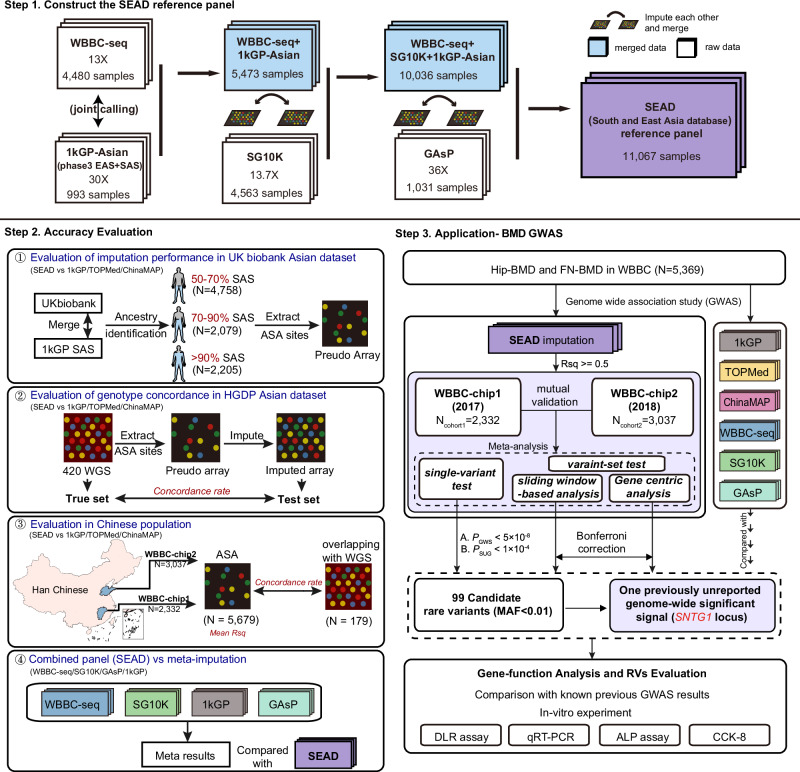
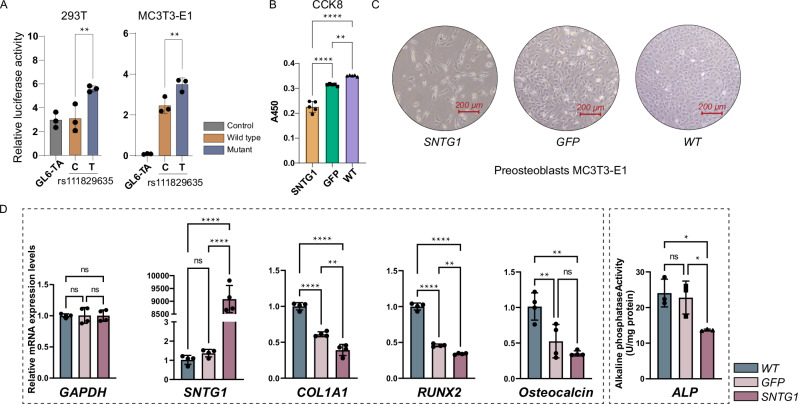
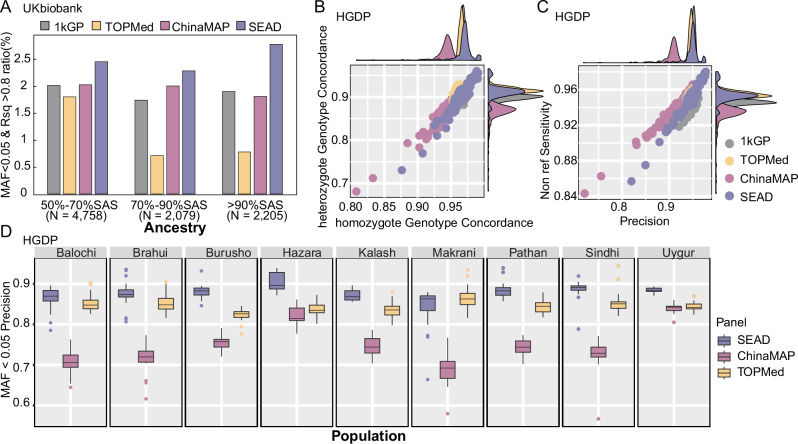
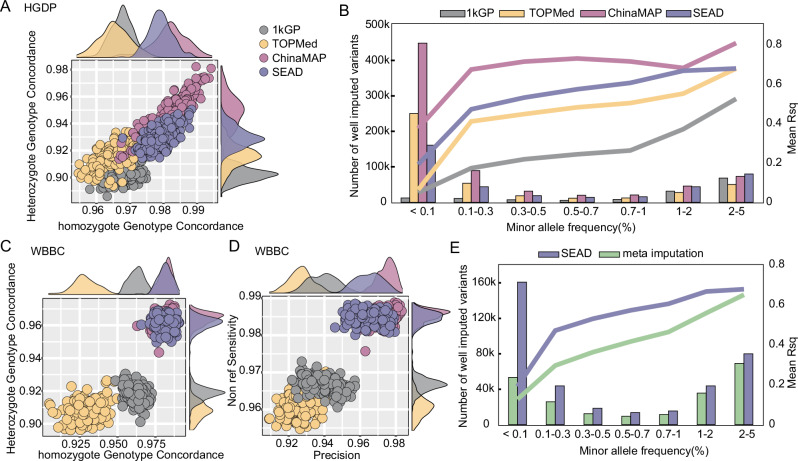
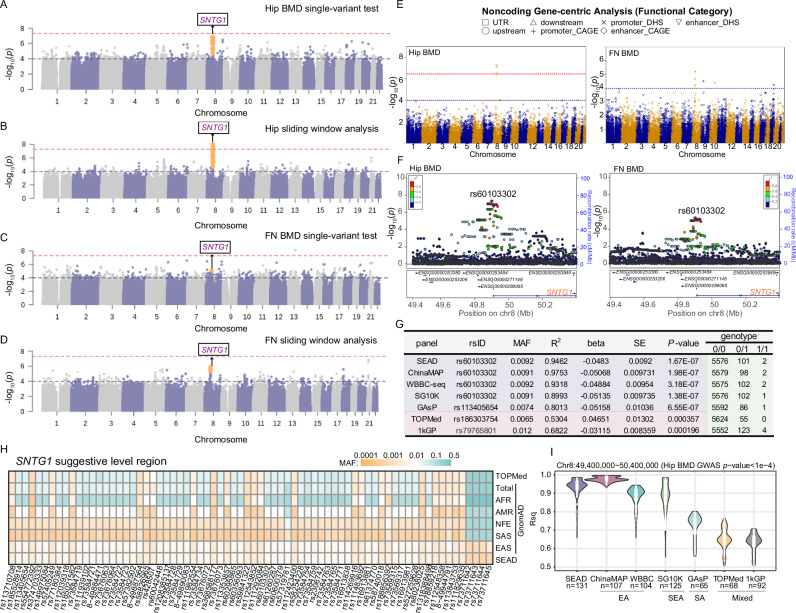
Limited whole genome sequencing (WGS) studies in Asian populations result in a lack of representative reference panels, thus hindering the discovery of ancestry-specific variants. Here, we present the South and East Asian reference Database (SEAD) panel ( https://imputationserver.westlake.edu.cn/ ), which integrates WGS data for 11,067 individuals from various sources across 17 Asian countries. The SEAD panel, comprising 22,134 haplotypes and 88,294,957 variants, demonstrates improved imputation accuracy for South Asian populations compared to 1000 Genomes Project, TOPMed, and ChinaMAP panels, with a higher proportion of well-imputed rare variants. For East Asian populations, SEAD shows concordance comparable to ChinaMAP, but outperforming TOPMed. Additionally, we apply the SEAD panel to conduct a genome-wide association study for total hip (Hip) and femoral neck (FN) bone mineral density (BMD) traits in 5369 genotyped Chinese samples. The single-variant test suggests that rare variants near SNTG1 are associated with Hip BMD (rs60103302, MAF = 0.0092, P = 1.67 × 10), and variant-set analysis further supports the association (P = 9.08 × 10, P = 5.27 × 10). This association was not reported previously and can only be detected by using Asian reference panels. Preliminary in vitro experiments for one of the rare variants identified provide evidence that it upregulates SNTG1 expression, which could in turn inhibit the proliferation and differentiation of preosteoblasts.
针对亚洲人群的全基因组测序(WGS)研究有限,导致缺乏具有代表性的参考面板,从而阻碍了特定祖先变异的发现。在此,我们展示了东南亚参考数据库(SEAD)面板(https://imputationserver.westlake.edu.cn/),该面板整合了来自17个亚洲国家不同来源的11,067个人的WGS数据。SEAD面板包含22,134个单倍型和88,294,957个变异,与千人基因组计划、TOPMed和中国地图面板相比,对南亚人群的归因准确性有所提高,具有更高比例的归因良好的罕见变异。对于东亚人群,SEAD显示出与中国地图相当的一致性,但优于TOPMed。此外,我们应用SEAD面板对5369个基因分型的中国样本中的全髋关节(Hip)和股骨颈(FN)骨密度(BMD)性状进行全基因组关联研究。单变异检验表明,SNTG1附近的罕见变异与髋关节骨密度相关(rs60103302,MAF = 0.0092,P = 1.67×10),变异集分析进一步支持了这种关联(P = 9.08×10,P = 5.27×10)。这种关联以前未被报道,只有使用亚洲参考面板才能检测到。对鉴定出的一种罕见变异进行的初步体外实验提供了证据,表明它上调了SNTG1的表达,这反过来可能抑制前成骨细胞的增殖和分化。