Global Immunization Division, Centers for Disease Control and Prevention, Atlanta, GA, United States.
Department of Emergency Medicine, Brown University, Providence, RI, United States.
Front Public Health. 2023 Jul 25;11:1080700. doi: 10.3389/fpubh.2023.1080700. eCollection 2023.
During the 2018-2020 Ebola virus disease (EVD) outbreak in the eastern part of the Democratic Republic of the Congo (DRC), prevention and control measures, such as Ebola vaccination were challenging by community mistrust. We aimed to understand perceptions regarding Ebola vaccination and identify determinants of Ebola vaccine uptake among HCWs.
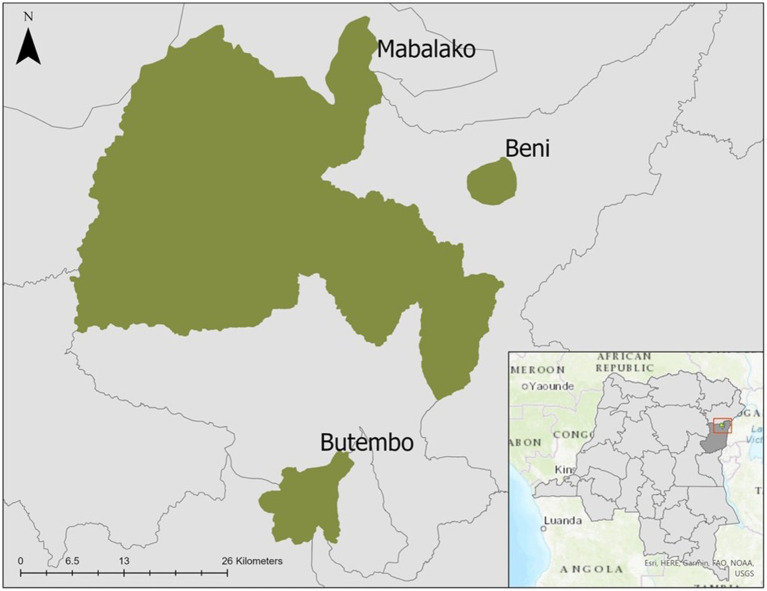
In March 2021, we conducted a cross-sectional survey among 438 HCWs from 100 randomly selected health facilities in three health zones (Butembo, Beni, Mabalako) affected by the 10th EVD outbreak in North Kivu, DRC. HCWs were eligible if they were ≥ 18 years and were working in a health facility during the outbreak. We used survey logistic regression to assess correlates of first-offer uptake (i.e., having received the vaccine the first time it was offered vs. after subsequent offers).
Of the 438 HCWs enrolled in the study, 420 (95.8%) reported that they were eligible and offered an Ebola vaccine. Among those offered vaccination, self-reported uptake of the Ebola vaccine was 99.0% (95% confidence interval (CI) [98.5-99.4]), but first-offer uptake was 70.2% (95% CI [67.1, 73.5]). Nearly all HCWs (94.3%; 95% CI [92.7-95.5]) perceived themselves to be at risk of contracting EVD. The most common concern was that the vaccine would cause side effects (65.7%; 95% CI [61.4-69.7]). In the multivariable analysis, mistrust of the vaccine source or how the vaccine was produced decreased the odds of first-time uptake.
Overall uptake of the Ebola vaccine was high among HCWs, but uptake at the first offer was substantially lower, which was associated with mistrust of the vaccine source. Future Ebola vaccination efforts should plan to make repeated vaccination offers to HCWs and address their underlying mistrust in the vaccines, which can, in turn, improve community uptake.
在 2018-2020 年刚果民主共和国(DRC)东部爆发的埃博拉病毒病(EVD)期间,由于社区的不信任,预防和控制措施(如埃博拉疫苗接种)面临挑战。我们旨在了解有关埃博拉疫苗接种的看法,并确定卫生工作者(HCWs)中埃博拉疫苗接种的决定因素。
在 2021 年 3 月,我们对来自刚果民主共和国北基伍省三个卫生区(贝尼、布滕博和马巴拉科)100 个随机选择的卫生设施的 438 名 HCWs 进行了横断面调查。符合条件的 HCWs 为年龄≥18 岁,且在疫情期间在卫生设施工作。我们使用调查逻辑回归评估首次接种(即第一次提供疫苗时接种与后续提供后接种)的相关性。
在纳入研究的 438 名 HCWs 中,420 名(95.8%)报告他们有资格并获得埃博拉疫苗接种。在接种疫苗的人群中,埃博拉疫苗的自我报告接种率为 99.0%(95%置信区间(CI)[98.5-99.4]),但首次接种率为 70.2%(95% CI [67.1, 73.5])。几乎所有 HCWs(94.3%;95% CI [92.7-95.5])认为自己有感染 EVD 的风险。最常见的担忧是疫苗会引起副作用(65.7%;95% CI [61.4-69.7])。在多变量分析中,对疫苗来源或疫苗生产方式的不信任降低了首次接种的几率。
埃博拉疫苗在 HCWs 中的总体接种率很高,但首次接种率明显较低,这与对疫苗来源的不信任有关。未来的埃博拉疫苗接种工作应计划向 HCWs 提供多次疫苗接种,并解决他们对疫苗的潜在不信任,这反过来又可以提高社区的接种率。