Department of Psychology, Maynooth University, Maynooth, Ireland.
Trinity Centre for Global Health, Trinity College Dublin, Dublin, Ireland.
PLoS One. 2021 Nov 3;16(11):e0258871. doi: 10.1371/journal.pone.0258871. eCollection 2021.
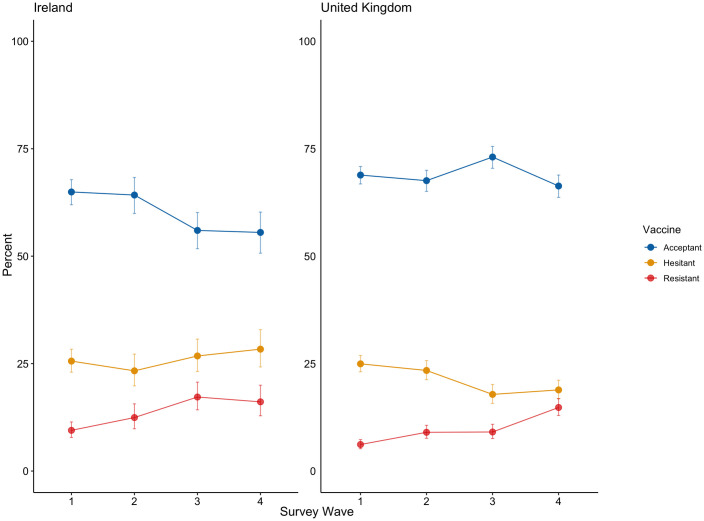
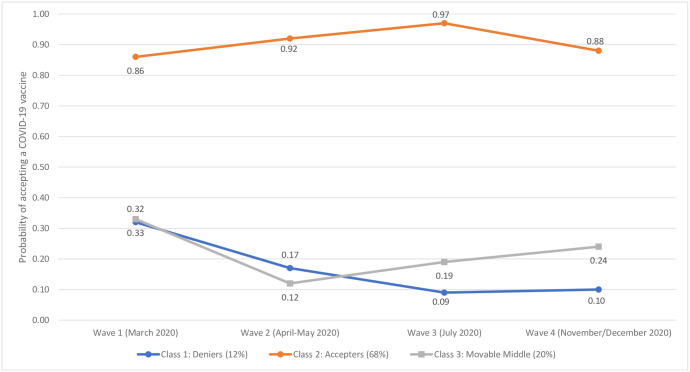
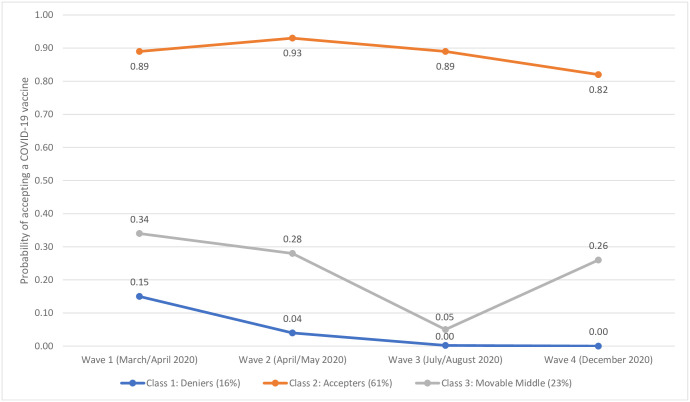
COVID-19 continues to pose a threat to global public health. Multiple safe and effective vaccines against COVID-19 are available with one-third of the global population now vaccinated. Achieving a sufficient level of vaccine coverage to suppress COVID-19 requires, in part, sufficient acceptance among the public. However, relatively high rates of hesitance and resistance to COVID-19 vaccination persists, threating public health efforts to achieve vaccine-induced population protection. In this study, we examined longitudinal changes in COVID-19 vaccine acceptance, hesitance, and resistance in two nations (the United Kingdom and the Republic of Ireland) during the first nine months of the pandemic, and identified individual and psychological factors associated with consistent non-acceptance of COVID-19 vaccination. Using nationally representative, longitudinal data from the United Kingdom (UK; N = 2025) and Ireland (N = 1041), we found that (1) COVID-19 vaccine acceptance declined in the UK and remained unchanged in Ireland following the emergence of approved vaccines; (2) multiple subgroups existed reflecting people who were consistently willing to be vaccinated ('Accepters': 68% in the UK and 61% in Ireland), consistently unwilling to be vaccinated ('Deniers': 12% in the UK and 16% in Ireland), and who fluctuated over time ('Moveable Middle': 20% in the UK and 23% in Ireland); and (3) the 'deniers' and 'moveable middle' were distinguishable from the 'accepters' on a range of individual (e.g., younger, low income, living alone) and psychological (e.g., distrust of scientists and doctors, conspiracy mindedness) factors. The use of two high-income, Western European nations limits the generalizability of these findings. Nevertheless, understanding how receptibility to COVID-19 vaccination changes as the pandemic unfolds, and the factors that distinguish and characterise those that are hesitant and resistant to vaccination is helpful for public health efforts to achieve vaccine-induced population protection against COVID-19.
COVID-19 继续对全球公共卫生构成威胁。目前已有三分之一的全球人口接种了针对 COVID-19 的安全有效的疫苗。要实现抑制 COVID-19 的足够疫苗接种率,部分需要公众有足够的接受度。然而,对 COVID-19 疫苗接种的犹豫不决和抵制率仍然相对较高,威胁着为实现疫苗诱导的人群保护而开展的公共卫生工作。在这项研究中,我们研究了在 COVID-19 大流行的前九个月中,两个国家(英国和爱尔兰共和国) COVID-19 疫苗接受度、犹豫不决和抵制的纵向变化,并确定了与持续不接受 COVID-19 疫苗接种相关的个体和心理因素。使用来自英国(N=2025)和爱尔兰(N=1041)的具有全国代表性的纵向数据,我们发现:(1) 在批准疫苗出现后,英国的 COVID-19 疫苗接受率下降,而爱尔兰则保持不变;(2) 存在多个亚组,反映了一直愿意接种疫苗的人(“接受者”:英国为 68%,爱尔兰为 61%)、一直不愿意接种疫苗的人(“拒绝者”:英国为 12%,爱尔兰为 16%)和随时间波动的人(“可移动中间派”:英国为 20%,爱尔兰为 23%);(3) “拒绝者”和“可移动中间派”与“接受者”在一系列个体因素(例如,年龄较小、收入较低、独居)和心理因素(例如,不信任科学家和医生、阴谋论思维)上存在差异。使用两个高收入的西欧国家限制了这些发现的普遍性。尽管如此,了解 COVID-19 疫苗接种接受度随着大流行的发展而变化的情况,以及区分和描述那些对疫苗接种犹豫不决和抵制的因素,有助于公共卫生努力实现 COVID-19 疫苗诱导的人群保护。