Aleti Gajender, Troyer Emily A, Hong Suzi
Department of Food and Animal Sciences, Tennessee State University, Nashville, TN, 37209, USA.
Department of Psychiatry, University of California San Diego, La Jolla, CA, 92093, USA.
Brain Behav Immun Health. 2023 Jul 31;32:100671. doi: 10.1016/j.bbih.2023.100671. eCollection 2023 Oct.
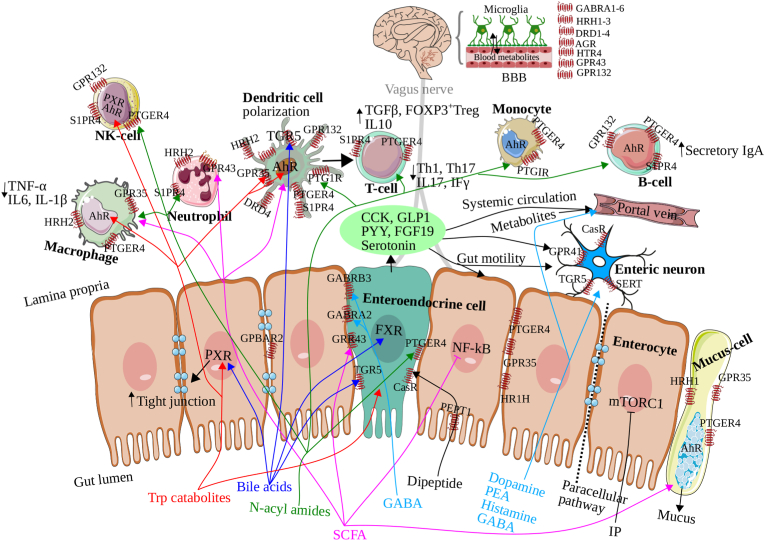
Human-microorganism interactions play a key role in human health. However, the underlying molecular mechanisms remain poorly understood. Small-molecules that offer a functional readout of microbe-microbe-human relationship are of great interest for deeper understanding of the inter-kingdom crosstalk at the molecular level. Recent studies have demonstrated that small-molecules from gut microbiota act as ligands for specific human G protein-coupled receptors (GPCRs) and modulate a range of human physiological functions, offering a mechanistic insight into the microbe-human interaction. To this end, we focused on analysis of bacterial metabolites that are currently recognized to bind to GPCRs and are found to activate the known downstream signaling pathways. We further mapped the distribution of these molecules across the public mass spectrometry-based metabolomics data, to identify the presence of these molecules across body sites and their association with health status. By combining this with RNA-Seq expression and spatial localization of GPCRs from a public human protein atlas database, we inferred the most predominant GPCR-mediated microbial metabolite-human cell interactions regulating gut-immune-brain axis. Furthermore, by evaluating the intestinal absorption properties and blood-brain barrier permeability of the small-molecules we elucidated their molecular interactions with specific human cell receptors, particularly expressed on human intestinal epithelial cells, immune cells and the nervous system that are shown to hold much promise for clinical translational potential. Furthermore, we provide an overview of an open-source resource for simultaneous interrogation of bioactive molecules across the druggable human GPCRome, a useful framework for integration of microbiome and metabolite cataloging with mechanistic studies for an improved understanding of gut microbiota-immune-brain molecular interactions and their potential therapeutic use.
人类与微生物的相互作用在人类健康中起着关键作用。然而,其潜在的分子机制仍知之甚少。能够提供微生物-微生物-人类关系功能读数的小分子,对于在分子水平上更深入地理解跨界串扰具有重要意义。最近的研究表明,来自肠道微生物群的小分子可作为特定人类G蛋白偶联受体(GPCR)的配体,并调节一系列人类生理功能,为微生物与人类的相互作用提供了机制性见解。为此,我们专注于分析目前已知与GPCR结合并能激活已知下游信号通路的细菌代谢产物。我们进一步在基于质谱的公共代谢组学数据中绘制了这些分子的分布图,以确定这些分子在身体各部位的存在情况及其与健康状况的关联。通过将此与来自公共人类蛋白质图谱数据库的GPCR的RNA测序表达和空间定位相结合,我们推断出调节肠道-免疫-脑轴的最主要的GPCR介导的微生物代谢产物-人类细胞相互作用。此外,通过评估小分子的肠道吸收特性和血脑屏障通透性,我们阐明了它们与特定人类细胞受体的分子相互作用,特别是在人类肠道上皮细胞、免疫细胞和神经系统上表达的受体,这些受体在临床转化潜力方面显示出很大前景。此外,我们概述了一个开源资源,用于同时探究可成药的人类GPCR组中的生物活性分子,这是一个将微生物组和代谢产物编目与机制研究相结合的有用框架,有助于更好地理解肠道微生物群-免疫-脑分子相互作用及其潜在的治疗用途。