Institute of Inorganic and Analytical Chemistry, University of Münster, Münster, Germany.
Skaggs School of Pharmacy and Pharmaceutical Sciences, University of California San Diego, La Jolla, San Diego, CA, USA.
Nat Commun. 2021 Jun 22;12(1):3832. doi: 10.1038/s41467-021-23953-9.
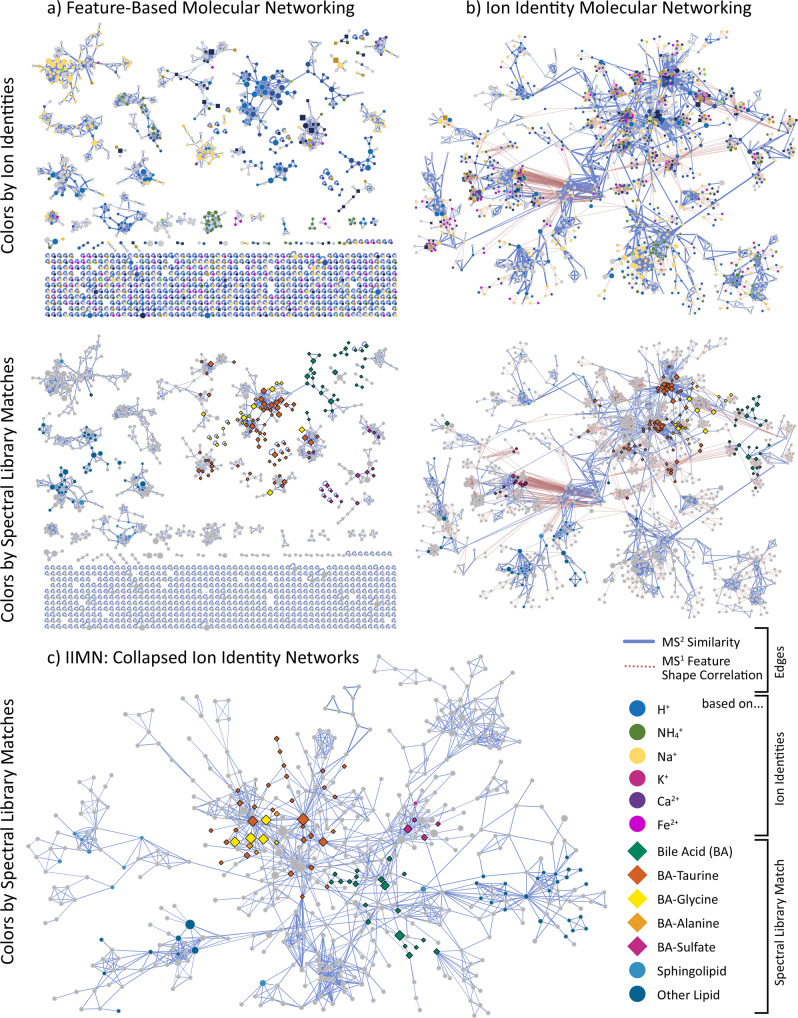
Molecular networking connects mass spectra of molecules based on the similarity of their fragmentation patterns. However, during ionization, molecules commonly form multiple ion species with different fragmentation behavior. As a result, the fragmentation spectra of these ion species often remain unconnected in tandem mass spectrometry-based molecular networks, leading to redundant and disconnected sub-networks of the same compound classes. To overcome this bottleneck, we develop Ion Identity Molecular Networking (IIMN) that integrates chromatographic peak shape correlation analysis into molecular networks to connect and collapse different ion species of the same molecule. The new feature relationships improve network connectivity for structurally related molecules, can be used to reveal unknown ion-ligand complexes, enhance annotation within molecular networks, and facilitate the expansion of spectral reference libraries. IIMN is integrated into various open source feature finding tools and the GNPS environment. Moreover, IIMN-based spectral libraries with a broad coverage of ion species are publicly available.
分子网络基于分子碎片模式的相似性将质谱连接起来。然而,在电离过程中,分子通常会形成具有不同碎裂行为的多种离子物种。因此,串联质谱基分子网络中这些离子物种的碎裂谱通常仍然没有连接,导致同一化合物类别的冗余和不连续的子网络。为了克服这一瓶颈,我们开发了离子身份分子网络(Ion Identity Molecular Networking,IIMN),该方法将色谱峰形状相关分析集成到分子网络中,以连接和合并同一分子的不同离子物种。新的特征关系提高了结构相关分子的网络连接性,可用于揭示未知的离子-配体络合物,增强分子网络内的注释,并促进光谱参考库的扩展。IIMN 集成到各种开源特征发现工具和 GNPS 环境中。此外,还提供了具有广泛离子物种覆盖范围的基于 IIMN 的光谱库。