Tekin Bekir Huseyin, Urbano Gutiérrez Rosa
School of Architecture, University of Liverpool, Liverpool, United Kingdom.
Front Med Technol. 2023 Jul 25;5:1219897. doi: 10.3389/fmedt.2023.1219897. eCollection 2023.
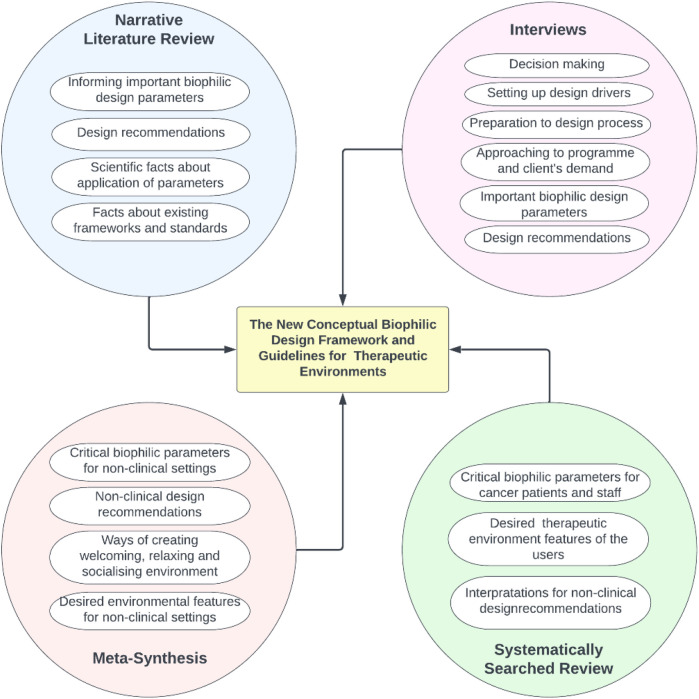
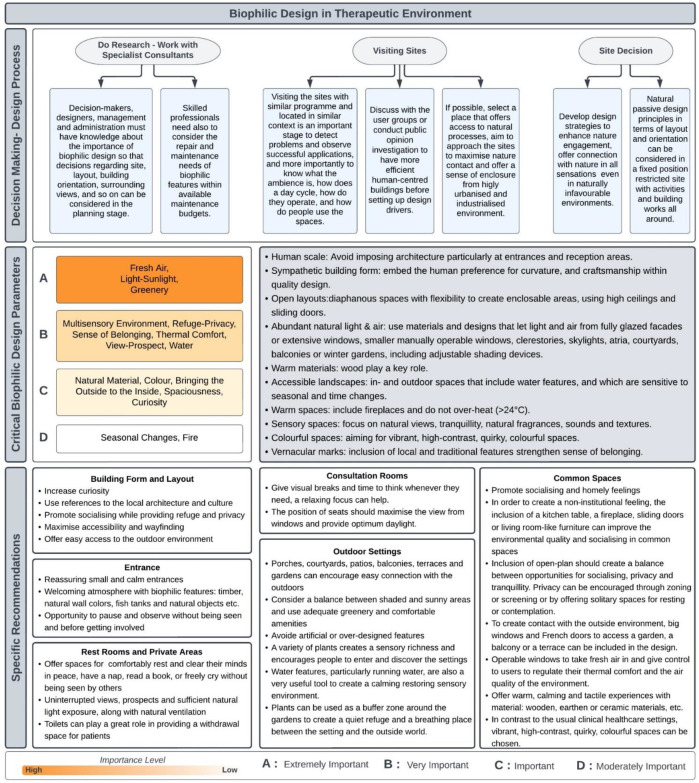
Increasing research corroborates that the qualities of the setting in which a patient receives healthcare positively influence health outcomes. Therefore, it has become progressively important to review the concept of therapeutic environments, as places where patients are treated with the most advanced medicine and technology, but also support their users in psychological, emotional and social terms. This quest for the optimal healing environment brings to the forefront the need to include other parameters in our design briefs, where the application of biophilic design proves to be paramount, as exposure to nature is associated with multiple health benefits. However, current biophilic design frameworks fail to provide efficient guidance, as their design recommendations don't differentiate the level of value of each design parameter for each building programme and context. Our position is that a biophilic design framework can only be efficient if it is adapted to specific building functions and is geographically and culturally contextualized. This study assessed the application of biophilic design in therapeutic environments for cancer patients in the UK, and provided a revised conceptual framework that can more efficiently guide designers and policies in future interventions. This framework was informed by synthesised analyses from healthcare environments on the user's experiences, and primary data obtained from semi-structured interviews with architects and managers, which was then benchmarked against scientific data about the impact of biophilic design on humans. This comprehensive approach helped to identify and rank those biophilic design parameters that appear the most critical for promoting and supporting health and wellbeing in cancer healthcare settings and provided an up-to-date compilation of crucial design actions to enact the necessary change in future research and design practice.
越来越多的研究证实,患者接受医疗保健的环境质量对健康结果有积极影响。因此,审视治疗环境的概念变得越来越重要,治疗环境不仅是患者接受最先进医学和技术治疗的地方,还在心理、情感和社会方面为使用者提供支持。对最佳康复环境的追求凸显了在我们的设计纲要中纳入其他参数的必要性,其中亲生物设计的应用被证明至关重要,因为接触自然与多种健康益处相关。然而,当前的亲生物设计框架未能提供有效的指导,因为它们的设计建议没有区分每个设计参数对于每个建筑项目和背景的价值水平。我们的观点是,亲生物设计框架只有在适应特定建筑功能并在地理和文化背景下进行调整时才会有效。本研究评估了亲生物设计在英国癌症患者治疗环境中的应用,并提供了一个经过修订的概念框架,该框架可以更有效地指导设计师和政策制定者未来的干预措施。这个框架是通过对医疗保健环境中用户体验的综合分析以及从与建筑师和管理人员的半结构化访谈中获得的原始数据得出的,然后将这些数据与关于亲生物设计对人类影响的科学数据进行对比。这种全面的方法有助于识别和排列那些在癌症医疗环境中对促进和支持健康与福祉最为关键的亲生物设计参数,并提供了一份最新的关键设计行动汇编,以便在未来的研究和设计实践中实施必要的变革。