Department of Infectious Disease Epidemiology, Robert Koch Institute, 13353 Berlin, Germany.
Postgraduate Training for Applied Epidemiology (PAE), Robert Koch Institute, 13353 Berlin, Germany.
J Travel Med. 2023 Oct 31;30(6). doi: 10.1093/jtm/taad107.
Giardiasis is a common gastrointestinal illness in travellers. Data on the actual giardiasis risk of travellers to different travel destinations are scarce. We aim to estimate the risk of giardiasis in travellers from Germany by destination country and region.
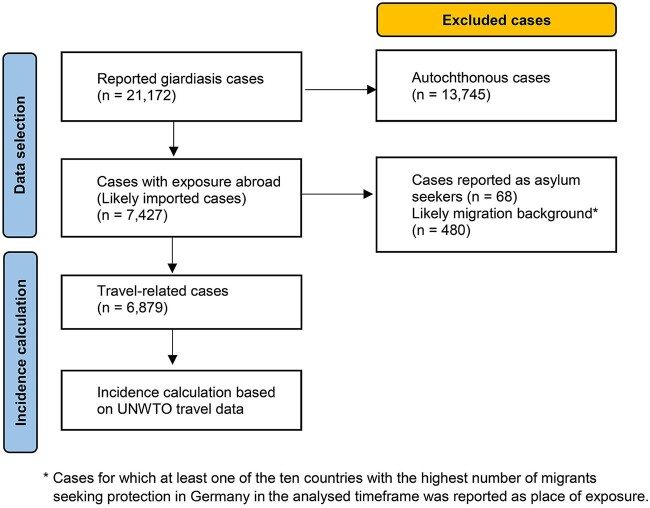
We analysed travel-related giardiasis cases, their countries and regions of exposure and the age and sex distribution of cases reported in 2014-19 in Germany. We defined a travel-related giardiasis case as a laboratory-confirmed (i.e. positive microscopy, antigen test or nucleic acid test) symptomatic individual with outbound travel abroad within 3-25 days before symptom onset. Based on the number of reported cases per exposure country and UNWTO travel data for Germany, we calculated the number of travel-related giardiasis cases per 100 000 travellers and compared the incidence in 2014-16 and 2017-19 to identify potential trends.
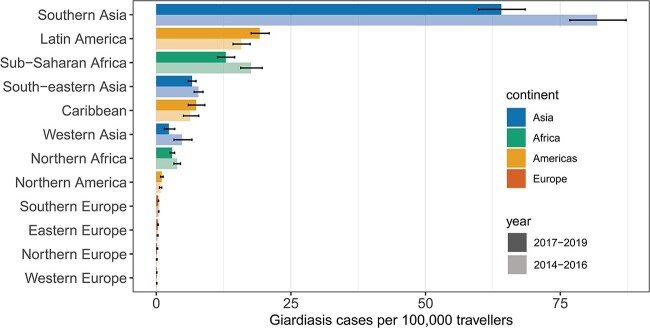
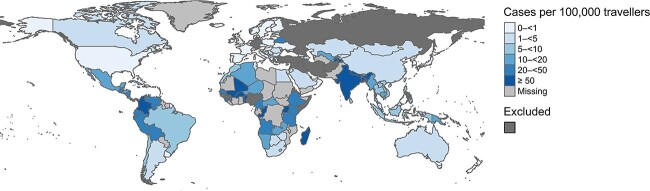
In 2014-19, 21 172 giardiasis cases were reported in Germany, corresponding to an overall incidence of 4.3 per 100 000 population. Of all cases, 6879 (32%) were travel-related with a median age of 34 [interquartile range (IQR): 25-50], 51% were male. Southern Asia was the most frequently reported exposure region and had the highest incidence in travellers (64.1 per 100 000 returning travellers) in 2017-19, followed by Latin America (19.2) and Sub-Saharan Africa (12.9). We observed statistically significant decreasing trends for Southern Asia and Sub-Saharan Africa. Latin America was the only region with a statistically significant increasing trend.
Almost one-third of recent giardiasis cases in Germany were travel-related. Giardiasis incidence in travellers differs greatly depending on the destination region. Decreasing trends in many regions might be due to improvements in food hygiene or travel conditions. Our results may inform medical consultation pre and post patient's travel.
贾第虫病是旅行者中常见的胃肠道疾病。关于旅行者前往不同目的地的实际贾第虫病风险的数据很少。我们旨在按目的地国家和地区估计德国旅行者的贾第虫病风险。
我们分析了 2014-19 年德国报告的与旅行相关的贾第虫病病例、暴露的国家和地区以及病例的年龄和性别分布。我们将实验室确诊的(即显微镜检查阳性、抗原检测或核酸检测)有症状的个体,在症状出现前 3-25 天内有出国旅行定义为与旅行相关的贾第虫病病例。根据报告的每个暴露国家的病例数和德国世界旅游组织的旅行数据,我们计算了每 100000 名旅行者中的与旅行相关的贾第虫病病例数,并比较了 2014-16 年和 2017-19 年的发病率,以确定潜在趋势。
2014-19 年,德国报告了 21172 例贾第虫病病例,总发病率为每 100000 人口 4.3 例。所有病例中,6879 例(32%)与旅行相关,中位年龄为 34 岁[四分位距(IQR):25-50],51%为男性。南亚是报告最多的暴露地区,2017-19 年旅行者的发病率最高(每 100000 名返回旅行者 64.1 例),其次是拉丁美洲(19.2 例)和撒哈拉以南非洲(12.9 例)。我们观察到南亚和撒哈拉以南非洲的发病率呈统计学意义上的下降趋势。拉丁美洲是唯一发病率呈统计学意义上上升的地区。
德国最近的贾第虫病病例中,近三分之一与旅行有关。旅行者的贾第虫病发病率因目的地地区而异。许多地区发病率下降可能是由于食品卫生或旅行条件的改善。我们的研究结果可能为患者旅行前后的医疗咨询提供信息。