Zepler Institute for Photonics and Nanoelectronics, University of Southampton, Southampton, United Kingdom.
School of Chemistry, University of Southampton, Southampton, United Kingdom.
PLoS One. 2023 Aug 10;18(8):e0284058. doi: 10.1371/journal.pone.0284058. eCollection 2023.
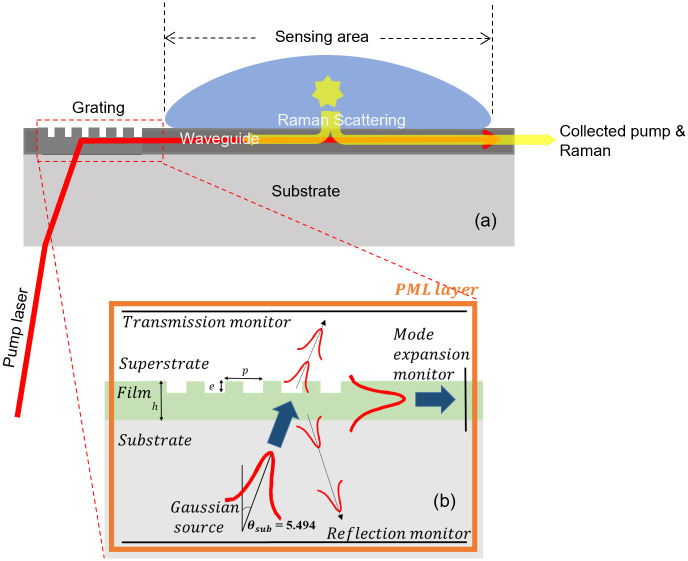
We report a waveguide-enhanced Raman spectroscopy (WERS) platform with alignment-tolerant under-chip grating input coupling. The demonstration is based on a 100-nm thick planar (slab) tantalum pentoxide (Ta2O5) waveguide and the use of benzyl alcohol (BnOH) and its deuterated form (d7- BnOH) as reference analytes. The use of grating couplers simplifies the WERS system by providing improved translational alignment tolerance, important for disposable chips, as well as contributing to improved Raman conversion efficiency. The use of non-volatile, non-toxic BnOH and d7-BnOH as chemical analytes results in easily observable shifts in the Raman vibration lines between the two forms, making them good candidates for calibrating Raman systems. The design and fabrication of the waveguide and grating couplers are described, and a discussion of further potential improvements in performance is presented.
我们报告了一种具有芯片下光栅输入耦合的对准容差的波导增强拉曼光谱(WERS)平台。该演示基于 100nm 厚的平面(平板)五氧化二钽(Ta2O5)波导,以及使用苯甲醇(BnOH)及其氘代形式(d7-BnOH)作为参考分析物。使用光栅耦合器通过提供改进的平移对准容差简化了 WERS 系统,这对于一次性芯片很重要,并且有助于提高拉曼转换效率。使用非挥发性、无毒的 BnOH 和 d7-BnOH 作为化学分析物,导致两种形式之间的拉曼振动线容易观察到位移,使它们成为校准拉曼系统的良好候选物。描述了波导和光栅耦合器的设计和制造,并讨论了进一步提高性能的潜力。