Heart Failure and Inherited Cardiac Diseases Unit, Department of Cardiology, Hospital Universitario Puerta de Hierro, Manuel de Falla, 2, Majadahonda, Madrid, 28222, Spain.
CIBER Cardiovascular, Instituto de Salud Carlos III, Avenida Monforte de Lemos 3-5, Madrid, 28029, Spain.
Eur Heart J Cardiovasc Imaging. 2023 Dec 21;25(1):75-85. doi: 10.1093/ehjci/jead184.
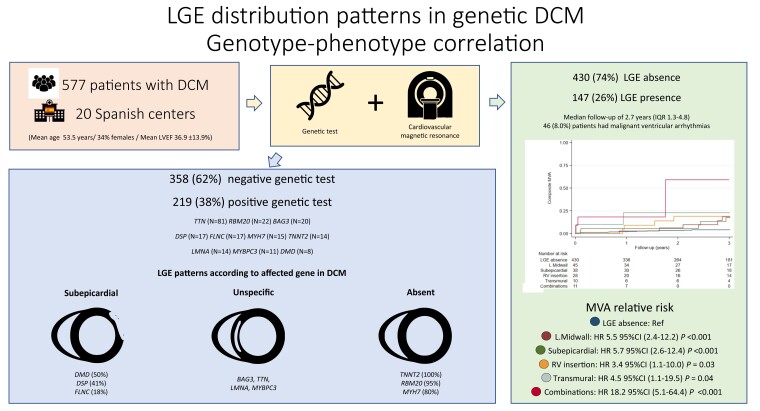
Late gadolinium enhancement (LGE) is frequently found in patients with dilated cardiomyopathy (DCM); there is little information about its frequency and distribution pattern according to the underlying genetic substrate. We sought to describe LGE patterns according to genotypes and to analyse the risk of major ventricular arrhythmias (MVA) according to patterns.
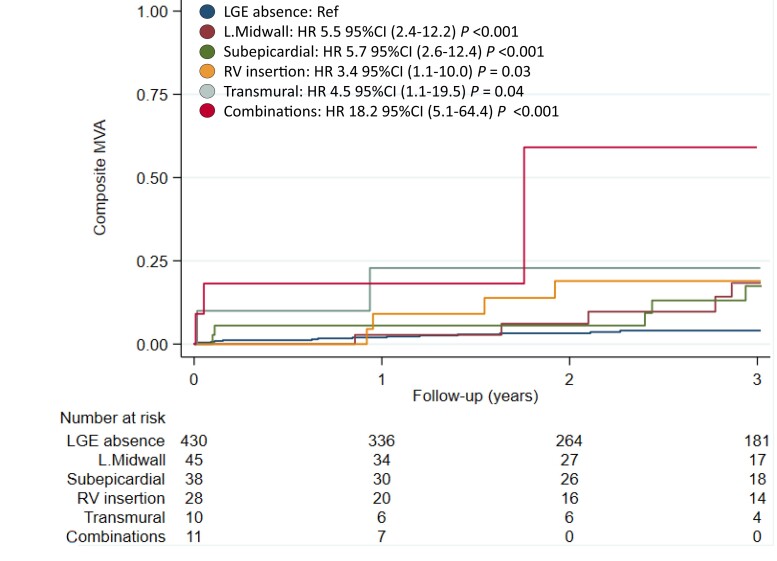
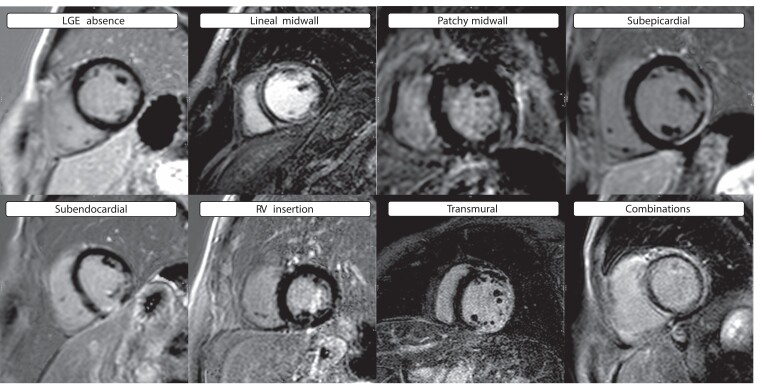
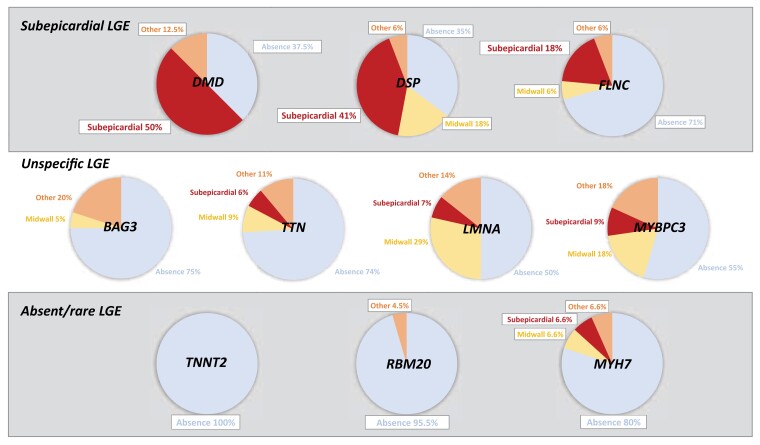
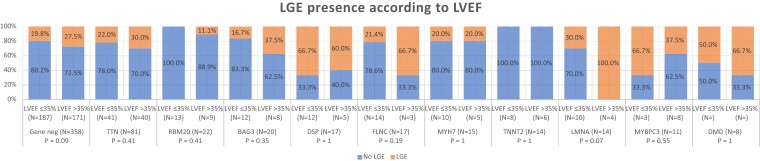
Cardiac magnetic resonance findings and LGE distribution according to genetics were performed in a cohort of 600 DCM patients followed at 20 Spanish centres. After exclusion of individuals with multiple causative gene variants or with variants in infrequent DCM-causing genes, 577 patients (34% females, mean age 53.5 years, left ventricular ejection fraction 36.9 ± 13.9%) conformed to the final cohort. A causative genetic variant was identified in 219 (38%) patients, and 147 (25.5%) had LGE. Significant differences were found comparing LGE patterns between genes (P < 0.001). LGE was absent or rare in patients with variants in TNNT2, RBM20, and MYH7 (0, 5, and 20%, respectively). Patients with variants in DMD, DSP, and FLNC showed a predominance of LGE subepicardial patterns (50, 41, and 18%, respectively), whereas patients with variants in TTN, BAG3, LMNA, and MYBPC3 showed unspecific LGE patterns. The genetic yield differed according to LGE patterns. Patients with subepicardial, lineal midwall, transmural, and right ventricular insertion points or with combinations of LGE patterns showed an increased risk of MVA compared with patients without LGE.
LGE patterns in DCM have a specific distribution according to the affected gene. Certain LGE patterns are associated with an increased risk of MVA and with an increased yield of genetic testing.
在扩张型心肌病(DCM)患者中经常发现晚期钆增强(LGE);根据潜在的遗传基础,关于其频率和分布模式的信息很少。我们试图根据基因型描述 LGE 模式,并根据模式分析主要室性心律失常(MVA)的风险。
在 20 个西班牙中心进行的 600 名 DCM 患者的队列中进行了心脏磁共振检查和遗传基础上的 LGE 分布。在排除了具有多种致病基因变异或罕见的 DCM 致病基因变异的个体后,577 名患者(34%为女性,平均年龄 53.5 岁,左心室射血分数 36.9±13.9%)符合最终队列。在 219 名(38%)患者中发现了致病基因变异,147 名(25.5%)有 LGE。基因之间的 LGE 模式存在显著差异(P<0.001)。在 TNNT2、RBM20 和 MYH7 变异患者中,LGE 缺失或罕见(分别为 0、5 和 20%)。在 DMD、DSP 和 FLNC 变异患者中,LGE 表现为心外膜下优势模式(分别为 50%、41%和 18%),而在 TTN、BAG3、LMNA 和 MYBPC3 变异患者中,LGE 模式无特异性。根据 LGE 模式,遗传检出率不同。与无 LGE 的患者相比,具有心外膜下、线性中壁、透壁和右室插入点或具有 LGE 模式组合的患者发生 MVA 的风险增加。
DCM 中的 LGE 模式根据受影响的基因具有特定的分布。某些 LGE 模式与 MVA 风险增加和遗传检测产率增加相关。