Major-Smith Daniel, Morgan Jimmy, Halstead Isaac, Tohidinik Hamid Reza, Iles-Caven Yasmin, Golding Jean, Northstone Kate
MRC Integrative Epidemiology Unit, University of Bristol, Bristol, UK.
Centre for Academic Child Health, Population Health Sciences, Bristol Medical School, University of Bristol, Bristol, BS8 2BN, UK.
Wellcome Open Res. 2023 Aug 22;7:159. doi: 10.12688/wellcomeopenres.17897.2. eCollection 2022.
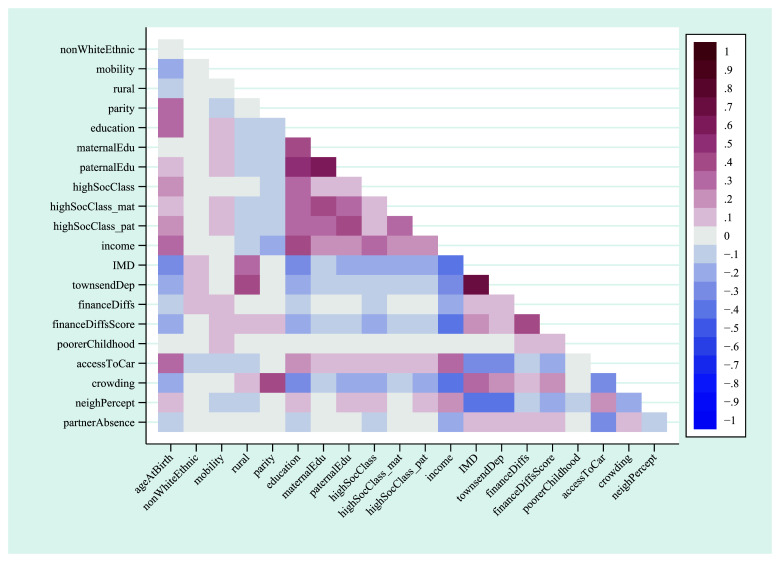
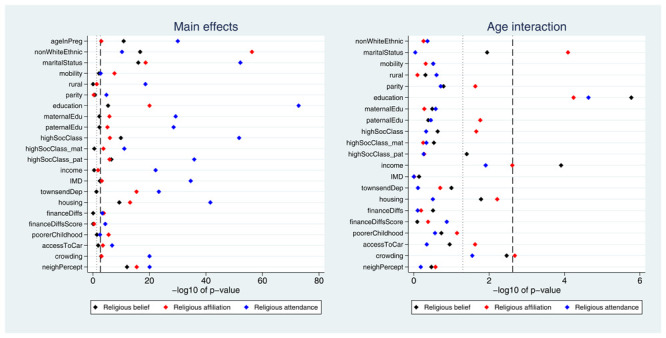
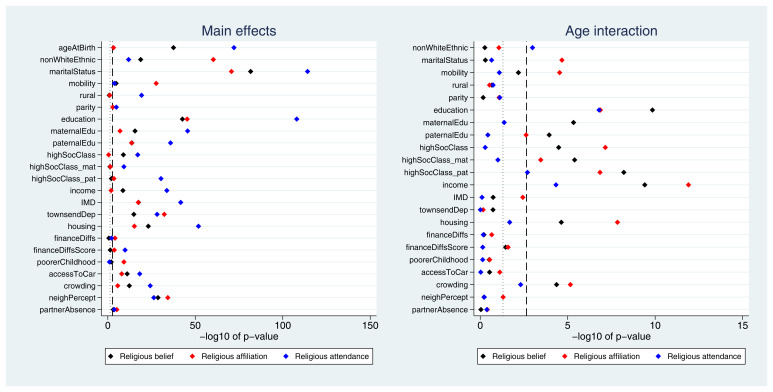
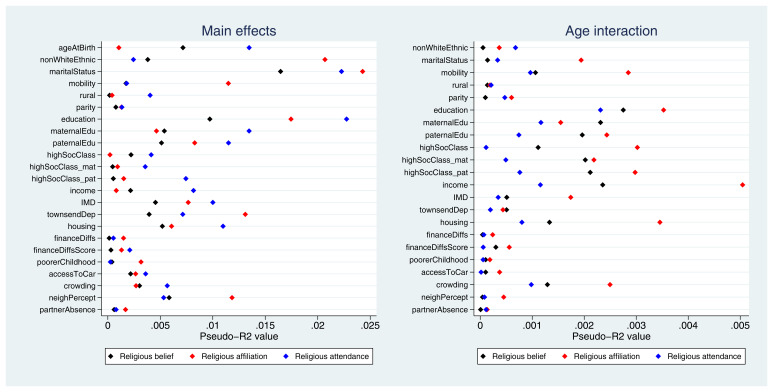
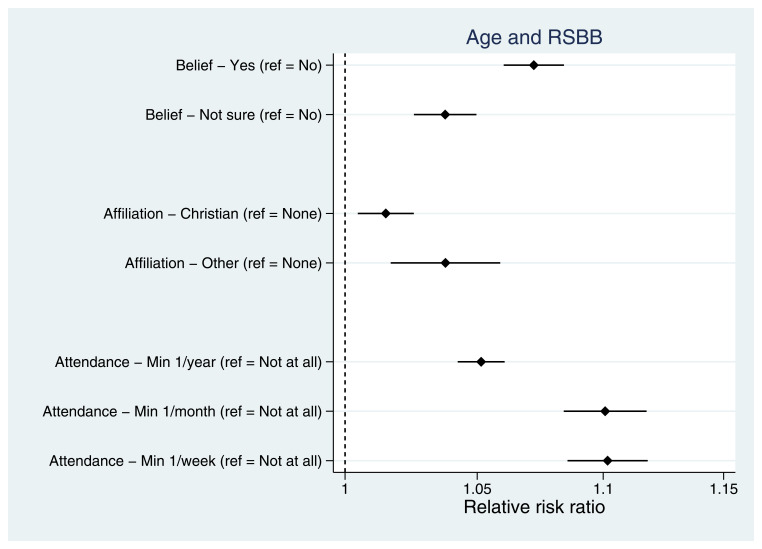
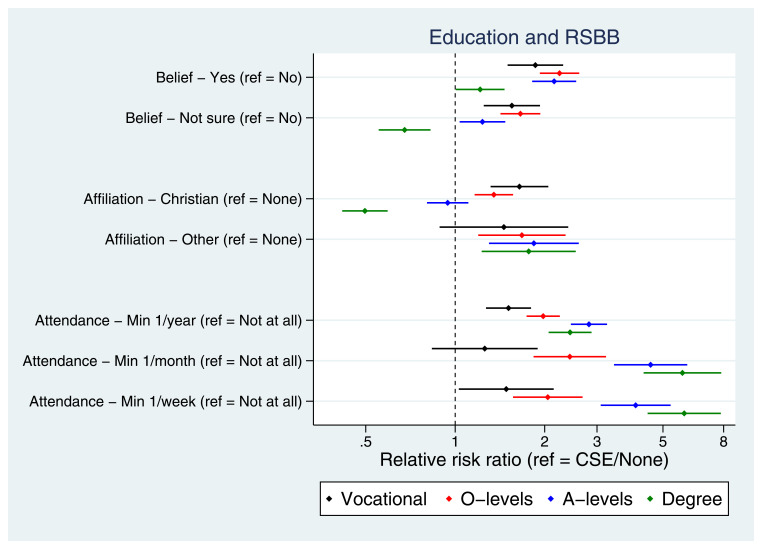
: We explored associations between possible demographic and socioeconomic causes of religious/spiritual beliefs and behaviours (RSBB) in the parental generation of the Avon Longitudinal Study of Parents and Children (ALSPAC). We used a prospective birth cohort study (ALSPAC) in Southwest England with 14,157 enrolled mothers and 14,154 associated partners. Three RSBB outcome measures collected during pregnancy were examined: religious belief (belief in God/a divine power; yes/not sure/no), religious affiliation (Christian/none/other) and religious attendance (frequency of attendance at a place of worship). Multiple demographic and socioeconomic exposures were assessed (23 in mothers and 22 in partners). We explored age-adjusted associations between each exposure and outcome using multinomial regression, in addition to exposure-age interactions. : Many demographic and socioeconomic factors were associated with RSBB, including age, ethnicity, marital status, education, income and deprivation. Overall, higher socioeconomic position was associated with increased levels of RSBB, particularly regarding religious attendance. For instance, compared to mothers with the lowest level of educational attainment, a degree-level education was associated with a six-fold increase in the relative risk ratio of religious attendance at least once a week, relative to not attending at all (RRR=5.90; 95% CI=[4.44; 7.86]). The magnitude of these associations often varied by outcome, e.g., income was associated with religious attendance, but only weakly with religious affiliation. Although results were demographically and socially patterned, overall effect sizes were relatively small, with a largest pseudo- value of 2.4%. Patterns of association were similar for mothers and partners. : The observed positive association between socioeconomic position and RSBB is contrary to much previous theoretical and empirical work. Potential reasons for these differences are discussed, including cross-cultural variation in religiosity and state support, and differences between RSBB measures. This descriptive paper can also help inform future studies using these data regarding the consideration of appropriate confounders.
我们在阿冯父母与儿童纵向研究(ALSPAC)的亲代中,探究了宗教/精神信仰与行为(RSBB)可能的人口统计学和社会经济成因之间的关联。我们采用了一项前瞻性出生队列研究(ALSPAC),该研究位于英格兰西南部,有14157名登记在册的母亲和14154名相关伴侣参与。研究考察了孕期收集的三项RSBB结果指标:宗教信仰(相信上帝/一种神圣力量;是/不确定/否)、宗教归属(基督教/无/其他)以及宗教参与(参加宗教场所的频率)。评估了多种人口统计学和社会经济暴露因素(母亲有23项,伴侣有22项)。除了暴露-年龄交互作用外,我们还使用多项回归探究了每种暴露因素与结果之间的年龄调整关联。
许多人口统计学和社会经济因素与RSBB相关,包括年龄、种族、婚姻状况、教育程度、收入和贫困程度。总体而言,较高的社会经济地位与RSBB水平的提高相关,尤其是在宗教参与方面。例如,与教育程度最低的母亲相比,拥有学位水平教育的母亲每周至少参加一次宗教活动的相对风险比相对于完全不参加的母亲增加了六倍(相对风险比=5.90;95%置信区间=[4.44;7.86])。这些关联的程度通常因结果而异,例如,收入与宗教参与相关,但与宗教归属的关联较弱。尽管结果在人口统计学和社会方面呈现出一定模式,但总体效应大小相对较小,最大伪值为2.4%。母亲和伴侣的关联模式相似。
社会经济地位与RSBB之间观察到的正相关与之前的许多理论和实证研究结果相反。讨论了这些差异的潜在原因,包括宗教信仰的跨文化差异和国家支持,以及RSBB测量方法之间的差异。这篇描述性论文也有助于为未来使用这些数据的研究提供参考,以考虑适当的混杂因素。