Lu Xin, Xie Daibin, Zhu Kaihua, Wei Shouhao, Mo Ziwei, Du Chunyu, Liang Lirong, Chen Guangming, Liu Zhuoxin
College of Materials Science and Engineering, Shenzhen University, Shenzhen, 518055, People's Republic of China.
State Key Laboratory of Polymer Materials Engineering, Sichuan University, Chengdu, 610065, People's Republic of China.
Nanomicro Lett. 2023 Aug 11;15(1):196. doi: 10.1007/s40820-023-01170-x.
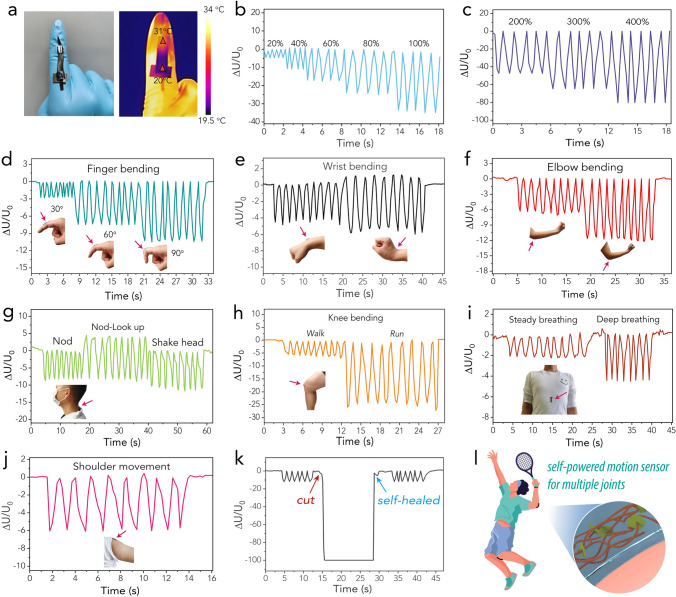
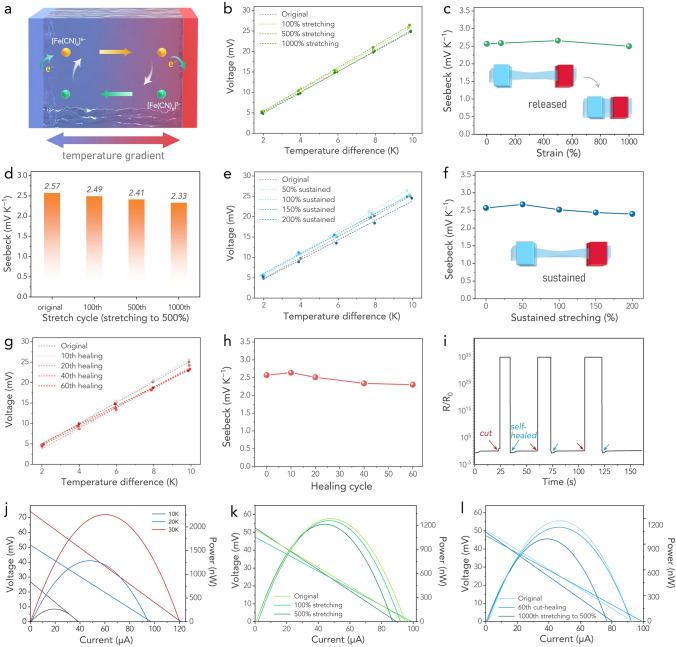
The evolution of wearable technology has prompted the need for adaptive, self-healable, and energy-autonomous energy devices. This study innovatively addresses this challenge by introducing an MXene-boosted hydrogel electrolyte, which expedites the assembly process of flexible thermocell (TEC) arrays and thus circumvents the complicated fabrication of typical wearable electronics. Our findings underscore the hydrogel electrolyte's superior thermoelectrochemical performance under substantial deformations and repeated self-healing cycles. The resulting hydrogel-based TEC yields a maximum power output of 1032.1 nW under the ΔT of 20 K when being stretched to 500% for 1000 cycles, corresponding to 80% of its initial state; meanwhile, it sustains 1179.1 nW under the ΔT of 20 K even after 60 cut-healing cycles, approximately 92% of its initial state. The as-assembled TEC array exhibits device-level self-healing capability and high adaptability to human body. It is readily applied for touch-based encrypted communication where distinct voltage signals can be converted into alphabet letters; it is also employed as a self-powered sensor to in-situ monitor a variety of body motions for complex human actions. The swift assembly approach, combined with the versatile functionality of the TEC device, paves the way for future advancements in wearable electronics targeting at fitness monitoring and human-machine interfaces.
可穿戴技术的发展催生了对自适应、可自我修复且能量自主的能量设备的需求。本研究创新性地应对了这一挑战,引入了一种MXene增强水凝胶电解质,该电解质加快了柔性热电池(TEC)阵列的组装过程,从而避免了典型可穿戴电子产品复杂的制造过程。我们的研究结果强调了该水凝胶电解质在大幅变形和重复自我修复循环下具有卓越的热电化学性能。由此产生的基于水凝胶的TEC在20 K的温差下,拉伸至500%并经历1000次循环后,最大功率输出为1032.1 nW,相当于其初始状态的80%;同时,即使经过60次切割-愈合循环,在20 K的温差下仍能维持1179.1 nW,约为其初始状态的92%。组装好的TEC阵列展现出器件级的自我修复能力以及对人体的高度适应性。它很容易应用于基于触摸的加密通信,其中不同的电压信号可被转换为字母;它还被用作自供电传感器,以原位监测各种人体运动,用于复杂的人类活动。这种快速组装方法,结合TEC设备的多功能性,为未来可穿戴电子产品在健身监测和人机界面方面的发展铺平了道路。