Department of Materials Science and Engineering, City University of Hong Kong, Kowloon, China.
State Key Laboratory of Rare Earth Utilization, Changchun Institute of Applied Chemistry, Chinese Academy of Sciences, Changchun, China.
Nat Commun. 2023 Apr 3;14(1):1856. doi: 10.1038/s41467-023-37565-y.
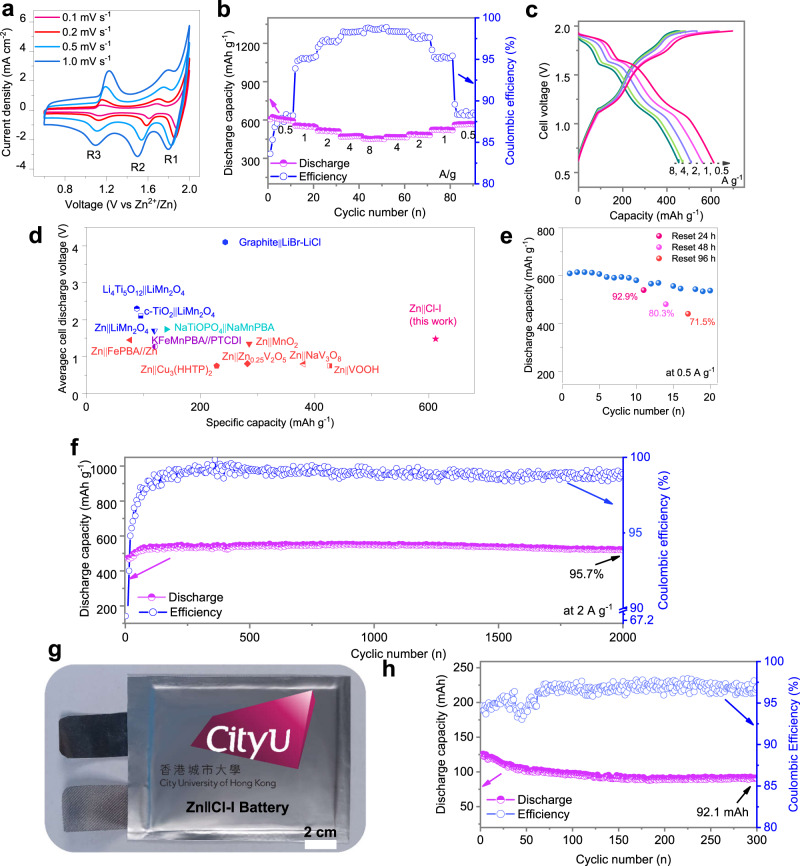
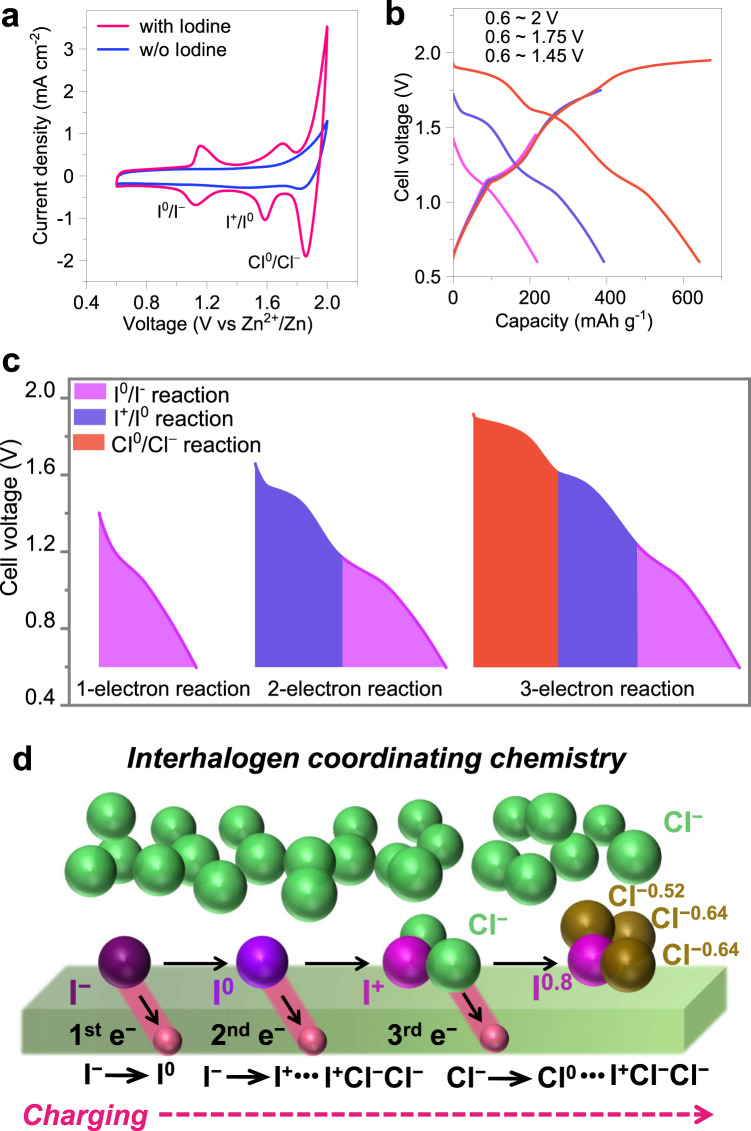
The chlorine-based redox reaction (ClRR) could be exploited to produce secondary high-energy aqueous batteries. However, efficient and reversible ClRR is challenging, and it is affected by parasitic reactions such as Cl gas evolution and electrolyte decomposition. Here, to circumvent these issues, we use iodine as positive electrode active material in a battery system comprising a Zn metal negative electrode and a concentrated (e.g., 30 molal) ZnCl aqueous electrolyte solution. During cell discharge, the iodine at the positive electrode interacts with the chloride ions from the electrolyte to enable interhalogen coordinating chemistry and forming ICl. In this way, the redox-active halogen atoms allow a reversible three-electrons transfer reaction which, at the lab-scale cell level, translates into an initial specific discharge capacity of 612.5 mAh g at 0.5 A g and 25 °C (corresponding to a calculated specific energy of 905 Wh kg). We also report the assembly and testing of a Zn | |Cl-I pouch cell prototype demonstrating a discharge capacity retention of about 74% after 300 cycles at 200 mA and 25 °C (final discharge capacity of about 92 mAh).
氯基氧化还原反应 (ClRR) 可用于生产二次高能水系电池。然而,高效且可逆的 ClRR 具有挑战性,并且受到副反应(如 Cl 气体析出和电解质分解)的影响。在这里,为了解决这些问题,我们在一个由 Zn 金属负极和浓缩(例如 30molal)ZnCl 水溶液电解质溶液组成的电池系统中使用碘作为正极活性材料。在电池放电过程中,正极处的碘与电解质中的氯离子相互作用,以实现卤间配位化学并形成 ICl。通过这种方式,氧化还原活性卤素原子允许可逆的三电子转移反应,在实验室规模的电池水平下,转化为在 0.5 A g 和 25°C 时初始比放电容量为 612.5 mAh g(对应于计算出的比能量为 905 Wh kg)。我们还报告了 Zn | |Cl-I 袋式电池原型的组装和测试,该原型在 25°C 和 200 mA 下循环 300 次后放电容量保留率约为 74%(最终放电容量约为 92 mAh)。