Department of Environmental Science, Stockholm University, Stockholm SE-106 91, Sweden.
School of Natural Sciences, Technology and Environmental Studies, Södertörn University, Huddinge SE-14189, Sweden.
Chem Res Toxicol. 2023 Sep 18;36(9):1471-1482. doi: 10.1021/acs.chemrestox.3c00041. Epub 2023 Aug 11.
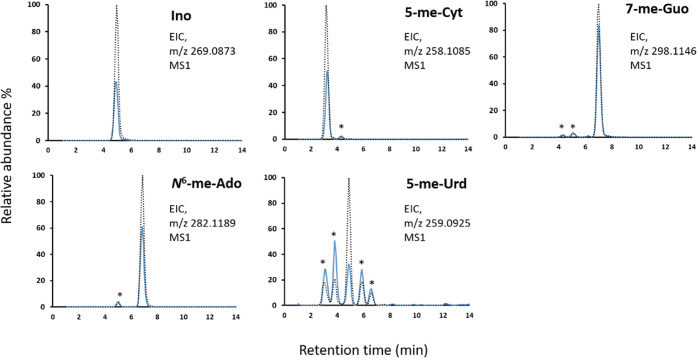
Adductomics studies are used for the detection and characterization of various chemical modifications (adducts) of nucleic acids and proteins. The advancements in liquid chromatography coupled with high-resolution tandem mass spectrometry (HRMS/MS) have resulted in efficient methods for qualitative and quantitative adductomics. We developed an HRMS-based method for the simultaneous analysis of RNA and DNA adducts in a single run and demonstrated its application using Baltic amphipods, useful sentinels of environmental disturbances, as test organisms. The novelty of this method is screening for RNA and DNA adducts by a single injection on an Orbitrap HRMS instrument using full scan and data-independent acquisition. The MS raw files were processed with an open-source program, , to identify and distinguish RNA and DNA adducts based on the characteristic neutral loss of ribonucleosides and 2'-deoxyribonucleosides, respectively. In the amphipods, in addition to the nearly 150 putative DNA adducts characterized earlier, we detected 60 putative RNA adducts. For the structural identification of the detected RNA adducts, the MODOMICS database was used. The identified RNA adducts included simple mono- and dimethylation and other larger functional groups on different ribonucleosides and deaminated product inosine. However, 54 of these RNA adducts are not yet structurally identified, and further work on their characterization may uncover new layers of information related to the transcriptome and help understand their biological significance. Considering the susceptibility of nucleic acids to environmental factors, including pollutants, the developed multi-adductomics methodology with further advancement has the potential to provide biomarkers for diagnostics of pollution effects in biota.
加合物组学研究用于检测和表征核酸和蛋白质的各种化学修饰(加合物)。液相色谱与高分辨率串联质谱(HRMS/MS)的进步已经产生了用于定性和定量加合物组学的有效方法。我们开发了一种基于 HRMS 的方法,可在单次运行中同时分析 RNA 和 DNA 加合物,并使用作为环境干扰有用的哨兵的波罗的海端足类动物作为测试生物来证明其应用。该方法的新颖之处在于在 Orbitrap HRMS 仪器上通过单次注射对 RNA 和 DNA 加合物进行筛选,使用全扫描和数据独立采集。MS 原始文件使用开源程序进行处理,根据核糖核苷和 2'-脱氧核糖核苷分别的特征中性丢失来识别和区分 RNA 和 DNA 加合物。在端足类动物中,除了先前表征的近 150 种假定的 DNA 加合物外,我们还检测到 60 种假定的 RNA 加合物。为了对检测到的 RNA 加合物进行结构鉴定,使用了 MODOMICS 数据库。鉴定的 RNA 加合物包括不同核糖核苷上的简单单甲基化和二甲基化以及其他较大的功能基团和脱氨基产物肌苷。然而,这些 RNA 加合物中有 54 种尚未进行结构鉴定,对其特征的进一步研究可能会揭示与转录组相关的新信息层,并有助于了解其生物学意义。考虑到核酸对包括污染物在内的环境因素的敏感性,具有进一步发展的这种多加合物组学方法有可能为生物体内污染影响的诊断提供生物标志物。