Vestibular Rehabilitation, New York Eye and Ear Infirmary of Mount Sinai, New York, NY, USA.
Department of Otolaryngology-Head and Neck Surgery, Icahn School of Medicine at Mount Sinai, New York, NY, USA.
J Neuroeng Rehabil. 2023 Aug 12;20(1):104. doi: 10.1186/s12984-023-01224-6.
We created a clinical virtual reality application for vestibular rehabilitation. Our app targets contextual sensory integration (C.S.I.) where patients are immersed in safe, increasingly challenging environments while practicing various tasks (e.g., turning, walking). The purpose of this pilot study was to establish the feasibility of a randomized controlled trial comparing C.S.I. training to traditional vestibular rehabilitation.
Thirty patients with vestibular dysfunction completed the Dizziness Handicap Inventory (DHI), Activities-Specific Balance Confidence Scale (ABC), Visual Vertigo Analog Scale (VVAS), Functional Gait Assessment (FGA), Timed-Up-and-Go (TUG), and Four-Square Step Test (FSST). Following initial assessment, the patients were randomized into 8 weeks (once per week in clinic + home exercise program) of traditional vestibular rehabilitation or C.S.I. training. Six patients had to stop participation due to the covid-19 pandemic, 6 dropped out for other reasons (3 from each group). Ten patients in the traditional group and 8 in the C.S.I group completed the study. We applied an intention to treat analysis.
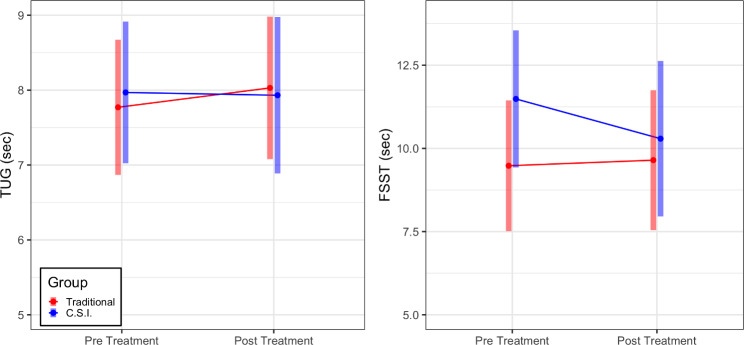
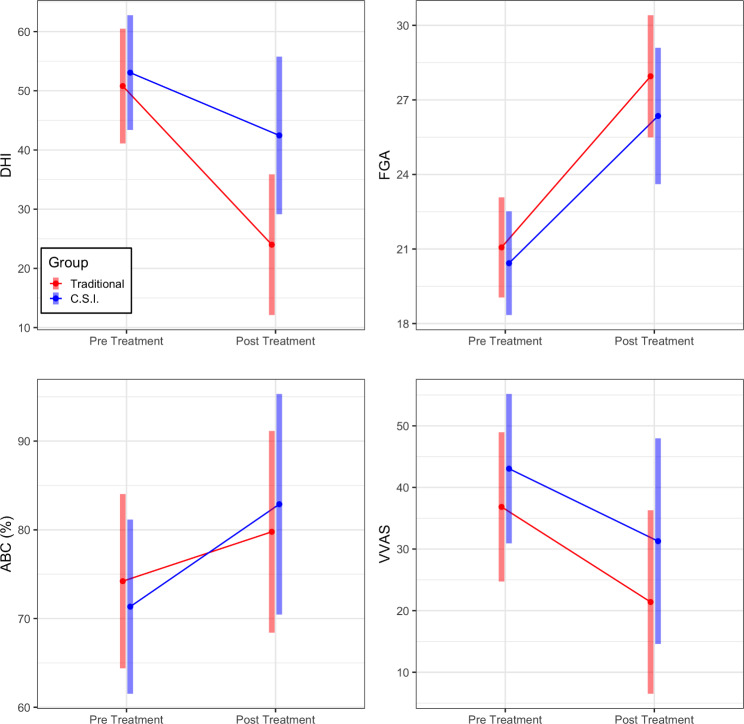
Following intervention, we observed a significant main effect of time with no main effect of group or group by time interaction for the DHI (mean difference - 18.703, 95% CI [-28.235, -9.172], p = 0.0002), ABC (8.556, [0.938, 16.174], p = 0.028), VVAS, (-13.603, [-25.634, -1.573], p = 0.027) and the FGA (6.405, [4.474, 8.335], p < 0.0001). No changes were observed for TUG and FSST.
Patients' symptoms and function improved following either vestibular rehabilitation method. C.S.I training appeared comparable but not superior to traditional rehabilitation.
This study (NCT04268745) was registered on clincaltrials.gov and can be found at https://clinicaltrials.gov/ct2/show/NCT04268745 .
我们开发了一款用于前庭康复的临床虚拟现实应用程序。我们的应用程序针对情境感觉整合(C.S.I.),让患者在安全、具有挑战性的环境中练习各种任务(如转身、行走)的同时沉浸其中。本研究的目的是确定一项比较 C.S.I.训练与传统前庭康复的随机对照试验的可行性。
30 名前庭功能障碍患者完成了眩晕障碍量表(DHI)、活动特异性平衡信心量表(ABC)、视觉眩晕模拟量表(VVAS)、功能性步态评估(FGA)、计时起立行走测试(TUG)和四方步测试(FSST)。初始评估后,患者被随机分为 8 周(每周一次在诊所+家庭运动计划)的传统前庭康复或 C.S.I.训练。由于 COVID-19 大流行,有 6 名患者不得不停止参与,6 名患者因其他原因退出(每组 3 名)。传统组有 10 名患者和 C.S.I 组有 8 名患者完成了研究。我们采用意向治疗分析。
干预后,我们观察到 DHI(平均差异-18.703,95%CI[-28.235,-9.172],p=0.0002)、ABC(8.556,[0.938,16.174],p=0.028)、VVAS(-13.603,[-25.634,-1.573],p=0.027)和 FGA(6.405,[4.474,8.335],p<0.0001)有显著的时间主效应,而无分组主效应或分组与时间的交互作用。TUG 和 FSST 没有变化。
患者的症状和功能在接受任何一种前庭康复方法后均有所改善。C.S.I.训练似乎与传统康复相当,但不优于传统康复。
本研究(NCT04268745)已在 clincaltrials.gov 注册,可在 https://clinicaltrials.gov/ct2/show/NCT04268745 上找到。