Gnocchi Davide, Nikolic Dragana, Paparella Rosa Rita, Sabbà Carlo, Mazzocca Antonio
Interdisciplinary Department of Medicine, University of Bari School of Medicine, Piazza G. Cesare, 11, 70124 Bari, Italy.
Cancers (Basel). 2023 Aug 3;15(15):3942. doi: 10.3390/cancers15153942.
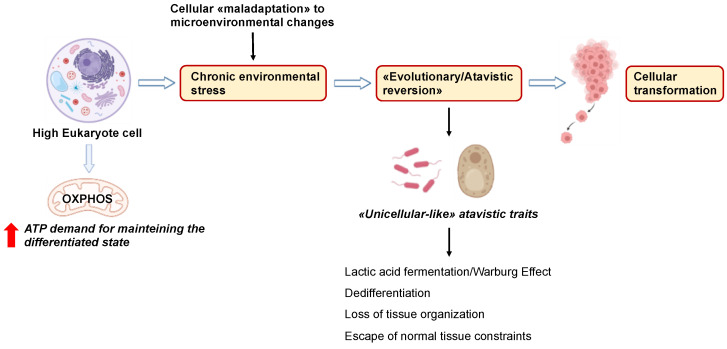
Adaptation of cancer cells to extreme microenvironmental conditions (i.e., hypoxia, high acidity, and reduced nutrient availability) contributes to cancer resilience. Furthermore, neoplastic transformation can be envisioned as an extreme adaptive response to tissue damage or chronic injury. The recent Systemic-Evolutionary Theory of the Origin of Cancer (SETOC) hypothesizes that cancer cells "revert" to "primitive" characteristics either ontogenically (embryo-like) or phylogenetically (single-celled organisms). This regression may confer robustness and maintain the disordered state of the tissue, which is a hallmark of malignancy. Changes in cancer cell metabolism during adaptation may also be the consequence of altered microenvironmental conditions, often resulting in a shift toward lactic acid fermentation. However, the mechanisms underlying the robust adaptive capacity of cancer cells remain largely unknown. In recent years, cancer cells' metabolic flexibility has received increasing attention among researchers. Here, we focus on how changes in the microenvironment can affect cancer cell energy production and drug sensitivity. Indeed, changes in the cellular microenvironment may lead to a "shift" toward "atavistic" biologic features, such as the switch from oxidative phosphorylation (OXPHOS) to lactic acid fermentation, which can also sustain drug resistance. Finally, we point out new integrative metabolism-based pharmacological approaches and potential biomarkers for early detection.
癌细胞对极端微环境条件(即缺氧、高酸度和营养物质可用性降低)的适应有助于癌症的恢复力。此外,肿瘤转化可被设想为对组织损伤或慢性损伤的一种极端适应性反应。最近的癌症起源系统进化理论(SETOC)假设癌细胞在个体发育上(类似胚胎)或系统发育上(单细胞生物)“恢复”到“原始”特征。这种退化可能赋予组织稳健性并维持其无序状态,而这是恶性肿瘤的一个标志。适应过程中癌细胞代谢的变化也可能是微环境条件改变的结果,通常会导致向乳酸发酵的转变。然而,癌细胞强大的适应能力背后的机制在很大程度上仍然未知。近年来,癌细胞的代谢灵活性在研究人员中受到越来越多的关注。在这里,我们关注微环境的变化如何影响癌细胞的能量产生和药物敏感性。事实上,细胞微环境的变化可能导致向“返祖”生物学特征的“转变”,例如从氧化磷酸化(OXPHOS)转变为乳酸发酵,这也可以维持耐药性。最后,我们指出了基于代谢的新的综合药理学方法和早期检测的潜在生物标志物。