Madka Venkateshwar, Patlolla Jagan M R, Venkatachalam Karthikkumar, Zhang Yuting, Pathuri Gopal, Stratton Nicole, Lightfoot Stanley, Janakiram Naveena B, Mohammed Altaf, Rao Chinthalapally V
Center for Cancer Prevention and Drug Development, Department of Internal Medicine, Hem-Onc Section, Stephenson Cancer Center, University of Oklahoma Health Sciences Center, Oklahoma City, OK 73104, USA.
Translational Research Program, Division of Cancer Treatment and Diagnosis, National Cancer Institute, Bethesda, MD 20892, USA.
Cancers (Basel). 2023 Aug 7;15(15):4001. doi: 10.3390/cancers15154001.
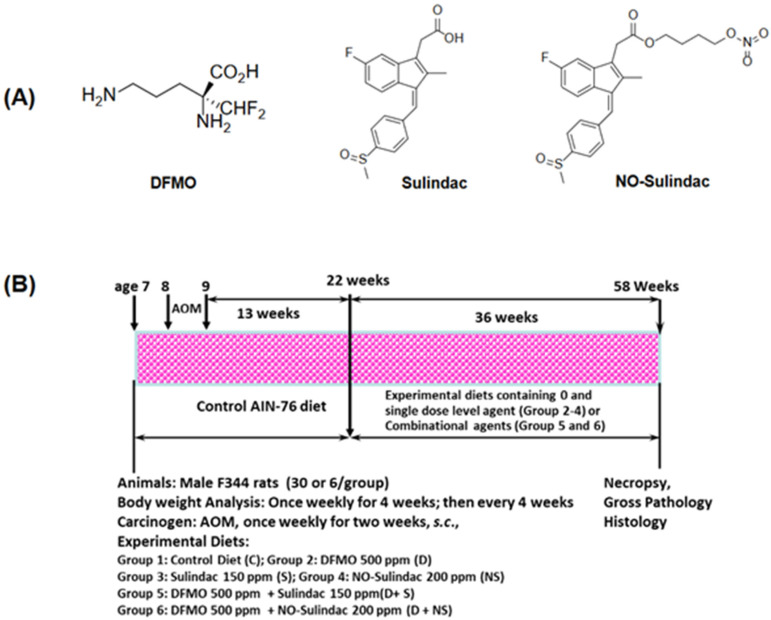
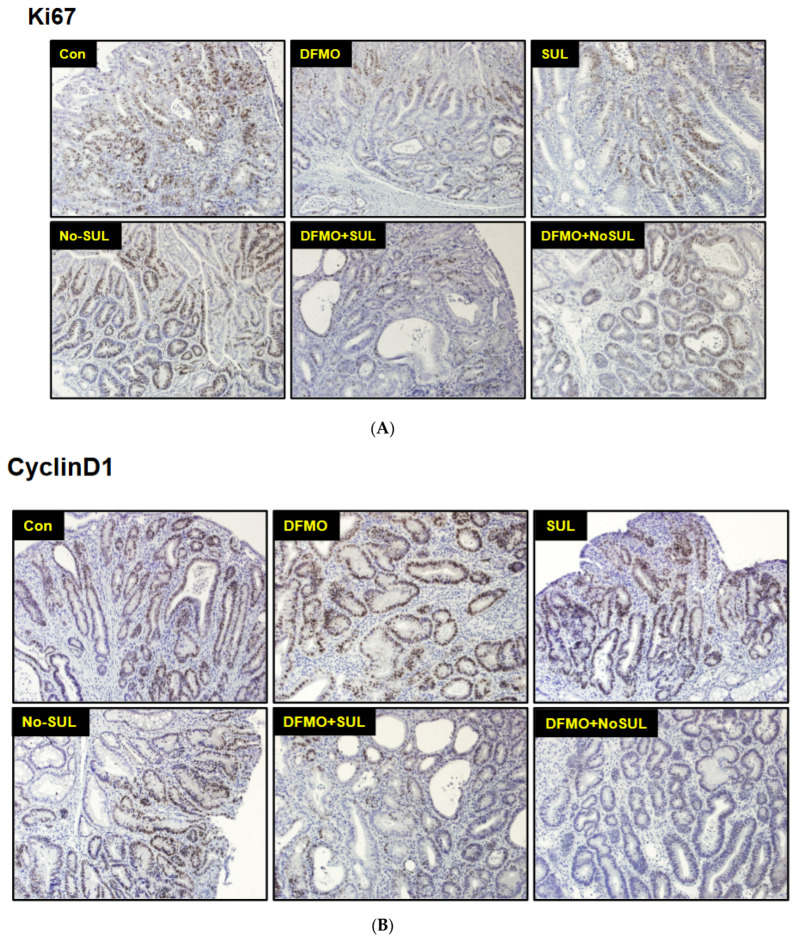
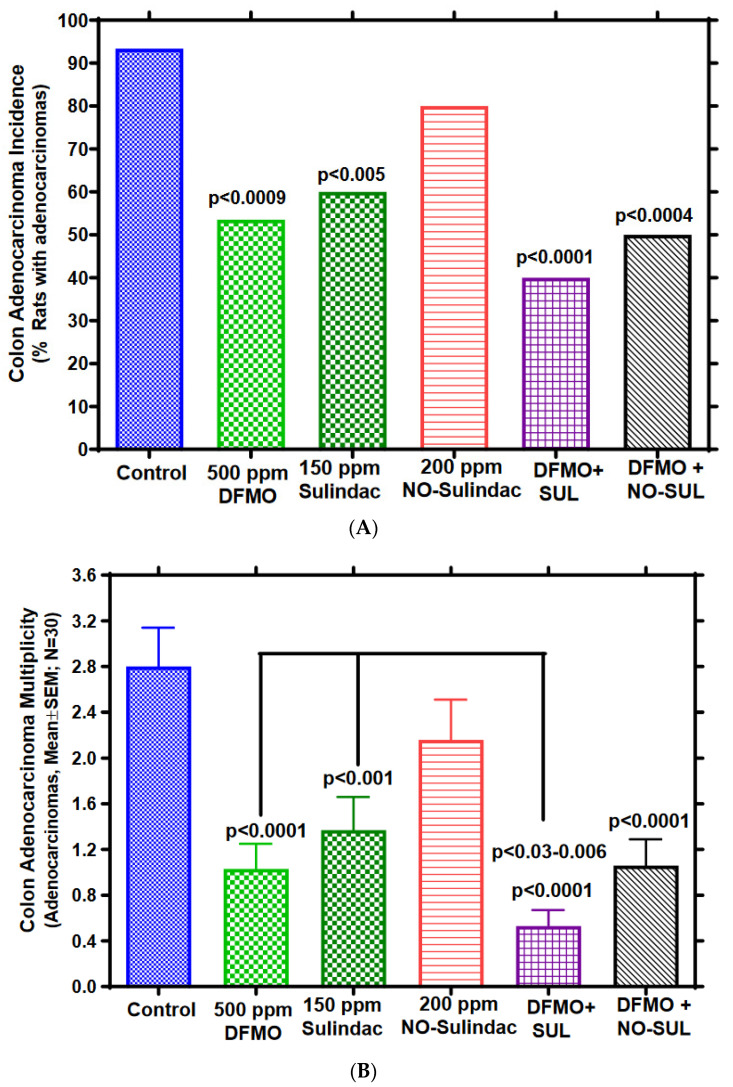
Non-steroidal anti-inflammatory drugs (NSAIDs) are promising colorectal cancer (CRC) chemopreventive drugs; however, to overcome NSAIDs' associated side effects, there is a need to develop safer and efficacious approaches. The present study was designed to evaluate (i) the efficacy of nitric-oxide releasing (NO)-Sulindac as compared to Sulindac; (ii) whether NO-Sulindac is superior to Sulindac in enhancing low-dose difluoromethylornithine (DFMO)-induced chemopreventive efficacy, and (iii) assessing the key biomarkers associated with colon tumor inhibition by these combinations. In F344 rats, colonic tumors were induced by azoxymethane (AOM). At the adenoma stage (13 weeks post AOM), groups of rats were fed the experimental diets containing 0 ppm, 500 ppm DFMO, 150 ppm Sulindac, and 200 ppm NO-Sulindac, individually or in combinations, for 36 weeks. Colon tumors were evaluated histopathologically and assayed for expression levels of proliferative, apoptotic, and inflammatory markers. Results suggest that (except for NO-Sulindac alone), DFMO, Sulindac individually, and DFMO combined with Sulindac or NO-Sulindac significantly suppressed AOM-induced adenocarcinoma incidence and multiplicities. DFMO and Sulindac suppressed adenocarcinoma multiplicity by 63% ( < 0.0001) and 51% ( < 0.0011), respectively, whereas NO-Sulindac had a modest effect (22.8%, = 0.09). Combinations of DFMO plus Sulindac or NO-Sulindac suppressed adenocarcinoma incidence (60%, < 0.0001; 50% < 0.0004), and multiplicity (81%, < 0.0001; 62%, < 0.0001). Rats that were fed the combination of DFMO plus Sulindac showed significant inhibition of tumor cell proliferation and induction of apoptosis. In addition, enhancement of p21, Bax, and caspases; downregulation of Ki-67, VEGF, and β-catenin; and modulation of iNOS, COX-2, and ODC activities in colonic tumors were observed. These observations show that a lower-dose of DFMO and Sulindac significantly enhanced CRC chemopreventive efficacy when compared to NO-Sulindac alone, and the combination of DFMO and NO-Sulindac was modestly efficacious as compared to DFMO alone.
非甾体抗炎药(NSAIDs)是很有前景的结直肠癌(CRC)化学预防药物;然而,为了克服NSAIDs相关的副作用,需要开发更安全有效的方法。本研究旨在评估:(i)与舒林酸相比,释放一氧化氮(NO)的舒林酸(NO-舒林酸)的疗效;(ii)NO-舒林酸在增强低剂量二氟甲基鸟氨酸(DFMO)诱导的化学预防疗效方面是否优于舒林酸;以及(iii)评估这些联合用药与结肠肿瘤抑制相关的关键生物标志物。在F344大鼠中,用偶氮甲烷(AOM)诱导结肠肿瘤。在腺瘤阶段(AOM注射后13周),将大鼠分组,分别或联合喂食含0 ppm、500 ppm DFMO、150 ppm舒林酸和200 ppm NO-舒林酸的实验饮食,持续36周。对结肠肿瘤进行组织病理学评估,并检测增殖、凋亡和炎症标志物的表达水平。结果表明,(单独使用NO-舒林酸除外),DFMO、舒林酸单独使用,以及DFMO与舒林酸或NO-舒林酸联合使用均显著抑制了AOM诱导的腺癌发病率和瘤数。DFMO和舒林酸分别将腺癌瘤数抑制了63%(<0.0001)和51%(<0.0011),而NO-舒林酸的作用较小(22.8%,P = 0.09)。DFMO加舒林酸或NO-舒林酸的联合用药抑制了腺癌发病率(60%,<0.0001;50%,<0.0004)和瘤数(81%,<0.0001;62%,<0.0001)。喂食DFMO加舒林酸联合用药的大鼠显示出肿瘤细胞增殖的显著抑制和凋亡的诱导。此外,还观察到结肠肿瘤中p21、Bax和半胱天冬酶的增强;Ki-67、VEGF和β-连环蛋白的下调;以及诱导型一氧化氮合酶、环氧化酶-2和鸟氨酸脱羧酶活性的调节。这些观察结果表明,与单独使用NO-舒林酸相比,较低剂量的DFMO和舒林酸显著增强了CRC化学预防疗效,并且DFMO与NO-舒林酸的联合用药与单独使用DFMO相比效果适中。