CMEMS-UMinho, University of Minho, 4800-058 Guimarães, Portugal.
LABBELS-Associate Laboratory, 4800-122 Braga, Portugal.
Int J Mol Sci. 2023 Jul 30;24(15):12204. doi: 10.3390/ijms241512204.
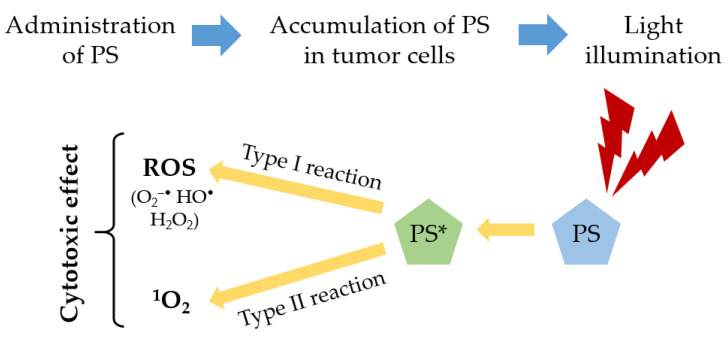
This review provides an update on the current state of photodynamic therapy (PDT) for colorectal cancer (CRC) and explores potential future directions in this field. PDT has emerged as a promising minimally invasive treatment modality that utilizes photosensitizers and specific light wavelengths to induce cell death in targeted tumor tissues. In recent years, significant progress has been made in understanding the underlying mechanisms, optimizing treatment protocols, and improving the efficacy of PDT for CRC. This article highlights key advancements in PDT techniques, including novel photosensitizers, light sources, and delivery methods. Furthermore, it discusses ongoing research efforts and potential future directions, such as combination therapies and nanotechnology-based approaches. By elucidating the current landscape and providing insights into future directions, this review aims to guide researchers and clinicians in harnessing the full potential of PDT for the effective management of CRC.
这篇综述介绍了光动力疗法(PDT)在结直肠癌(CRC)中的最新应用,并探讨了该领域未来的潜在方向。PDT 已成为一种有前途的微创治疗方式,它利用光敏剂和特定的光波来诱导靶向肿瘤组织中的细胞死亡。近年来,人们在理解其潜在机制、优化治疗方案以及提高 PDT 治疗 CRC 的疗效方面取得了重大进展。本文重点介绍了 PDT 技术的关键进展,包括新型光敏剂、光源和输送方法。此外,还讨论了正在进行的研究工作和潜在的未来方向,如联合治疗和基于纳米技术的方法。通过阐明当前的研究现状并提供对未来方向的见解,本文旨在为研究人员和临床医生提供指导,以充分发挥 PDT 在有效管理 CRC 方面的潜力。