Kastelic Marjan, Gregurić Gračner Gordana, Tomažič Iztok, Kvapil Pavel, Harej Mojca, Dovč Alenka
Zoo Ljubljana, Večna Pot 70, 1000 Ljubljana, Slovenia.
Institute for Poultry, Birds, Small Mammals and Reptiles, Veterinary Faculty, University of Ljubljana, Gerbičeva 60, 1000 Ljubljana, Slovenia.
Animals (Basel). 2023 Aug 2;13(15):2491. doi: 10.3390/ani13152491.
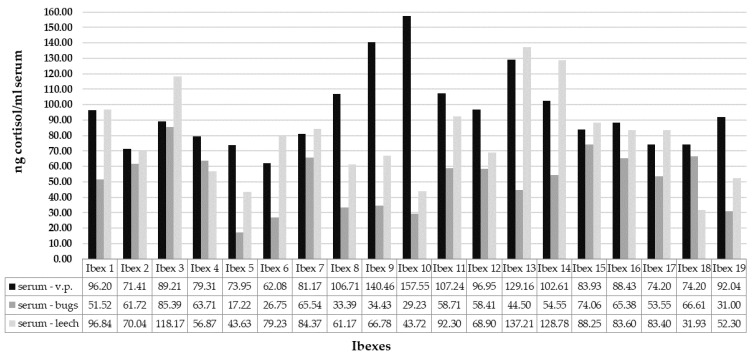
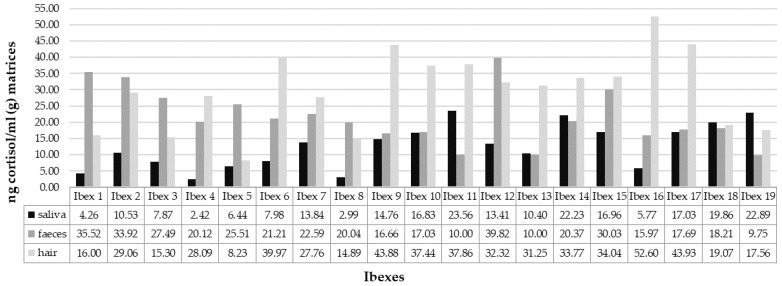
The usefulness of blood collection using venipuncture versus kissing bugs or medicinal leeches and the collection of saliva, faeces, hair, urine, and tears for measuring "immunoreactive" C (iC) concentration in Alpine ibexes was verified using commercial enzyme immunoassays. The mean value of serum C was highest in serum collected using venipuncture and lowest in serums collected using kissing bugs. Statistically significant differences were observed between venipuncture and kissing bugs and between leeches and kissing bugs. However, no statistically significant difference was found in C concentrations between samples collected with venipuncture and those collected with leeches. The highest mean value of C concentration was measured in serum (all three methods), followed by that in hair and faeces, and the lowest mean value was found in saliva. Statistically significant differences were found between saliva and faeces samples and between saliva and hair samples. The difference between the concentrations for faeces and hair was not statistically significant. A significant difference in C concentration between males and females was found in saliva. A significant difference in C concentration among different ages was measured in serum obtained using venipuncture in all three groups and in faeces between the groups older than ten years and younger than 10 months. Highly significant differences in C concentrations were also found between hair sampled in summer and hair sampled in autumn. Collecting tear and urine samples is a laborious procedure and is therefore less acceptable for C determination. Due to the small number of samples, statistical values are not given for these two matrices.
通过商业酶免疫测定法验证了采用静脉穿刺采血与使用猎蝽或药用水蛭采血以及采集唾液、粪便、毛发、尿液和泪液来测量阿尔卑斯野山羊“免疫反应性”C(iC)浓度的有效性。静脉穿刺采集的血清中C的平均值最高,猎蝽采集的血清中C的平均值最低。在静脉穿刺与猎蝽采集以及水蛭与猎蝽采集之间观察到了统计学上的显著差异。然而,静脉穿刺采集的样本与水蛭采集的样本之间的C浓度没有统计学上的显著差异。C浓度的最高平均值在血清中测得(所有三种方法),其次是毛发和粪便,唾液中的平均值最低。在唾液与粪便样本之间以及唾液与毛发样本之间发现了统计学上的显著差异。粪便和毛发的浓度差异没有统计学意义。在唾液中发现雄性和雌性之间的C浓度存在显著差异。在所有三组中,通过静脉穿刺获得的血清以及10岁以上和10个月以下组之间的粪便中,不同年龄之间的C浓度存在显著差异。夏季采集的毛发和秋季采集的毛发之间的C浓度也存在高度显著差异。采集泪液和尿液样本是一项费力的程序,因此在测定C时不太适用。由于样本数量较少,未给出这两种基质的统计值。