Jones Brittany L, McClain Abby M, Sportelli Jessica J, Le-Bert Carolina Ruiz
National Marine Mammal Foundation, 2240 Shelter Island Dr Ste 200, San Diego, CA 92106, USA.
Naval Information Warfare Center Pacific, San Diego, CA 92107, USA.
Animals (Basel). 2023 Aug 5;13(15):2531. doi: 10.3390/ani13152531.
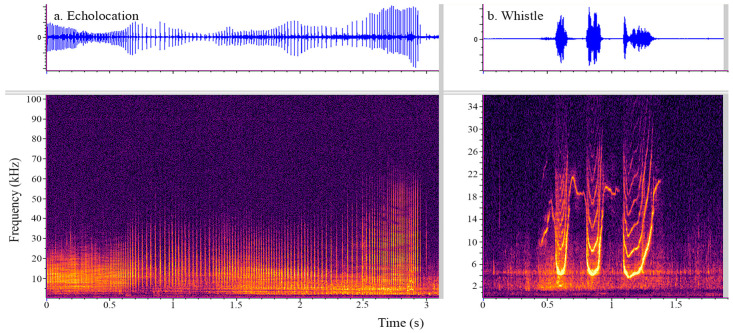
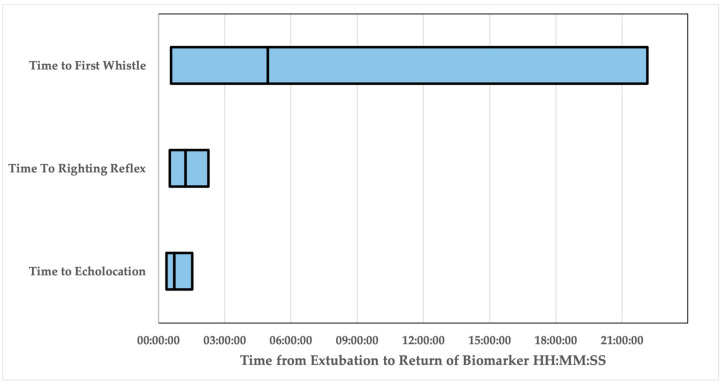
(1) Background: When a human or animal is recovering from general anesthesia, their medical team uses several behavioral and physiological parameters to assess their emergence from the unconscious state to complete wakefulness. However, the return of auditory and acoustic behaviors indicative of the complete return of consciousness in humans can be difficult to assess in a completely aquatic non-human mammal. Dolphins produce sound using the nasal system while using both passive auditory and active biological sonar (echolocation) to navigate and interrogate their environment. The sounds generated by dolphins, such as whistles and clicks, however, can be difficult to hear when the animal is submerged. (2) Methods: We implemented a system to audibly and visually (i.e., using spectrograms) monitor the underwater acoustic behavior of dolphins recovering from anesthesia. (3) Results: Eleven of the twelve recorded dolphins began echolocating within 92 min (Mean = 00:43:41 HH:MM:SS) following spontaneous respirations. In all cases, the dolphins echolocated prior to whistling (Mean = 04:57:47). The return of echolocation was significantly correlated to the return of the righting reflex (Mean = 1:13:44), a commonly used behavioral indicator of dolphin emergence. (4) Conclusions: We suggest that acoustic monitoring for the onset of click production may be a useful supplement to the established medical and behavioral biomarkers of restoring consciousness following anesthesia in bottlenose dolphins.
(1) 背景:当人类或动物从全身麻醉中恢复时,其医疗团队会使用多种行为和生理参数来评估他们从无意识状态恢复到完全清醒的过程。然而,对于完全水生的非人类哺乳动物而言,很难评估表明人类意识完全恢复的听觉和声学行为的恢复情况。海豚利用鼻腔系统发出声音,同时使用被动听觉和主动生物声纳(回声定位)来导航和探测周围环境。然而,当海豚潜入水中时,它们发出的诸如哨声和咔哒声等声音很难被听到。(2) 方法:我们实施了一个系统,用于在听觉和视觉上(即使用频谱图)监测从麻醉中恢复的海豚的水下声学行为。(3) 结果:在记录的12只海豚中,有11只在自主呼吸后的92分钟内(平均 = 00:43:41 HH:MM:SS)开始进行回声定位。在所有情况下,海豚在发出哨声之前就进行了回声定位(平均 = 04:57:47)。回声定位的恢复与翻正反射的恢复显著相关(平均 = 1:13:44),翻正反射是海豚苏醒的常用行为指标。(4) 结论:我们认为,对咔哒声产生开始的声学监测可能是对宽吻海豚麻醉后恢复意识的既定医学和行为生物标志物的有用补充。