Memorial University of Newfoundland, St John's, NL, Canada.
Isra University Islamabad, Islamabad, Pakistan.
West J Nurs Res. 2023 Oct;45(10):894-901. doi: 10.1177/01939459231189789. Epub 2023 Aug 12.
Individuals with multimorbidity and complexity have multifaceted care needs requiring integrated and collaborative care from nurses, families, and health care teams. Nurses, as the frontline care professionals, should develop therapeutic relationships with patients and their families and professional relationships with health care team members to ensure the delivery of effective integrated care. Failure to develop effective interpersonal and professional relationships can negatively affect patient care.
The purpose of this study was to explore nurses' challenges with developing interpersonal and professional relationships during integrated care for individuals with multimorbidity and complexity.
A descriptive qualitative design was used. We interviewed a purposive sample of 19 nurses with experience of caring for individuals with multimorbidity and complexity across two hospitals in Pakistan. Semi-structured interviews were used for data collection, and data were analyzed using reflexive thematic analysis.
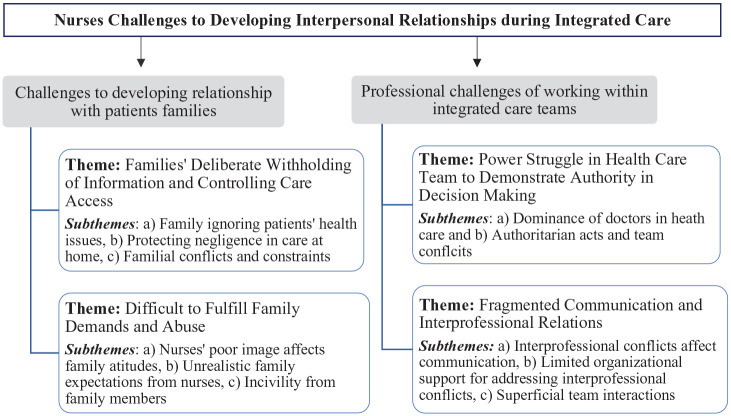
Two challenges were identified affecting the relationships between patients' families and nurses, and two challenges influencing the professional relationships within the team. Families withheld information, controlled care access of their relatives, posed unrealistic demands, and abused nurses, affecting nurse-family relationships. Power struggles to demonstrate authority in decision-making were common within health care teams, affecting nurses' professional capacity to provide effective care.
Health care team, patient, and family collaboration is instrumental in improved care for individuals with multimorbidity and complexity. Nurse leaders and health care organizations should take initiatives to address nurses' interpersonal confrontations to support them in the provision of quality care.
患有多种疾病和病情复杂的患者具有多方面的护理需求,需要护士、家庭和医疗团队提供综合和协作的护理。护士作为一线护理专业人员,应与患者及其家属建立治疗性关系,并与医疗团队成员建立专业关系,以确保提供有效的综合护理。未能建立有效的人际和专业关系可能会对患者护理产生负面影响。
本研究旨在探讨护士在为患有多种疾病和病情复杂的患者提供综合护理时,在建立人际和专业关系方面所面临的挑战。
采用描述性定性设计。我们对巴基斯坦两家医院的 19 名有照顾多种疾病和病情复杂患者经验的护士进行了目的抽样访谈。采用半结构化访谈进行数据收集,并使用反思性主题分析对数据进行分析。
确定了两个影响护士与患者家属关系的挑战,以及两个影响团队内专业关系的挑战。家属隐瞒信息、控制亲属的护理机会、提出不切实际的要求和虐待护士,影响了护士与家属的关系。在医疗团队中,争夺决策权以展示权威的权力斗争很常见,这影响了护士提供有效护理的专业能力。
医疗团队、患者和家庭的协作对于改善患有多种疾病和病情复杂的患者的护理至关重要。护士领导和医疗保健组织应采取主动行动,解决护士之间的人际冲突,支持他们提供优质护理。