Miyake Kunio, Horiuchi Sayaka, Shinohara Ryoji, Kushima Megumi, Otawa Sanae, Yui Hideki, Akiyama Yuka, Ooka Tadao, Kojima Reiji, Yokomichi Hiroshi, Mochizuki Kazuki, Yamagata Zentaro
Department of Health Sciences, Interdisciplinary Graduate School of Medicine and Engineering, University of Yamanashi, Chuo, Japan.
Center for Birth Cohort Studies, University of Yamanashi, Chuo, Japan.
Front Nutr. 2023 Jul 27;10:1203669. doi: 10.3389/fnut.2023.1203669. eCollection 2023.
Animal studies have shown that maternal low-fiber diets during pregnancy may impair brain development and function in offspring, but this has not been validated by epidemiological studies. The aim of this study was to investigate the link between maternal dietary fiber intake during pregnancy and neurodevelopmental delay in offspring using a large birth cohort.
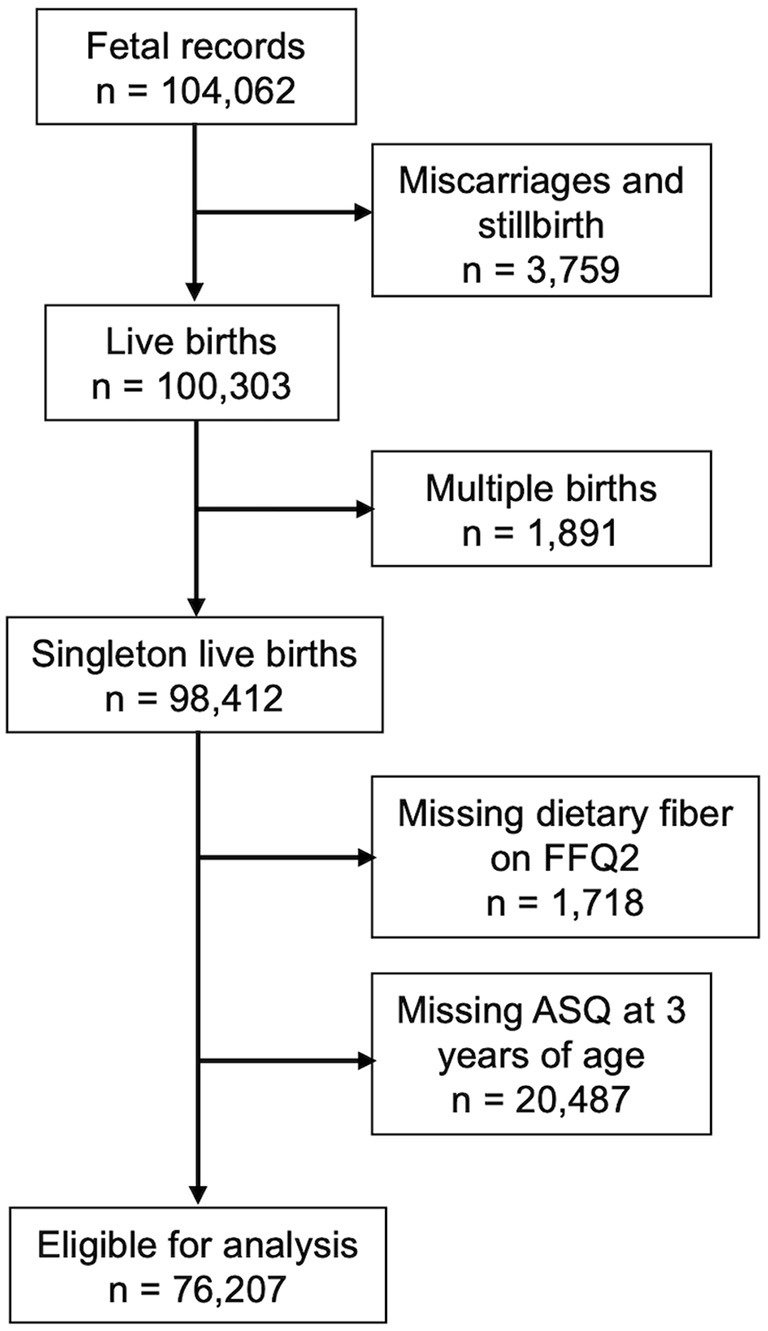
A total of 76,207 mother-infant pairs were analyzed using data from the Japan Environment and Children's Study, a nationwide prospective cohort study. Maternal dietary fiber intake was estimated using the food frequency questionnaire in mid-pregnancy. Maternal dietary fiber intake was adjusted for energy and classified into quintiles. Developmental delay was assessed in five domains using the Japanese version of the Ages and Stages Questionnaire, Third Edition at the age of 3 years. The logistic regression analysis was performed to estimate the odds ratio (OR) and 95% confidence interval (CI) for the link between dietary fiber intake during pregnancy and developmental delay at the age of 3 years.
The lowest intake group of total dietary fiber had a higher risk of delayed communication [adjusted OR (aOR), 1.51; 95% CI, 1.32-1.74], fine motor (aOR, 1.45; 95% CI, 1.32-1.61), problem-solving (aOR, 1.46; 95% CI, 1.32-1.61), and personal-social skills (aOR, 1.30; 95% CI, 1.12-1.50) than did the highest intake group. An analysis that excluded the effects of insufficient folic acid intake during pregnancy also showed a similar trend.
This study showed that maternal dietary fiber deficiency during pregnancy might influence an increased risk of neurodevelopmental delay in offspring.
动物研究表明,孕期母亲低纤维饮食可能会损害后代的大脑发育和功能,但这尚未得到流行病学研究的验证。本研究的目的是利用一个大型出生队列,调查孕期母亲膳食纤维摄入量与后代神经发育迟缓之间的联系。
使用日本环境与儿童研究(一项全国性前瞻性队列研究)的数据,对总共76207对母婴进行了分析。在孕中期使用食物频率问卷估计母亲膳食纤维摄入量。将母亲膳食纤维摄入量按能量进行调整,并分为五分位数。在3岁时使用日本版《年龄与发育进程问卷》第三版,在五个领域评估发育迟缓情况。进行逻辑回归分析,以估计孕期膳食纤维摄入量与3岁时发育迟缓之间联系的比值比(OR)和95%置信区间(CI)。
总膳食纤维摄入量最低的组,在沟通迟缓方面的风险更高[调整后的OR(aOR)为1.51;95%CI为1.32 - 1.74],精细运动方面(aOR为1.45;95%CI为1.32 - 1.61),解决问题能力方面(aOR为1.46;95%CI为1.32 - 1.61),以及个人社交技能方面(aOR为1.30;95%CI为1.12 - 1.50),均高于摄入量最高的组。一项排除孕期叶酸摄入不足影响的分析也显示了类似趋势。
本研究表明,孕期母亲膳食纤维缺乏可能会增加后代神经发育迟缓的风险。