Moradi Asma, Davati Nafiseh, Emamifar Aryou
Department of Food Science and Technology, College of Food Industry Bu-Ali Sina University Hamedan Iran.
Food Sci Nutr. 2023 May 22;11(8):4781-4793. doi: 10.1002/fsn3.3457. eCollection 2023 Aug.
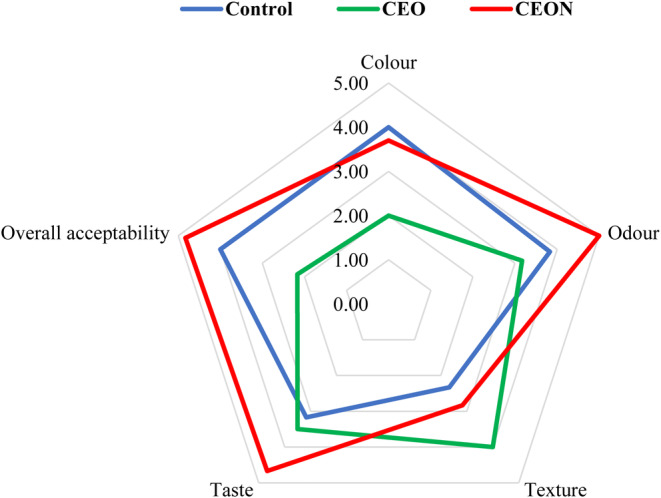
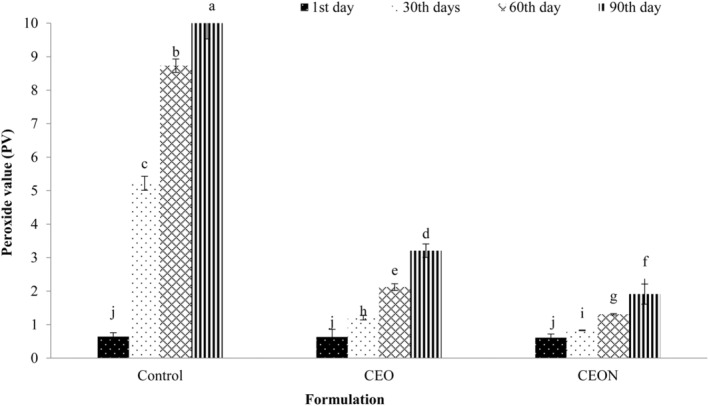
The present study aimed to investigate the effects of essential oil (CEO) and its nanoemulsion (CEON) on oxidative stability and microbial growth of mayonnaise during storage. The GC analysis indicated that Cuminaldehyde (27.99%), o-Cymene (17.31%), γ-Terpinen (16.67%), and β-Pinene (9.35%) were the major components of CEO, respectively. The assessments of minimum inhibitory concentration (MIC) and minimum bactericidal concentration (MBC) showed that ATCC 25922 (MBC = 12 and MBC = 6 mg/mL) was the most resistant bacteria, and in contrast, ATCC 29213 (MBC = 6 and MBC = 3 mg/mL) was the most sensitive bacteria. In the radical-scavenging assay, CEON (IC = 5 ± 0.07 μg/mL) exhibited a higher antioxidant activity than CEO (IC = 10 ± 0.13 μg/mL). The results showed that applying the MBC of CEO and CEON in mayonnaise led to a significant decrease ( < .05) in acidity, peroxide value, number of acid-resistant bacteria and fungi, and total microbial count compared with the control sample. In conclusion, this study demonstrated that using CEON resulted in oxidative stability, microbial growth control, and desirable sensorial attributes in mayonnaise compared with CEO and control samples.
本研究旨在探讨香芹精油(CEO)及其纳米乳液(CEON)对蛋黄酱储存期间氧化稳定性和微生物生长的影响。气相色谱分析表明,香芹醛(27.99%)、邻伞花烃(17.31%)、γ-松油烯(16.67%)和β-蒎烯(9.35%)分别是CEO的主要成分。最低抑菌浓度(MIC)和最低杀菌浓度(MBC)评估表明,ATCC 25922(MBC = 12且MBC = 6 mg/mL)是最具抗性的细菌,相反,ATCC 29213(MBC = 6且MBC = 3 mg/mL)是最敏感的细菌。在自由基清除试验中,CEON(IC = 5±0.07 μg/mL)表现出比CEO(IC = 10±0.13 μg/mL)更高的抗氧化活性。结果表明,与对照样品相比,在蛋黄酱中应用CEO和CEON的MBC导致酸度、过氧化值、耐酸细菌和真菌数量以及总微生物数量显著降低(<0.05)。总之,本研究表明,与CEO和对照样品相比,使用CEON可使蛋黄酱具有氧化稳定性、控制微生物生长并具有理想的感官特性。