Ryu Dongmin, Bak Taeyoung, Ahn Daewoong, Kang Hayoung, Oh Sanggeun, Min Hyun-Seok, Lee Sumin, Lee Jimin
Tomocube Inc., Daejeon, 34109, Republic of Korea.
Department of Computer Science and Engineering, Ulsan National Institute of Science and Technology (UNIST), Ulsan, 44919, Republic of Korea.
Heliyon. 2023 Jul 20;9(8):e18297. doi: 10.1016/j.heliyon.2023.e18297. eCollection 2023 Aug.
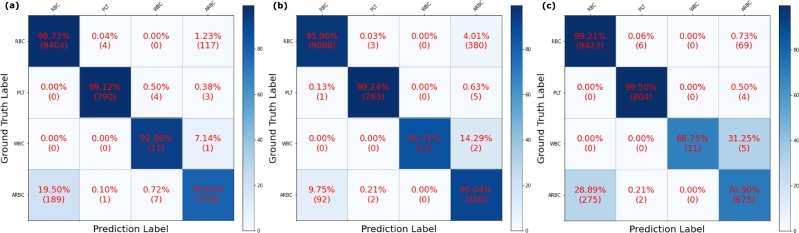
Hematology analysis, a common clinical test for screening various diseases, has conventionally required a chemical staining process that is time-consuming and labor-intensive. To reduce the costs of chemical staining, label-free imaging can be utilized in hematology analysis. In this work, we exploit optical diffraction tomography and the fully convolutional one-stage object detector or FCOS, a deep learning architecture for object detection, to develop a label-free hematology analysis framework. Detected cells are classified into four groups: red blood cell, abnormal red blood cell, platelet, and white blood cell. In the results, the trained object detection model showed superior detection performance for blood cells in refractive index tomograms (0.977 mAP) and also showed high accuracy in the four-class classification of blood cells (0.9708 weighted F1 score, 0.9712 total accuracy). For further verification, mean corpuscular volume (MCV) and mean corpuscular hemoglobin (MCH) were compared with values obtained from reference hematology equipment, with our results showing reasonable correlation in both MCV (0.905) and MCH (0.889). This study provides a successful demonstration of the proposed framework in detecting and classifying blood cells using optical diffraction tomography for label-free hematology analysis.
血液学分析是一种用于筛查各种疾病的常见临床检测方法,传统上需要一个耗时且费力的化学染色过程。为了降低化学染色成本,无标记成像可用于血液学分析。在这项工作中,我们利用光学衍射断层扫描和全卷积单阶段目标检测器(FCOS,一种用于目标检测的深度学习架构)来开发一个无标记血液学分析框架。检测到的细胞分为四组:红细胞、异常红细胞、血小板和白细胞。结果显示,训练后的目标检测模型在折射率断层图像中对血细胞具有卓越的检测性能(平均精度均值为0.977),并且在血细胞的四类分类中也具有较高的准确率(加权F1分数为0.9708,总准确率为0.9712)。为了进一步验证,将平均红细胞体积(MCV)和平均红细胞血红蛋白含量(MCH)与参考血液学设备获得的值进行了比较,我们的结果显示MCV(0.905)和MCH(0.889)均具有合理的相关性。本研究成功展示了所提出的框架在使用光学衍射断层扫描进行无标记血液学分析时对血细胞进行检测和分类的能力。