Cruz-Reina Luis J, Flórez-Rojas Juan Sebastián, López Gerson-Dirceu, Herrera-Orozco Israel, Carazzone Chiara, Sierra Rocío
Product and Processes Design Group, Department of Chemical and Food Engineering, Universidad de los Andes, Carrera 1 No. 18A-10, Bogotá D.C. 111711, Colombia.
Laboratory of Advanced Analytical Techniques in Natural Products, Department of Chemistry, Universidad de los Andes, Carrera 1 No. 18A-10, Bogotá D.C.111711, Colombia.
Heliyon. 2023 Jul 28;9(8):e18632. doi: 10.1016/j.heliyon.2023.e18632. eCollection 2023 Aug.
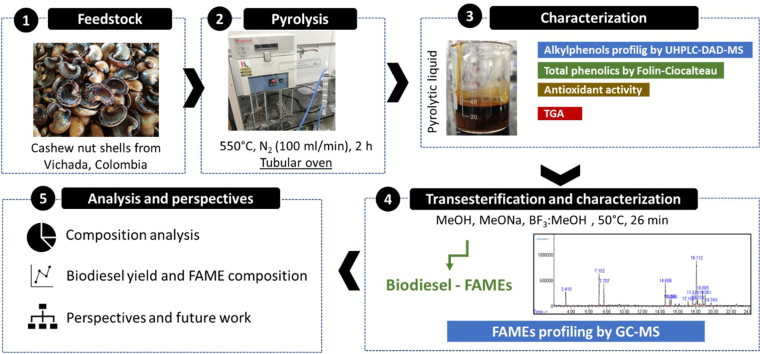
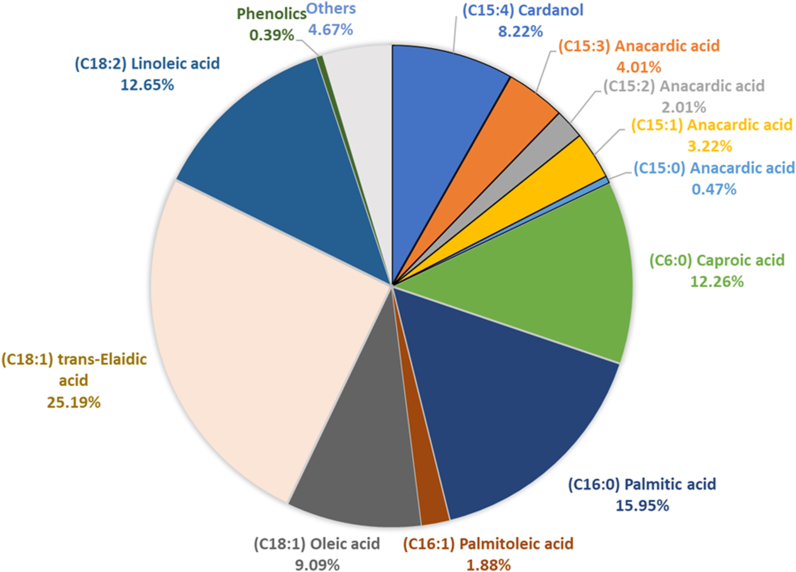
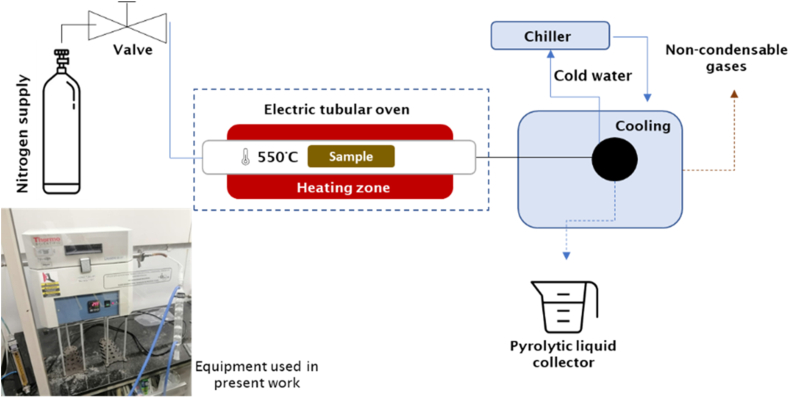
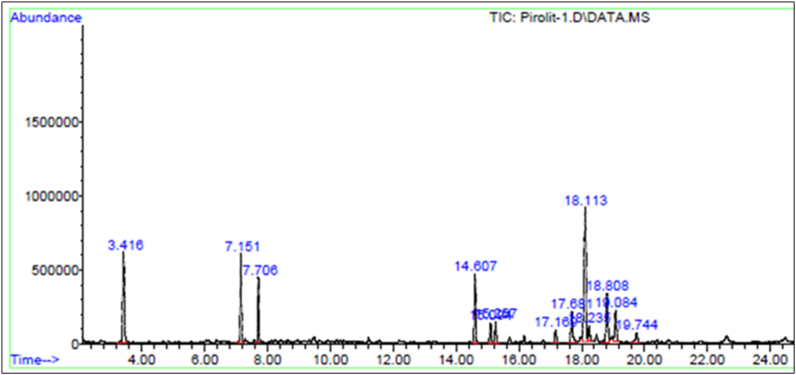
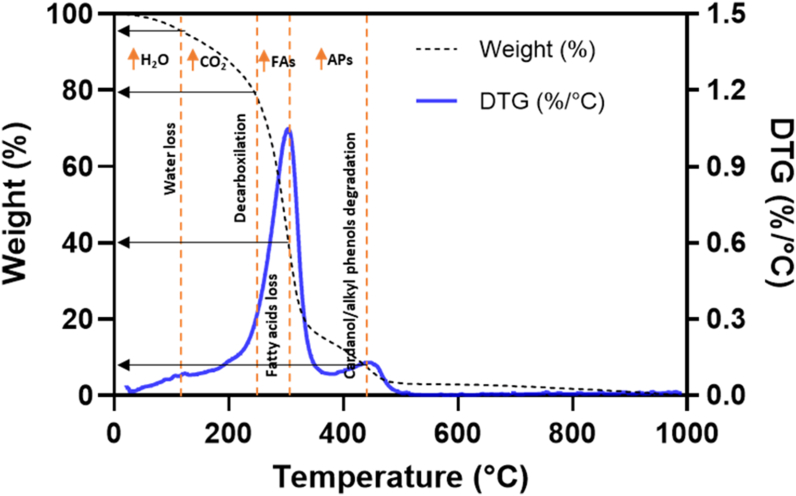
Sustainable management of non-edible agricultural residues of cashew nut production is a concern in Colombia. Therefore, this study aimed to study the fatty acid content of a pyrolytic liquid obtained from cashew nut shells (CNSs) from the Vichada region in Colombia. Transesterification of pyrolytic liquid was conducted to obtain biodiesel at the micro-scale as the first approach for this valorization route. Proximal analysis of samples was carried out using advanced analytical techniques (UHPLC-MS and CG-MS) whereas phenolic content and antioxidant activity were determined. The production yield of pyrolytic liquid was 69.15 ± 5.07% weight (wt.), at 550 °C and 2h of pyrolysis and the liquid was rich in fatty acids (∼70% wt.) and long-chain phenols (∼18% wt.). Among the phenolic compounds in liquid, mainly unsaturated C15:4 cardanol was identified (82.1 ± 5.5 mg/g), whereas the antioxidant activity of pyrolytic liquid was 0.714 ± 0.030 TE/g. Moreover, the biodiesel yield was 81% using catalyst sodium methoxide (12% v), and 50 °C and 26 min for the reaction. The obtained biodiesel in the hexane fraction was rich in methyl -8-octadecanoate (20.9 % wt.) and methyl palmitate (14.3 % wt.), being the representative compounds in the biodiesel. Therefore, the results indicated that thermal conversion of CNSs for obtaining biodiesel on a one-step process is a suitable strategy for the management of toxic and non-edible cashew residues. Finally, this is the first work of its kind that propose in detail the composition of pyrolytic liquid obtained from Colombian cashew nut residues under the proximate analysis approach and using advanced analytical techniques.
腰果生产中不可食用农业残留物的可持续管理是哥伦比亚关注的一个问题。因此,本研究旨在研究从哥伦比亚比查达地区的腰果壳(CNSs)中获得的热解液体的脂肪酸含量。作为这种增值途径的第一步,在微观尺度上对热解液体进行酯交换以获得生物柴油。使用先进的分析技术(超高效液相色谱 - 质谱联用仪和气相色谱 - 质谱联用仪)对样品进行近红外分析,同时测定酚类含量和抗氧化活性。在550℃热解2小时时,热解液体的产率为69.15±5.07%重量(wt.),该液体富含脂肪酸(约70% wt.)和长链酚(约18% wt.)。在液体中的酚类化合物中,主要鉴定出不饱和C15:4腰果酚(82.1±5.5毫克/克),而热解液体的抗氧化活性为0.714±0.030 TE/g。此外,使用甲醇钠催化剂(12% v),在50℃反应26分钟时,生物柴油产率为81%。在己烷馏分中获得的生物柴油富含 -8-十八烷酸甲酯(20.9% wt.)和棕榈酸甲酯(14.3% wt.),它们是生物柴油中的代表性化合物。因此,结果表明,通过一步法将CNSs热转化为生物柴油是管理有毒且不可食用的腰果残渣的合适策略。最后,这是同类研究中的首次工作,详细提出了在近红外分析方法下并使用先进分析技术从哥伦比亚腰果残渣中获得的热解液体的组成。