Esan Ayomikun, Vanholsbeeck Frédérique, Swift Simon, McGoverin Cushla M
Department of Molecular Medicine and Pathology, University of Auckland, Auckland, New Zealand.
Biomicrofluidics. 2023 Aug 9;17(4):044104. doi: 10.1063/5.0159254. eCollection 2023 Jul.
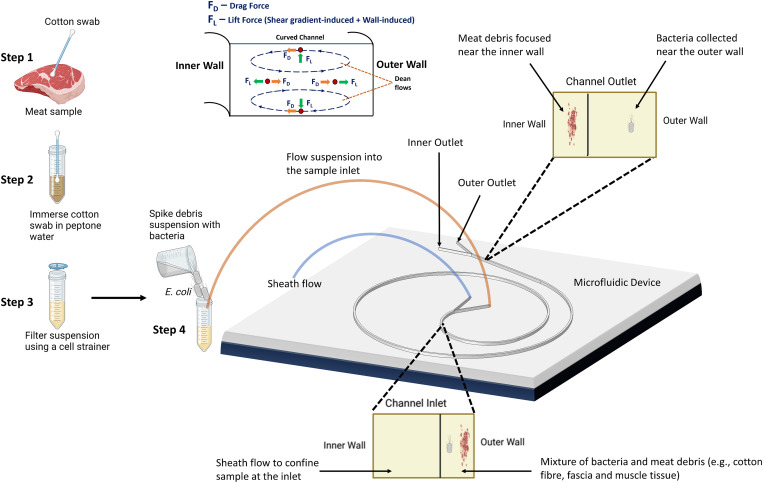
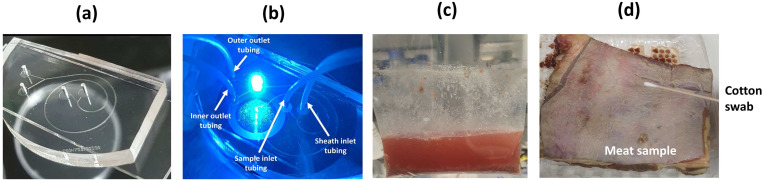
With the global increase in food exchange, rapid identification and enumeration of bacteria has become crucial for protecting consumers from bacterial contamination. Efficient analysis requires the separation of target particles (e.g., bacterial cells) from food and/or sampling matrices to prevent matrix interference with the detection and analysis of target cells. However, studies on the separation of bacteria-sized particles and defined particles, such as bacterial cells, from heterogeneous debris, such as meat swab suspensions, are limited. In this study, we explore the use of passive-based inertial microfluidics to separate bacterial cells from debris, such as fascia, muscle tissues, and cotton fibers, extracted from ground meat and meat swabs-a novel approach demonstrated for the first time. Our objective is to evaluate the recovery efficiency of bacterial cells from large debris obtained from ground meat and meat swab suspensions using a spiral microfluidic device. In this study, we establish the optimal flow rates and Dean number for continuous bacterial cell and debris separation and a methodology to determine the percentage of debris removed from the sample suspension. Our findings demonstrate an average recovery efficiency of 80% for bacterial cells separated from debris in meat swab suspensions, while the average recovery efficiency from ground beef suspensions was 70%. Furthermore, approximately 50% of the debris in the ground meat suspension were separated from bacterial cells.
随着全球食品交换的增加,快速鉴定和计数细菌对于保护消费者免受细菌污染至关重要。高效分析需要将目标颗粒(如细菌细胞)与食品和/或采样基质分离,以防止基质干扰目标细胞的检测和分析。然而,关于从异质碎片(如肉拭子悬浮液)中分离细菌大小的颗粒和特定颗粒(如细菌细胞)的研究有限。在本研究中,我们探索使用基于被动的惯性微流控技术从碎肉和肉拭子中提取的碎片(如筋膜、肌肉组织和棉纤维)中分离细菌细胞——这是一种首次展示的新方法。我们的目标是使用螺旋微流控装置评估从碎肉和肉拭子悬浮液中获得的大碎片中细菌细胞的回收效率。在本研究中,我们确定了连续分离细菌细胞和碎片的最佳流速和Dean数,以及一种确定从样品悬浮液中去除碎片百分比的方法。我们的研究结果表明,从肉拭子悬浮液中的碎片中分离出的细菌细胞平均回收效率为80%,而从绞牛肉悬浮液中的平均回收效率为70%。此外,绞牛肉悬浮液中约50%的碎片与细菌细胞分离。