Sharif Md Arman, Khan Arman Mahmud, Salekeen Rahagir, Rahman Md Hafijur, Mahmud Sakib, Bibi Shabana, Biswas Partha, Nazmul Hasan Md, Islam Kazi Mohammed Didarul, Rahman S M Mahbubur, Islam Md Emdadul, Alshammari Abdulrahman, Alharbi Metab, Hayee Abdul
Biotechnology and Genetic Engineering Discipline, Life Science School, Khulna University, Khulna 9208, Bangladesh.
Department of Biosciences, Shifa Tameer-e-Millat University, Islamabad 41000, Pakistan.
Saudi Pharm J. 2023 Aug;31(8):101681. doi: 10.1016/j.jsps.2023.06.014. Epub 2023 Jun 21.
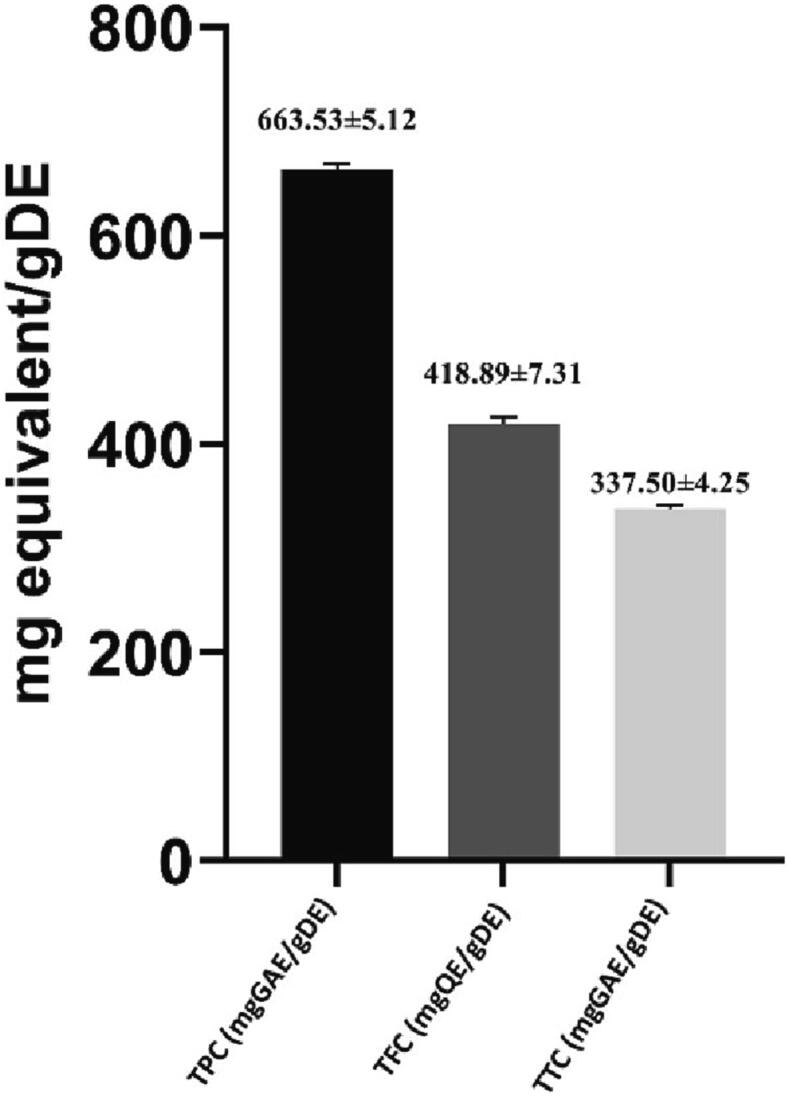
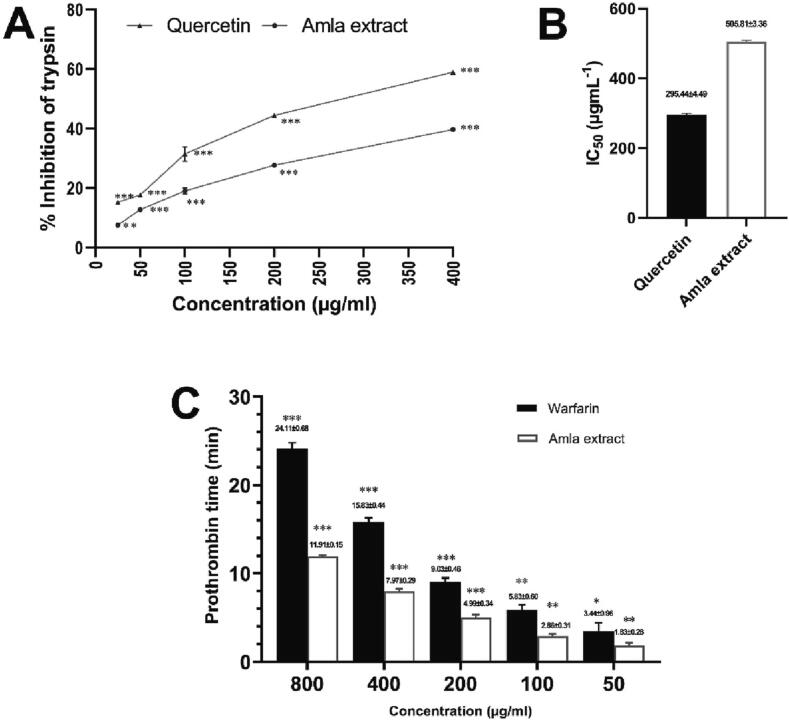
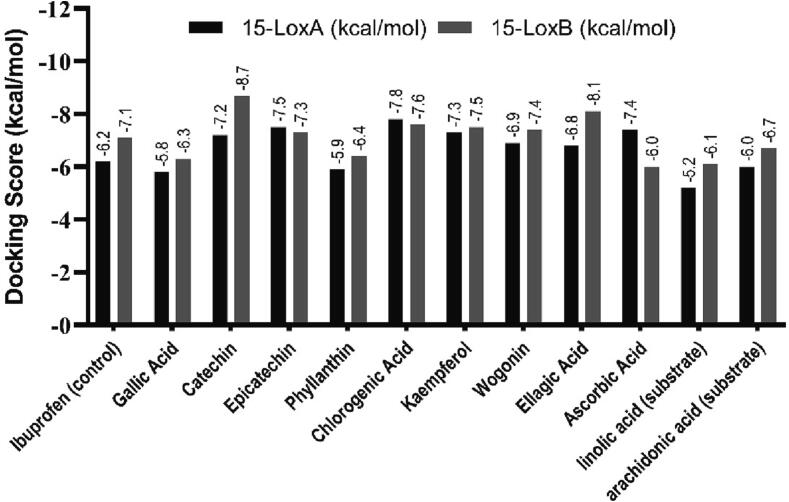
Amla () has long been used in traditional folk medicine to prevent and cure a variety of inflammatory diseases. In this study, the antioxidant activity (DPPH scavenging and reducing power), anti-inflammatory activity (RBC Membrane Stabilization and 15-LOX inhibition), and anticoagulation activity (Serin protease inhibition and Prothrombin Time assays) of the methanolic extract of amla were conducted. Amla exhibited a substantial amount of phenolic content (TPC: 663.53 mg GAE/g) and flavonoid content (TFC: 418.89 mg GAE/g). A strong DPPH scavenging effect was observed with an IC of 311.31 µg/ml as compared to standard ascorbic acid with an IC of 130.53 µg/ml. In reducing power assay, the EC value of the extract was found to be 196.20 µg/ml compared to standard ascorbic acid (EC = 33.83 µg/ml). The IC value of the RBC membrane stabilization and 15-LOX assays was observed as 101.08 µg/ml (IC of 58.62 µg/ml for standard aspirin) and 195.98 µg/ml (IC of 19.62 µg/ml for standard quercetin), respectively. The extract also strongly inhibited serine protease (trypsin) activity with an IC of 505.81 µg/ml (IC of 295.44 µg/ml for standard quercetin). The blood coagulation time (PTT) was found to be 11.91 min for amla extract and 24.11 min for standard Warfarin. Thus, the findings of an study revealed that the methanolic extract of amla contains significant antioxidant, anti-inflammatory, and anticoagulation activity. Furthermore, docking and simulation of reported phytochemicals of amla with human 15-LOXA and 15-LOXB were carried out to validate the anti-inflammatory activity of amla. In this analysis, epicatechin and catechin showed greater molecular interaction and were considerably stable throughout the 100 ns simulation with 15-lipoxygenase A (15-LOXA) and 15-lipoxygenase B (15-LOXB) respectively.
印度醋栗()长期以来一直被用于传统民间医学中,以预防和治疗各种炎症性疾病。在本研究中,对印度醋栗甲醇提取物的抗氧化活性(DPPH清除和还原能力)、抗炎活性(红细胞膜稳定和15-LOX抑制)以及抗凝血活性(丝氨酸蛋白酶抑制和凝血酶原时间测定)进行了研究。印度醋栗表现出大量的酚类含量(总酚含量:663.53毫克没食子酸当量/克)和黄酮类含量(总黄酮含量:418.89毫克没食子酸当量/克)。与标准抗坏血酸(IC50为130.53微克/毫升)相比,观察到印度醋栗具有较强的DPPH清除作用,IC50为311.31微克/毫升。在还原能力测定中,提取物的EC50值为196.20微克/毫升,而标准抗坏血酸的EC50值为33.83微克/毫升。红细胞膜稳定和15-LOX测定的IC50值分别为101.08微克/毫升(标准阿司匹林的IC50为58.62微克/毫升)和195.98微克/毫升(标准槲皮素的IC为19.62微克/毫升)。该提取物还强烈抑制丝氨酸蛋白酶(胰蛋白酶)活性,IC50为505.81微克/毫升(标准槲皮素的IC50为295.44微克/毫升)。印度醋栗提取物的凝血时间(PTT)为11.91分钟,标准华法林的凝血时间为24.11分钟。因此,一项研究的结果表明,印度醋栗甲醇提取物具有显著的抗氧化、抗炎和抗凝血活性。此外,还对印度醋栗报道的植物化学物质与人15-LOXA和15-LOXB进行了对接和模拟,以验证印度醋栗的抗炎活性。在该分析中,表儿茶素和儿茶素分别与15-脂氧合酶A(15-LOXA)和15-脂氧合酶B(15-LOXB)在100纳秒模拟过程中显示出更大的分子相互作用且相当稳定。