Hu Ye-Ting, Chen Xiao-Feng, Zhai Chun-Bao, Yu Xiao-Tian, Liu Gang, Xiong Zhi-Guo, Wang Zi-Qiang, Cai San-Jun, Li Wen-Cai, Kong Xiang-Xing, Xiao Qian, Wang Cai-Hua, Tao Zhi-Hua, Niu Li-Yun, Men Jian-Long, Wang Qing, Wei Shao-Zhong, Hu Jun-Jie, Yang Ting-Han, Peng Jun-Jie, Jiang Guo-Zhong, Lv Ning, Chen Yi-You, Zheng Shu, Gu Yan-Hong, Ding Ke-Feng
Department of Colorectal Surgery and Oncology (Key Laboratory of Cancer Prevention and Intervention, China National Ministry of Education, Key Laboratory of Molecular Biology in Medical Sciences, Zhejiang Province, China) The Second Affiliated Hospital, Zhejiang University School of Medicine Hangzhou Zhejiang China.
Department of Oncology The First Affiliated Hospital with Nanjing Medical University (Jiangsu Province Hospital) Nanjing China.
MedComm (2020). 2023 Aug 12;4(4):e345. doi: 10.1002/mco2.345. eCollection 2023 Aug.
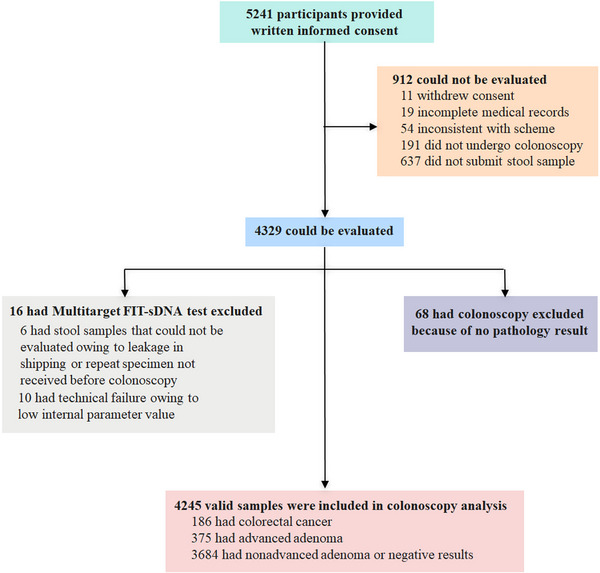
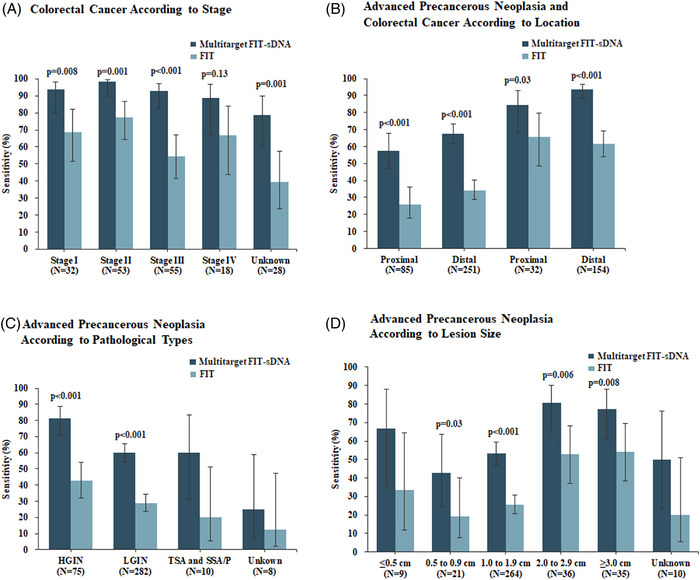
Colorectal cancer (CRC) is a major malignancy threatening the health of people in China and screening could be effective for preventing the occurrence and reducing the mortality of CRC. We conducted a multicenter, prospective clinical study which recruited 4,245 high-risk CRC individuals defined as having positive risk-adapted scores or fecal immunochemical test (FIT) results, to evaluate the clinical performance of the multitarget fecal immunochemical and stool DNA (FIT-sDNA) test for CRC screening. Each participant was asked to provide a stool sample prior to bowel preparation, and FIT-sDNA test and FIT were performed independently of colonoscopy. We found that 186 (4.4%) were confirmed to have CRC, and 375 (8.8%) had advanced precancerous neoplasia among the high CRC risk individuals. The sensitivity of detecting CRC for FIT-sDNA test was 91.9% (95% CI, 86.8-95.3), compared with 62.4% (95% CI, 54.9-69.3) for FIT ( < 0.001). The sensitivity for detecting advanced precancerous neoplasia was 63.5% (95% CI, 58.3-68.3) for FIT-sDNA test, compared with 30.9% (95% CI, 26.3-35.6) for FIT ( < 0.001). Multitarget FIT-sDNA test detected more colorectal advanced neoplasia than FIT. Overall, these findings indicated that in areas with limited colonoscopy resources, FIT-sDNA test could be a promising further risk triaging modality to select patients for colonoscopy in CRC screening.
结直肠癌(CRC)是威胁中国人民健康的主要恶性肿瘤,筛查对预防CRC的发生和降低其死亡率可能有效。我们开展了一项多中心前瞻性临床研究,招募了4245名高危CRC个体,这些个体被定义为风险适应性评分或粪便免疫化学检测(FIT)结果呈阳性,以评估多靶点粪便免疫化学和粪便DNA(FIT-sDNA)检测用于CRC筛查的临床性能。每位参与者在肠道准备前被要求提供一份粪便样本,FIT-sDNA检测和FIT独立于结肠镜检查进行。我们发现,在CRC高危个体中,186例(4.4%)被确诊患有CRC,375例(8.8%)患有高级别癌前瘤变。FIT-sDNA检测CRC的灵敏度为91.9%(95%CI,86.8-95.3),而FIT为62.4%(95%CI,54.9-69.3)(P<0.001)。FIT-sDNA检测高级别癌前瘤变的灵敏度为63.5%(95%CI,58.3-68.3),而FIT为30.9%(95%CI,26.3-35.6)(P<0.001)。多靶点FIT-sDNA检测比FIT检测出更多的结直肠高级别瘤变。总体而言,这些发现表明,在结肠镜检查资源有限的地区,FIT-sDNA检测可能是一种有前景的进一步风险分层方式,用于在CRC筛查中选择进行结肠镜检查的患者。