Franik Sebastian, Fleischer Kathrin, Kortmann Barbara, Stikkelbroeck Nike M, D'Hauwers Kathleen, Bouvattier Claire, Slowikowska-Hilczer Jolanta, Grunenwald Solange, van de Grift Tim, Cartault Audrey, Richter-Unruh Annette, Reisch Nicole, Thyen Ute, IntHout Joanna, Claahsen-van der Grinten Hedi L
Department of Obstetrics and Gynaecology, Radboudumc, Nijmegen, The Netherlands.
Department of Pediatric Urology, Radboudumc, Nijmegen, The Netherlands.
Endocr Connect. 2023 Sep 19;12(10). doi: 10.1530/EC-23-0111. Print 2023 Oct 1.
Klinefelter syndrome (KS) is associated with an increased risk of lower socioeconomic status and a higher risk for morbidity and mortality, which may have a significant impact on quality of life (QOL). The objective of this study is to investigate QOL in a large European cohort of men with KS.
Cross-sectional multicentre study.
Two-hundred-eighteen men with KS were recruited from 14 clinical study centres in 6 European countries which participated in the European dsd-LIFE study. Male normative data from a healthy and a psychiatric reference population were used for comparison. The validated World Health Organization (WHO) QOL (WHOQOL)-BREF questionnaire was used to investigate five main domains of quality of life (WHOQOL): global, physical, psychological, environment, and social.
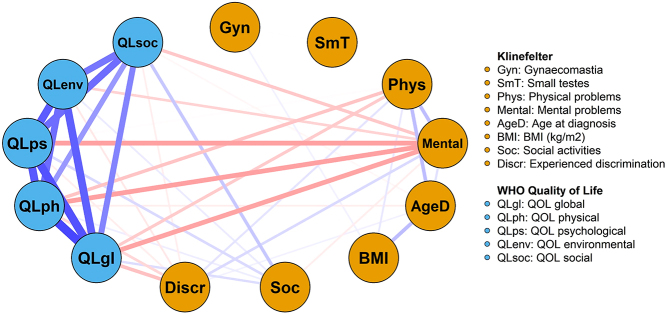
The QOL physical domain score was lower for men with KS compared to the healthy reference population (KS: 66.9; s.d. 19.4, n = 193; healthy reference population: 76.5; s.d. 16.2, n = 1324, P < 0.001) but higher compared to the psychiatric reference population (54.6; s.d. 20.6; n = 77, P < 0.001). The WHOQOL-psychological domain score was lower for men with KS compared to the healthy reference population (KS: 63.6; s.d. 17.8, n = 193; healthy reference population: 67.8; s.d. 15.6, n = 1324, P < 0.05) but higher compared to the psychiatric reference population (45.9; s.d. 26.0), n = 77, P < 0.001). The social domain score on the WHOQOL questionnaire was found to be lower in men with Klinefelter syndrome (KS) compared to the healthy reference population (KS: 60.0; s.d. 21.6, n = 193; healthy reference population: 68.2; s.d. 13.8, n = 1324, P < 0.001). However, this score was similar to that of the psychiatric reference population (61.0; s.d. 17.0, n = 77, P = 0.5). The WHO environment domain score of men with KS (70.0; s.d. 15.0, n = 193) was similar to the healthy reference population (70.5; s.d. 20.7, n = 1324) but higher compared to the psychiatric reference population (61.9; s.d. 20.8, n = 77, P = 0.002). Experienced discrimination, less social activities, and the presence of chronic health problems were associated with significantly decreased QOL in men with KS.
Overall QOL in European men with KS is significantly worse compared to a healthy European reference population. Especially, the presence of discrimination, less social activities, and chronic health problems is associated with lower physical, psychological, and social QOL. Further studies are necessary to investigate if a multidisciplinary approach may help to provide adequate counselling and psychosocial support to improve QOL.
克氏综合征(KS)与社会经济地位较低的风险增加以及发病和死亡风险较高相关,这可能对生活质量(QOL)产生重大影响。本研究的目的是调查欧洲一大群患有KS的男性的生活质量。
横断面多中心研究。
从参与欧洲dsd-LIFE研究的6个欧洲国家的14个临床研究中心招募了218名患有KS的男性。使用来自健康和精神科参考人群的男性标准数据进行比较。使用经过验证的世界卫生组织(WHO)生活质量(WHOQOL)-BREF问卷来调查生活质量的五个主要领域(WHOQOL):总体、身体、心理、环境和社会。
与健康参考人群相比,患有KS的男性的WHOQOL身体领域得分较低(KS:66.9;标准差19.4,n = 193;健康参考人群:76.5;标准差16.2,n = 1324,P < 0.001),但与精神科参考人群相比得分较高(54.6;标准差20.6;n = 77,P < 0.001)。与健康参考人群相比,患有KS的男性的WHOQOL心理领域得分较低(KS:63.6;标准差17.8,n = 193;健康参考人群:67.8;标准差15.6,n = 1324,P < 0.05),但与精神科参考人群相比得分较高(45.9;标准差26.0),n = 77,P < 0.001)。发现克氏综合征(KS)男性的WHOQOL问卷社会领域得分低于健康参考人群(KS:60.0;标准差21.6,n = 193;健康参考人群:68.2;标准差13.8,n = 1324,P < 0.001)。然而,该得分与精神科参考人群的得分相似(61.0;标准差17.0,n = 77,P = 0.5)。患有KS的男性的WHO环境领域得分(70.0;标准差15.0,n = 193)与健康参考人群相似(70.5;标准差20.7,n = 1324),但与精神科参考人群相比得分较高(61.9;标准差20.8,n = 77,P = 0.002)。经历过歧视、社交活动较少以及存在慢性健康问题与患有KS的男性的生活质量显著下降相关。
与健康的欧洲参考人群相比,欧洲患有KS的男性的总体生活质量明显更差。特别是,存在歧视、社交活动较少和慢性健康问题与较低的身体、心理和社会生活质量相关。有必要进行进一步研究,以调查多学科方法是否有助于提供适当的咨询和心理社会支持以改善生活质量。