Graduate Program in Translational Biology, Medicine and Health, Virginia Tech, Roanoke, Virginia, USA.
Department of Surgery, University of Michigan Medical School, Ann Arbor, Michigan, USA.
Int J Hyperthermia. 2023;40(1):2244206. doi: 10.1080/02656736.2023.2244206.
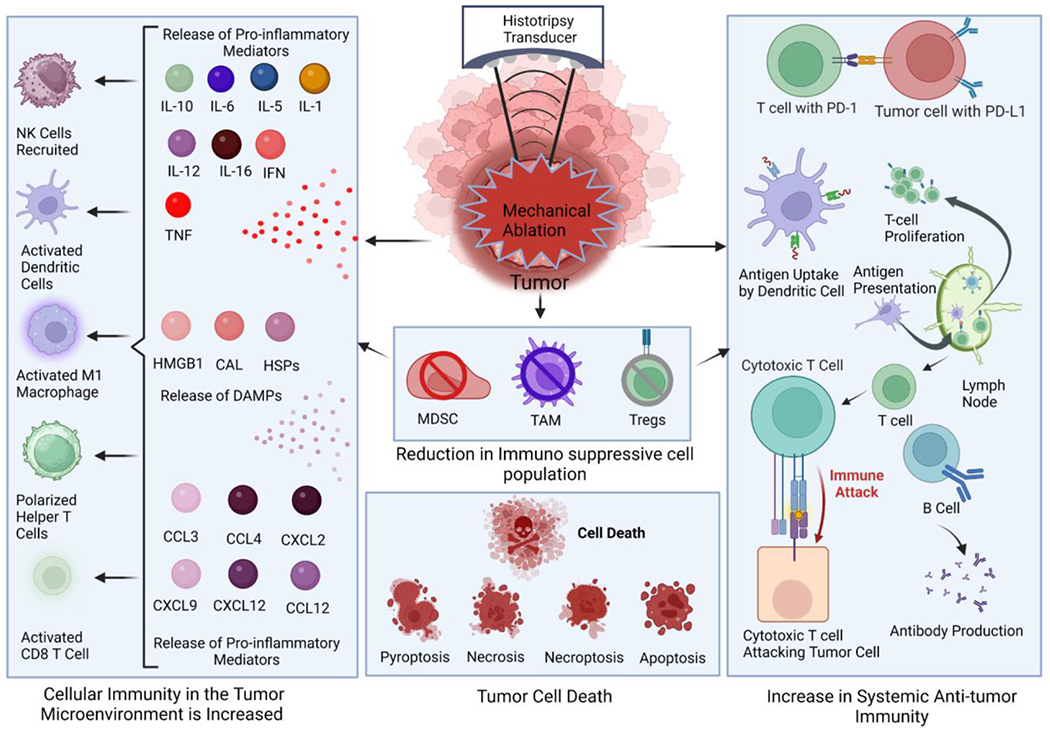
Focused Ultrasound (FUS) is emerging as a promising primary and adjunct therapy for the treatment of cancer. This includes histotripsy, which is a noninvasive, non-ionizing, non-thermal ultrasound guided ablation modality. As histotripsy has progressed from bench-to-bedside, it has become evident that this therapy has benefits beyond local tumor ablation. Specifically, histotripsy has the potential to shift the local tumor microenvironment from immunologically 'cold' to 'hot'. This is associated with the production of damage associated molecular patterns, the release of a selection of proinflammatory mediators, and the induction of inflammatory forms of cell death in cells just outside of the treatment zone. In addition to the induction of this innate immune response, histotripsy can also improve engagement of the adaptive immune system and promote systemic anti-tumor immunity targeting distal tumors and metastatic lesions. These tantalizing observations suggest that, in settings of widely metastatic disease burden, selective histotripsy of a limited number of accessible tumors could be a means of maximizing responsiveness to systemic immunotherapy. More work is certainly needed to optimize treatment strategies that best synergize histotripsy parameters with innate and adaptive immune responses. Likewise, rigorous clinical studies are still necessary to verify the presence and repeatability of these phenomena in human patients. As this technology nears regulatory approval for clinical use, it is our expectation that the insights and immunomodulatory mechanisms summarized in this review will serve as directional guides for rational clinical studies to validate and optimize the potential immunotherapeutic role of histotripsy tumor ablation.
聚焦超声(FUS)作为癌症治疗的一种有前途的主要和辅助治疗方法正在出现。这包括组织破坏,这是一种非侵入性、非电离、非热超声引导消融方式。随着组织破坏从实验室走向临床,很明显,这种治疗方法除了局部肿瘤消融之外还有其他好处。具体来说,组织破坏有可能将局部肿瘤微环境从免疫“冷”转变为“热”。这与损伤相关分子模式的产生、一系列促炎介质的释放以及治疗区外细胞中炎症形式的细胞死亡的诱导有关。除了诱导这种先天免疫反应外,组织破坏还可以改善适应性免疫系统的参与,并促进针对远处肿瘤和转移性病变的全身抗肿瘤免疫。这些诱人的观察结果表明,在广泛转移疾病负担的情况下,对有限数量的可接近肿瘤进行选择性组织破坏可能是最大限度提高对全身免疫疗法反应性的一种手段。当然,需要做更多的工作来优化治疗策略,使组织破坏参数与先天和适应性免疫反应最佳协同作用。同样,仍然需要严格的临床研究来验证这些现象在人类患者中的存在和可重复性。随着该技术接近临床使用的监管批准,我们期望本综述中总结的见解和免疫调节机制将作为指导方向,用于验证和优化组织破坏肿瘤消融的潜在免疫治疗作用的合理临床研究。