Department of Survey Research & Data Analystics, International Institute for Population Sciences, Mumbai, India.
Department of Bio-Statistics and Epidemiology, International Institute for Population Sciences, Mumbai, India.
BMC Health Serv Res. 2023 Aug 14;23(1):864. doi: 10.1186/s12913-023-09781-1.
COVID-19 has disrupted maternal and child health services. Community Health Workers (CHWs) supported the women by visiting pregnant women's homes and providing the MCH services as required. This study attempts to understand the role of CHW and its impact on the Ante-Natal Care (ANC) services pre-pandemic and post-Pandemic in the poor resource setting.
The Swabhimaan programme interventions were carried out in the selected blocks in the Indian States of Bihar, Odisha and Chhattisgarh with the objective to improve the nutritional status of mothers, pregnant women and adolescents living in resource-poor blocks of three selected states during 2016-2022. Cross-sectional surveys, namely pre-pandemic (2018-19) and post-pandemic (2021-22) of pregnant and mothers of under two children, utilised to fulfil the objectives of this study. These surveys are part of Swabhimaan evaluation, a community-based non-randomised controlled study.
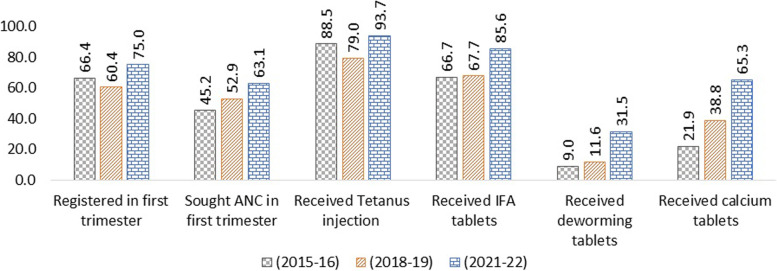
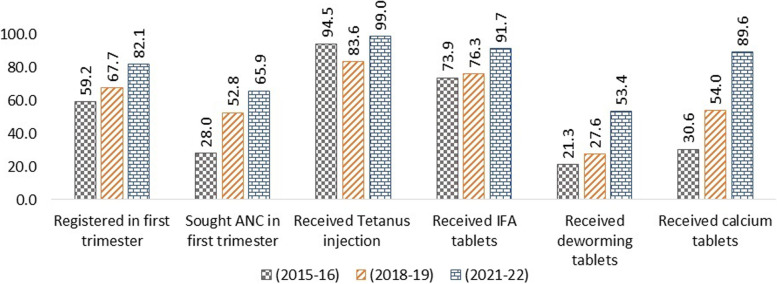
The ANC services received by women have increased over time from 2015 to 2022. Our findings confirm that the ground-level community and health systems were active during the pandemic, and the results show significant improvement. Additionally, the women supported by the CHW have substantially improved pregnancy registration, first ANC, Tetanus injection, consumption of Iron Folic Acid, Calcium and deworming tablets than those who did not. Propesnsity Score Matching analysis shows that the average treatment effect on the various ANC services of having the support of CHW is significant.
This study shows the vital role of CHWs in utilising various Maternal and Child Health services. Better linkage and networking of the CHWs with the community will ensure health service delivery regularly and in an emergency like a pandemic and develop resilience.
COVID-19 扰乱了母婴健康服务。社区卫生工作者(CHW)通过家访为孕妇提供所需的母婴保健服务,以支持孕妇。本研究试图了解 CHW 的作用及其在大流行前和大流行后对资源匮乏环境下产前护理(ANC)服务的影响。
Swabhimaan 计划干预措施在印度比哈尔邦、奥里萨邦和恰蒂斯加尔邦的选定区块进行,目的是改善生活在三个选定邦资源匮乏区块的母亲、孕妇和青少年的营养状况2016-2022 年。利用横断面调查,即在大流行前(2018-19 年)和大流行后(2021-22 年)对孕妇和 2 岁以下儿童的母亲进行调查,以实现本研究的目标。这些调查是 Swabhimaan 评估的一部分,这是一项基于社区的非随机对照研究。
妇女接受的 ANC 服务从 2015 年到 2022 年有所增加。我们的研究结果证实,基层社区和卫生系统在大流行期间保持活跃,结果显示出显著的改善。此外,与未接受 CHW 支持的妇女相比,接受 CHW 支持的妇女在妊娠登记、第一次 ANC、破伤风注射、铁叶酸、钙和驱虫片的服用方面有了显著改善。倾向得分匹配分析表明,CHW 支持对各种 ANC 服务的平均治疗效果具有统计学意义。
本研究表明 CHW 在利用各种母婴健康服务方面发挥了重要作用。更好地将 CHW 与社区联系起来并建立网络,将确保在大流行等紧急情况下定期提供卫生服务,并培养韧性。