Child Development and Nutrition, UNICEF India, New Delhi, India
Independent Consultant, New Delhi, India.
BMJ Open. 2019 Nov 18;9(11):e031632. doi: 10.1136/bmjopen-2019-031632.
Swabhimaan is a community-based programme to improve adolescent girls' and women's nutrition in the rural areas of three Indian states-Bihar, Chhattisgarh and Odisha with high prevalence of undernutrition.
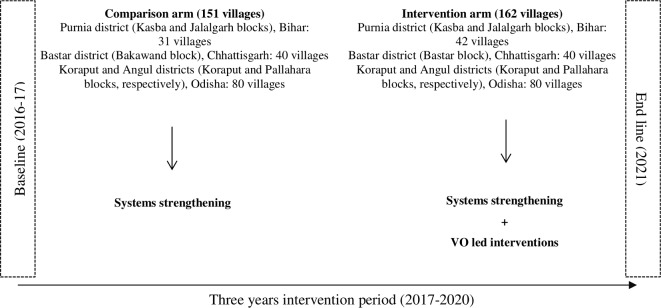
Swabhimaan has a nested prospective, non-randomised controlled evaluation. Since 2017, five intervention sites receive community-led interventions through national government's livelihood mission supported women's self-help group federations and five control sites will initiate these activities 36 months later, in 2020. Community-led activities aim to improve coverage of 18 interventions including adequacy of food consumed, prevention of micronutrient deficiencies, access to basic health services and special care of nutritionally 'at risk' girls and women, improving hygiene and access to water and sanitation services and access to family planning services. The evaluation includes baseline (2016-2017), midline (2018-2019) and endline (2020-2021) surveys covering 6638 adolescent girls, 2992 pregnant women and 8755 mothers of children under 2. The final impact analysis will be by intention to treat, comparing primary and secondary outcomes in five intervention areas and five control areas. The primary outcomes are: (1) a 15% reduction in the proportion of adolescent girls with a body mass index (BMI) <18.5 kg/m; (2) a 15% reduction in the proportion of mothers of children under two with a BMI <18.5 kg/m and (3) and a 0.4 cm improvement in mean mid-upper arm circumference among pregnant women.
All procedures involving human subjects were approved by the Institutional Ethics Committee of the All India Institute of Medical Sciences, Bihar, Chhattisgarh and Odisha and in compliance with guidelines laid down in the Declaration of Helsinki. Evidence will inform maternal and preconception nutrition policy at national and state level.
58261b2f46876 and CTRI/2016/11/007482; Pre-results.
Swabhimaan 是一个基于社区的项目,旨在改善印度三个邦(比哈尔邦、恰蒂斯加尔邦和奥里萨邦)农村地区青少年女孩和妇女的营养状况,这些邦的营养不良患病率很高。
Swabhimaan 采用嵌套前瞻性、非随机对照评估。自 2017 年以来,五个干预点通过国家政府生计使命下的社区主导干预措施,支持妇女自助团体联合会,五个对照点将在 36 个月后,即 2020 年,开始这些活动。社区主导的活动旨在提高 18 项干预措施的覆盖率,包括所摄入食物的充足性、预防微量营养素缺乏、获得基本保健服务以及对营养“处于危险中”的女孩和妇女的特殊护理,改善卫生和获得水和卫生服务以及获得计划生育服务。评估包括基线(2016-2017 年)、中期(2018-2019 年)和终线(2020-2021 年)调查,涵盖 6638 名青少年女孩、2992 名孕妇和 8755 名 2 岁以下儿童的母亲。最终的影响分析将采用意向治疗,比较五个干预区和五个对照区的主要和次要结果。主要结果是:(1)身体质量指数(BMI)<18.5kg/m2 的青少年女孩比例减少 15%;(2)2 岁以下儿童的母亲 BMI<18.5kg/m2 的比例减少 15%;(3)孕妇的平均上臂中部周长增加 0.4cm。
涉及人类受试者的所有程序均获得了比哈尔邦、恰蒂斯加尔邦和奥里萨邦全印度医学科学研究所机构伦理委员会的批准,并符合《赫尔辛基宣言》规定的准则。证据将为国家和州一级的孕产妇和孕前营养政策提供信息。
58261b2f46876 和 CTRI/2016/11/007482;预结果。