Lee Ji Woo, Song Kwang Hoon
Department of Nano-Bioengineering, Incheon National University, Incheon, Republic of Korea.
Research Center of Brain-Machine Interface, Incheon National University, Incheon, Republic of Korea.
J Tissue Eng. 2023 Aug 12;14:20417314231191881. doi: 10.1177/20417314231191881. eCollection 2023 Jan-Dec.
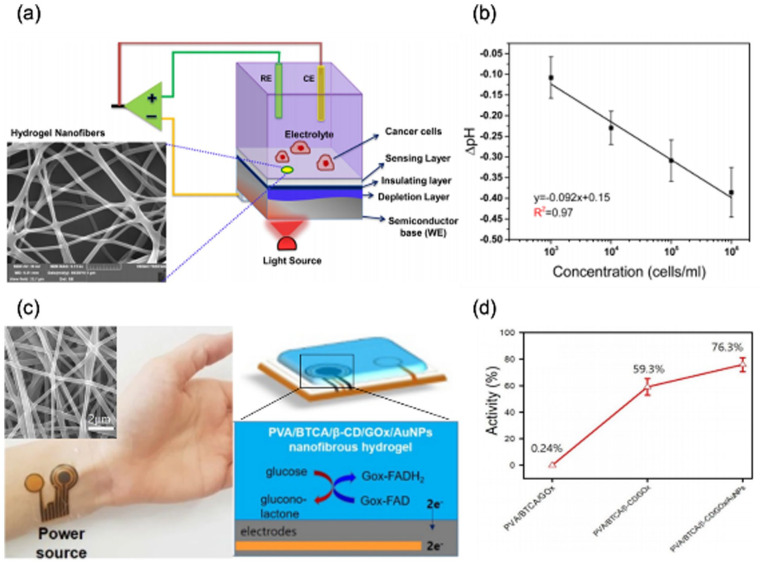
Hydrogels, hydrophilic and biocompatible polymeric networks, have been used for numerous biomedical applications because they have exhibited abilities to mimic features of extracellular matrix (ECM). In particular, the hydrogels engineered with electrospinning techniques have shown great performances in biomedical applications. Electrospinning techniques are to generate polymeric micro/nanofibers that can mimic geometries of natural ECM by drawing micro/nanofibers from polymer precursors with electrical forces, followed by structural stabilization of them. By exploiting the electrospinning techniques, the fibrous hydrogels have been fabricated and utilized as 2D/3D cell culture platforms, implantable scaffolds, and wound dressings. In addition, some hydrogels that respond to external stimuli have been used to develop biosensors. For comprehensive understanding, this review covers electrospinning processes, hydrogel precursors used for electrospinning, characteristics of fibrous hydrogels and specific biomedical applications of electrospun fibrous hydrogels and highlight their potential to promote use in biomedical applications.
水凝胶是亲水性和生物相容性的聚合物网络,由于其具有模仿细胞外基质(ECM)特征的能力,已被用于众多生物医学应用。特别是,采用静电纺丝技术制备的水凝胶在生物医学应用中表现出优异的性能。静电纺丝技术是通过电力从聚合物前驱体中拉出微/纳米纤维,从而生成能够模仿天然ECM几何形状的聚合物微/纳米纤维,随后对其进行结构稳定化处理。通过利用静电纺丝技术,已制备出纤维状水凝胶,并将其用作二维/三维细胞培养平台、可植入支架和伤口敷料。此外,一些对外部刺激有响应的水凝胶已被用于开发生物传感器。为了全面理解,本综述涵盖了静电纺丝过程、用于静电纺丝的水凝胶前驱体、纤维状水凝胶的特性以及静电纺丝纤维状水凝胶的具体生物医学应用,并强调了它们在生物医学应用中推广使用的潜力。