Section of Nephrology, Boston University Chobanian & Avedisian School of Medicine and Boston Medical Center, Boston, Massachusetts.
Anschutz Medical Campus, University of Colorado School of Medicine, Aurora.
JAMA Netw Open. 2023 Aug 1;6(8):e2328944. doi: 10.1001/jamanetworkopen.2023.28944.
Latinx people have a high burden of kidney disease but are less likely to receive home dialysis compared to non-Latinx White people. The disparity in home dialysis therapy has not been completely explained by demographic, medical, or social factors.
To understand the barriers and facilitators to home dialysis therapy experienced by Latinx individuals with kidney failure receiving home dialysis.
DESIGN, SETTING, AND PARTICIPANTS: This qualitative study used semistructured interviews with Latinx adults with kidney failure receiving home dialysis therapy in Denver, Colorado, and Houston, Texas, between November 2021 and March 2023. Patients were recruited from home dialysis clinics affiliated with academic medical centers. Of 39 individuals approached, 27 were included in the study. Interviews were audio-recorded, transcribed verbatim, and analyzed using thematic analysis.
Themes and subthemes regarding barriers and facilitators to home dialysis therapy.
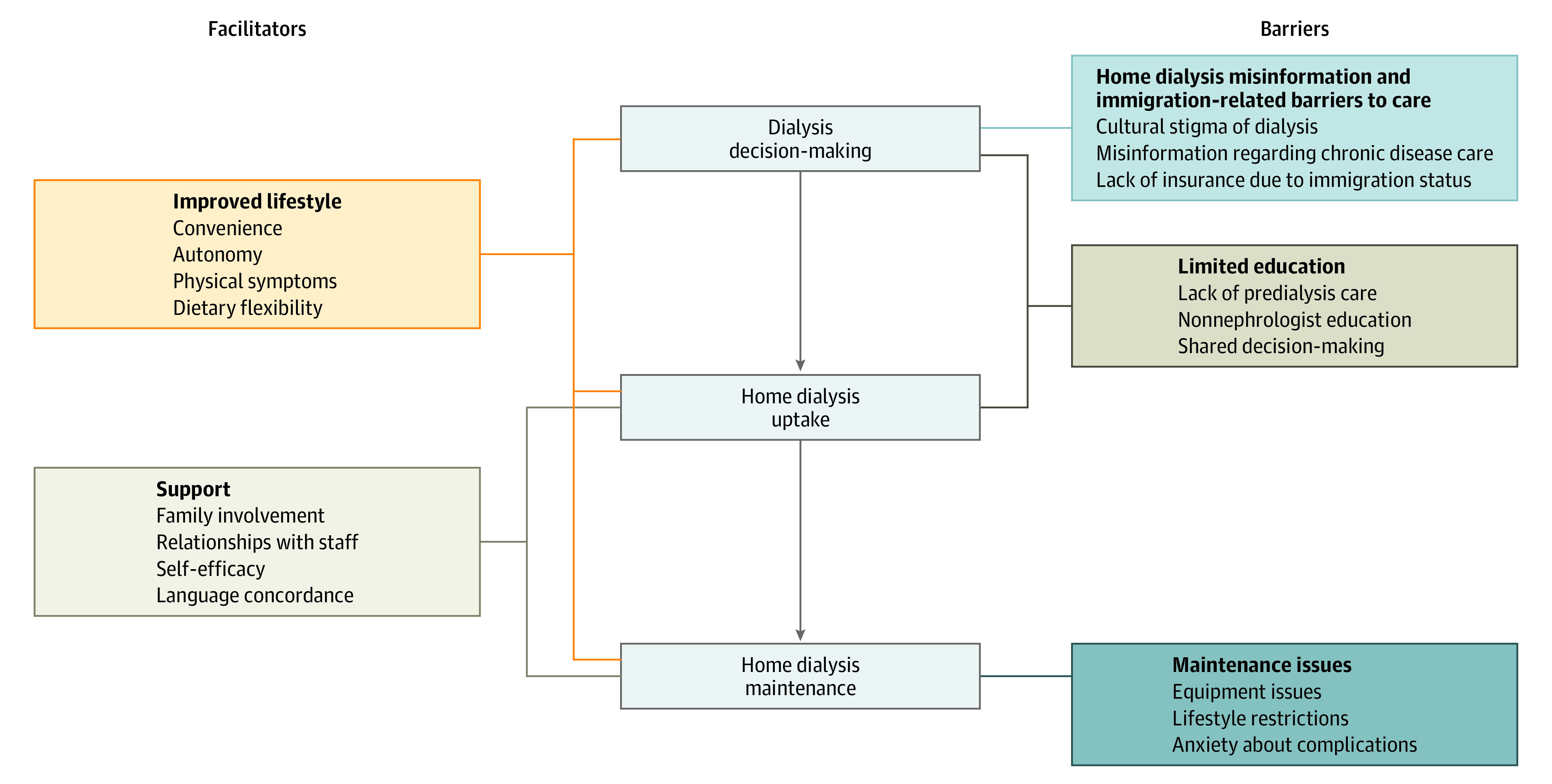
A total of 27 Latinx adults (17 [63%] female and 10 [37%] male) with kidney failure who were receiving home dialysis participated. Themes and subthemes were identified, 3 related to challenges with home dialysis and 2 related to facilitators. Challenges to home dialysis included misinformation and immigration-related barriers to care (including cultural stigma of dialysis, misinformation regarding chronic disease care, and lack of health insurance due to immigration status), limited dialysis education (including lack of predialysis care, no-nephrologist education, and shared decision-making), and maintenance of home dialysis (including equipment issues, lifestyle restrictions, and anxiety about complications). Facilitators to home dialysis included improved lifestyle (including convenience, autonomy, physical symptoms, and dietary flexibility) and support (including family involvement, relationships with staff, self-efficacy, and language concordance).
Latinx participants in this study who were receiving home dialysis received misinformation and limited education regarding home dialysis, yet were engaged in self-advocacy and reported strong family and clinic support. These findings may inform new strategies aimed at improving access to home dialysis education and uptake for Latinx individuals with kidney disease.
拉丁裔人群患肾脏疾病的负担很重,但与非拉丁裔白人相比,他们接受家庭透析的可能性较低。家庭透析治疗的差异不能完全用人口统计学、医学或社会因素来解释。
了解接受家庭透析治疗的肾衰竭拉丁裔个体在家庭透析治疗中经历的障碍和促进因素。
设计、地点和参与者:这是一项定性研究,使用半结构式访谈,对 2021 年 11 月至 2023 年 3 月期间在科罗拉多州丹佛市和德克萨斯州休斯顿市接受家庭透析治疗的肾衰竭拉丁裔成年人进行。患者是从与学术医疗中心有关联的家庭透析诊所招募的。在接触的 39 个人中,有 27 人被纳入研究。访谈进行了录音,并逐字转录,然后使用主题分析进行分析。
与家庭透析治疗相关的障碍和促进因素的主题和子主题。
共有 27 名患有肾衰竭且正在接受家庭透析的拉丁裔成年人(17 名[63%]为女性,10 名[37%]为男性)参与了研究。确定了主题和子主题,其中 3 个与家庭透析的挑战有关,2 个与促进因素有关。家庭透析的挑战包括信息错误和与护理相关的移民障碍(包括对透析的文化污名、对慢性病护理的错误信息以及因移民身份而缺乏健康保险)、有限的透析教育(包括缺乏透析前护理、无肾病专家教育和共同决策)以及家庭透析的维持(包括设备问题、生活方式限制以及对并发症的焦虑)。家庭透析的促进因素包括改善生活方式(包括方便、自主、身体症状和饮食灵活性)和支持(包括家庭参与、与工作人员的关系、自我效能和语言一致性)。
本研究中接受家庭透析治疗的拉丁裔参与者接受了有关家庭透析的错误信息和有限的教育,但他们积极倡导自己的权益,并报告说得到了强大的家庭和诊所支持。这些发现可能为改善拉丁裔肾脏病患者获得家庭透析教育和采用的新策略提供信息。