Faculty of Nursing, Federal University of Goiás, Catalão, Brazil.
Nursing Department, Federal University of Rondônia, Porto Velho, Brazil.
PLoS One. 2023 Aug 15;18(8):e0284967. doi: 10.1371/journal.pone.0284967. eCollection 2023.
Timely detection of cleaning failure is critical for quality assurance within Sterilising Service Units (SSUs). Rapid Adenosine Triphosphate (ATP) testing provides a real time and quantitative indication of cellular contaminants, when used to measure surface or device cleanliness. The aim of this study was to investigate the use of an ATP algorithm and to whether it could be used as a routine quality assurance step, to monitor surgical instruments cleanliness in SSUs prior to sterilisation.
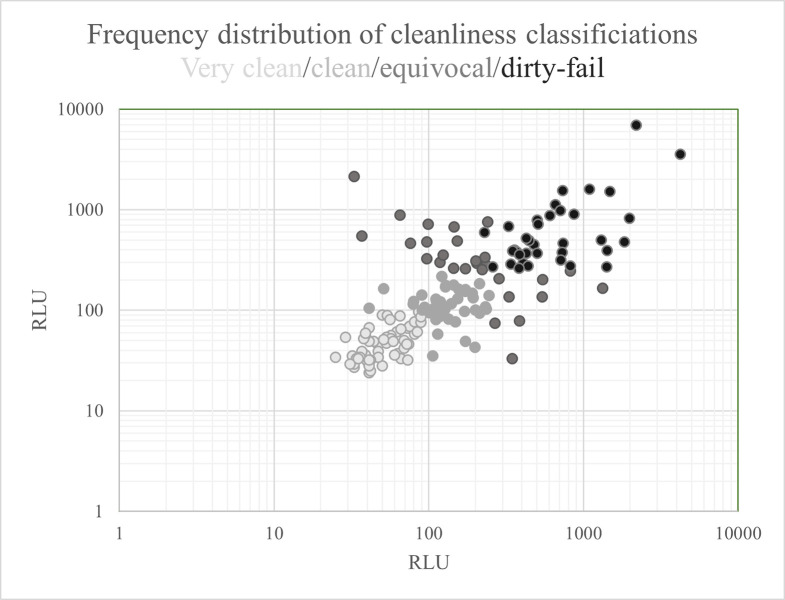
Cleanliness monitoring using rapid ATP testing was undertaken in the SSUs of four hospitals located in the western (Amazonia) region of Brazil. ATP testing was conducted (Clean Trace, 3M) on 163 surgical instruments, following manual cleaning. A sampling algorithm using a duplicate swab approach was applied to indicate surgical instruments as (i) very clean, (ii) clean, (iii) equivocal or (iv) fail, based around a 'clean' cut-off of 250 Relative Light Units (RLU) and a 'very clean' <100 RLU.
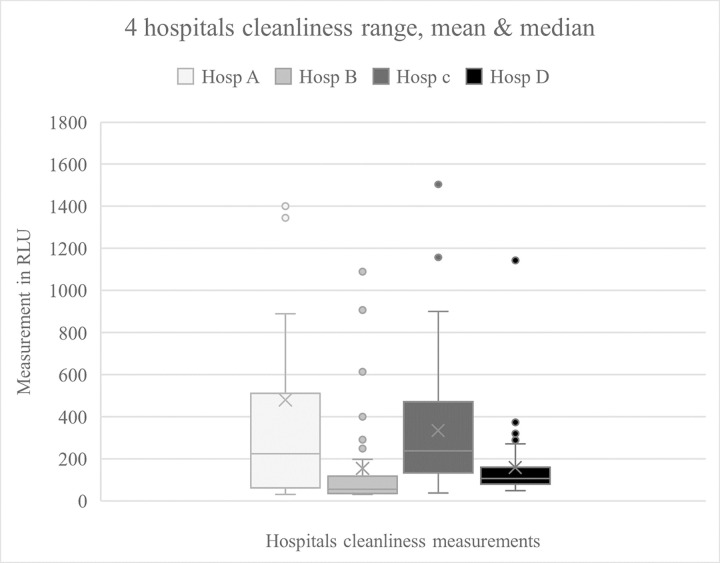
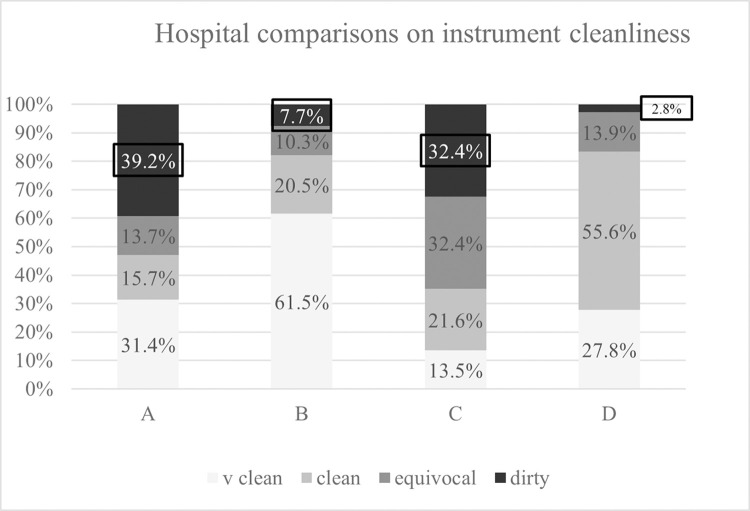
The four cleanliness categories were significantly differentiated (P≤0.001). The worst performing locations (hospitals A & C) had failure rates of 39.2% and 32.4%, respectively, and were distinctly different from hospitals B & D (P≤0.001). The best performing hospitals (B & D) had failure rates of 7.7% and 2.8%, respectively.
The ATP testing algorithm provides a simple to use method within SSUs. The measurements are in real time, quantitative and useful for risk-based quality assurance monitoring, and the tool can be used for staff training. The four-tiered approach to the grading of surgical instrument cleanliness provides a nuanced approach for continuous quality improvement within SSU than does a simple pass/fail methodology.
及时发现清洗失败对于消毒服务部门(SSU)的质量保证至关重要。当用于测量表面或设备清洁度时,快速三磷酸腺苷(ATP)测试可实时提供细胞污染物的定量指示。本研究旨在调查 ATP 算法的使用情况,以及它是否可用于作为常规质量保证步骤,以监测 SSU 中手术器械在消毒前的清洁度。
在巴西西部(亚马逊地区)的四家医院的 SSU 中进行了使用快速 ATP 测试的清洁度监测。在手动清洁后,对 163 个手术器械进行了 ATP 测试(3M 的 Clean Trace)。采用重复拭子采样算法,根据“清洁”截止值 250 相对光单位(RLU)和“非常清洁”<100 RLU,将手术器械指示为(i)非常清洁、(ii)清洁、(iii)不确定或(iv)失败。
四个清洁类别有显著差异(P≤0.001)。表现最差的两个地点(医院 A 和 C)的失败率分别为 39.2%和 32.4%,明显不同于医院 B 和 D(P≤0.001)。表现最好的两个医院(B 和 D)的失败率分别为 7.7%和 2.8%。
ATP 测试算法为 SSU 提供了一种简单易用的方法。测量是实时、定量的,可用于基于风险的质量保证监测,该工具可用于员工培训。手术器械清洁度的四级分级方法为 SSU 的持续质量改进提供了比简单的通过/失败方法更细致的方法。