Department of Urology, Affiliated Hospital of Chengdu University, Chengdu, 610081, Sichuan, China.
Department of Radiology, Ninety-Three Hospital, Jiangyou City, 610000, Sichuan, China.
BMC Med Imaging. 2023 Aug 15;23(1):106. doi: 10.1186/s12880-023-01074-7.
Biparametric MRI (bpMRI) is a faster, contrast-free, and less expensive MRI protocol that facilitates the detection of prostate cancer. The aim of this study is to determine whether a biparametric MRI PI-RADS v2.1 score-based model could reduce unnecessary biopsies in patients with suspected prostate cancer (PCa).
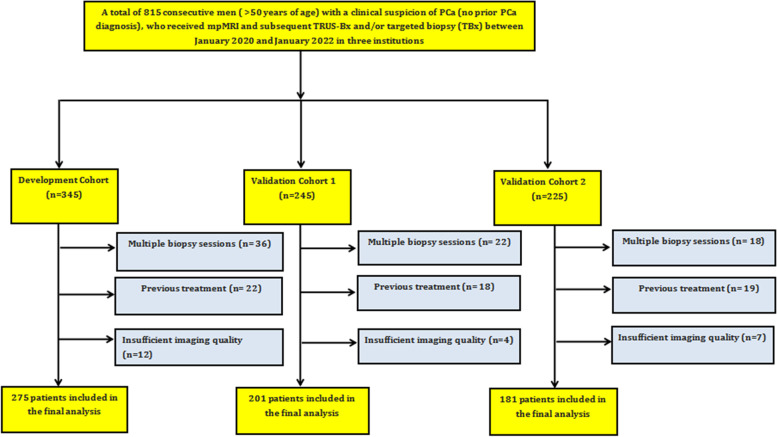
The patients who underwent MRI-guided biopsies and systematic biopsies between January 2020 and January 2022 were retrospectively analyzed. The development cohort used to derive the prediction model consisted of 275 patients. Two validation cohorts included 201 patients and 181 patients from 2 independent institutions. Predictive models based on the bpMRI PI-RADS v2.1 score (bpMRI score) and clinical parameters were used to detect clinically significant prostate cancer (csPCa) and compared by analyzing the area under the curve (AUC) and decision curves. Spearman correlation analysis was utilized to determine the relationship between International Society of Urological Pathology (ISUP) grade and clinical parameters/bpMRI score.
Logistic regression models were constructed using data from the development cohort to generate nomograms. By applying the models to the all cohorts, the AUC for csPCa was significantly higher for the bpMRI PI-RADS v2.1 score-based model than for the clinical model in both cohorts (p < 0.001). Considering the test trade-offs, urologists would agree to perform 10 fewer bpMRIs to avoid one unnecessary biopsy, with a risk threshold of 10-20% in practice. Correlation analysis showed a strong correlation between the bpMRI score and ISUP grade.
A predictive model based on the bpMRI score and clinical parameters significantly improved csPCa risk stratification, and the bpMRI score can be used to determine the aggressiveness of PCa prior to biopsy.
双参数磁共振成像(bpMRI)是一种更快、无对比剂且更经济的 MRI 方案,有助于前列腺癌的检测。本研究旨在确定基于 bpMRI PI-RADS v2.1 评分的模型是否可以减少疑似前列腺癌(PCa)患者的不必要活检。
回顾性分析了 2020 年 1 月至 2022 年 1 月期间接受 MRI 引导活检和系统活检的患者。用于推导预测模型的开发队列包括 275 例患者。两个验证队列包括来自 2 个独立机构的 201 例和 181 例患者。使用基于 bpMRI PI-RADS v2.1 评分(bpMRI 评分)和临床参数的预测模型来检测临床显著前列腺癌(csPCa),并通过分析曲线下面积(AUC)和决策曲线进行比较。Spearman 相关性分析用于确定国际泌尿病理学会(ISUP)分级与临床参数/bpMRI 评分之间的关系。
使用开发队列中的数据构建了逻辑回归模型,以生成列线图。将模型应用于所有队列,bpMRI PI-RADS v2.1 评分模型的 csPCa AUC 显著高于两个队列中的临床模型(p<0.001)。考虑到测试权衡,泌尿科医生将同意减少 10 次 bpMRI 检查,以避免一次不必要的活检,在实践中风险阈值为 10-20%。相关性分析显示 bpMRI 评分与 ISUP 分级之间存在很强的相关性。
基于 bpMRI 评分和临床参数的预测模型显著改善了 csPCa 风险分层,bpMRI 评分可用于在活检前确定 PCa 的侵袭性。