Department of Human Genetics, Leiden University Medical Center, Leiden, The Netherlands.
Department of Radiology, Leiden University Medical Center, Leiden, The Netherlands.
Nat Commun. 2023 Aug 15;14(1):4909. doi: 10.1038/s41467-023-40555-9.
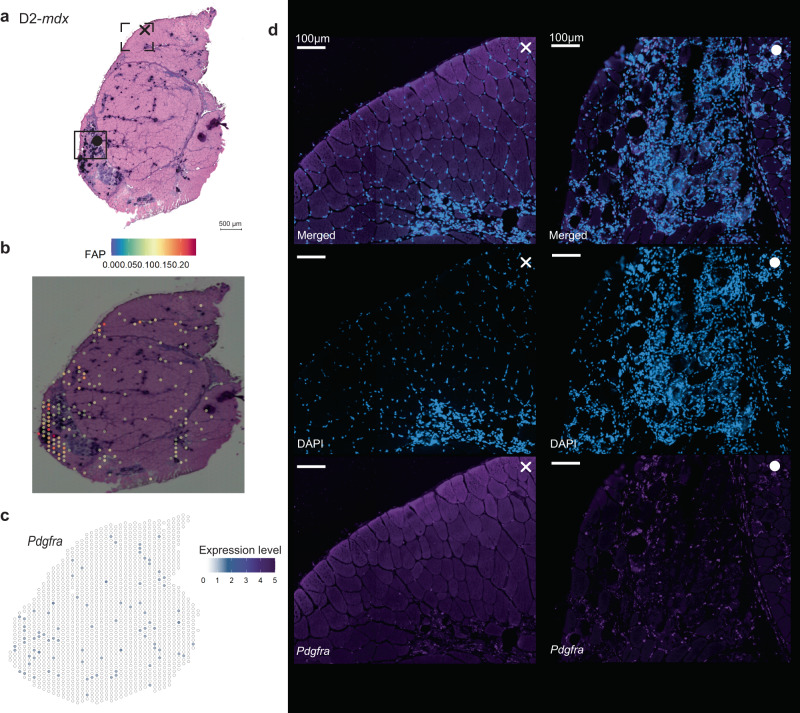
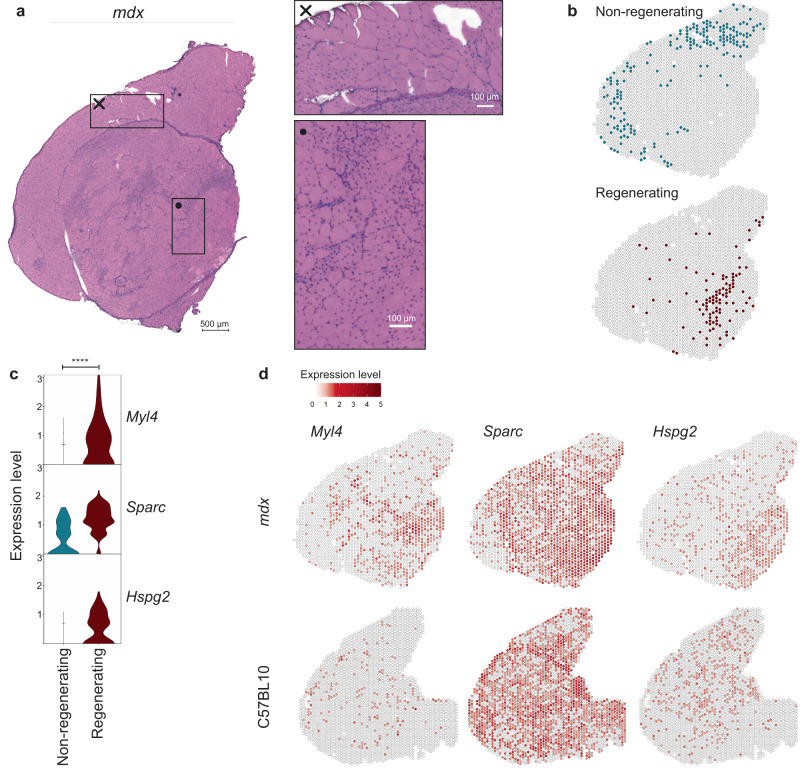
Duchenne muscular dystrophy is caused by mutations in the DMD gene, leading to lack of dystrophin. Chronic muscle damage eventually leads to histological alterations in skeletal muscles. The identification of genes and cell types driving tissue remodeling is a key step to developing effective therapies. Here we use spatial transcriptomics in two Duchenne muscular dystrophy mouse models differing in disease severity to identify gene expression signatures underlying skeletal muscle pathology and to directly link gene expression to muscle histology. We perform deconvolution analysis to identify cell types contributing to histological alterations. We show increased expression of specific genes in areas of muscle regeneration (Myl4, Sparc, Hspg2), fibrosis (Vim, Fn1, Thbs4) and calcification (Bgn, Ctsk, Spp1). These findings are confirmed by smFISH. Finally, we use differentiation dynamic analysis in the D2-mdx muscle to identify muscle fibers in the present state that are predicted to become affected in the future state.
杜氏肌营养不良症是由 DMD 基因突变引起的,导致肌营养不良蛋白缺失。慢性肌肉损伤最终导致骨骼肌的组织学改变。确定驱动组织重塑的基因和细胞类型是开发有效治疗方法的关键步骤。在这里,我们使用空间转录组学在两种疾病严重程度不同的杜氏肌营养不良症小鼠模型中进行研究,以确定骨骼肌肉病理学的基因表达特征,并将基因表达直接与肌肉组织学联系起来。我们进行去卷积分析以确定导致组织学改变的细胞类型。我们发现肌肉再生区域(Myl4、Sparc、Hspg2)、纤维化(Vim、Fn1、Thbs4)和钙化(Bgn、Ctsk、Spp1)中特定基因的表达增加。这些发现通过 smFISH 得到了证实。最后,我们在 D2-mdx 肌肉中使用分化动态分析来鉴定目前状态下的肌肉纤维,这些纤维预计在未来状态下会受到影响。