Pharmetheus AB, Uppsala, Sweden.
Camurus AB, Lund, Sweden.
Clin Pharmacokinet. 2023 Oct;62(10):1427-1443. doi: 10.1007/s40262-023-01288-6. Epub 2023 Aug 16.
In treating opioid use disorder (OUD), subcutaneous (SC) extended-release buprenorphine (BPN) depots, e.g., CAM2038, have been shown to provide smaller and less frequent fluctuations in BPN plasma concentrations and pharmacodynamic responses, improve outcomes, reduce treatment burden, and lower risks of misuse and diversion compared to daily sublingual (SL) BPN. This analysis characterized the pharmacokinetics (PK) of BPN following intravenous and SL administration, and administration of SC CAM2038 weekly and monthly.
Pharmacokinetic data from two Phase 1 and two Phase 2 trials in healthy participants and participants with OUD, respectively, were used to develop a population PK model using non-linear mixed effects modelling. The analysis included data from 252 participants and 10,658 BPN observations.
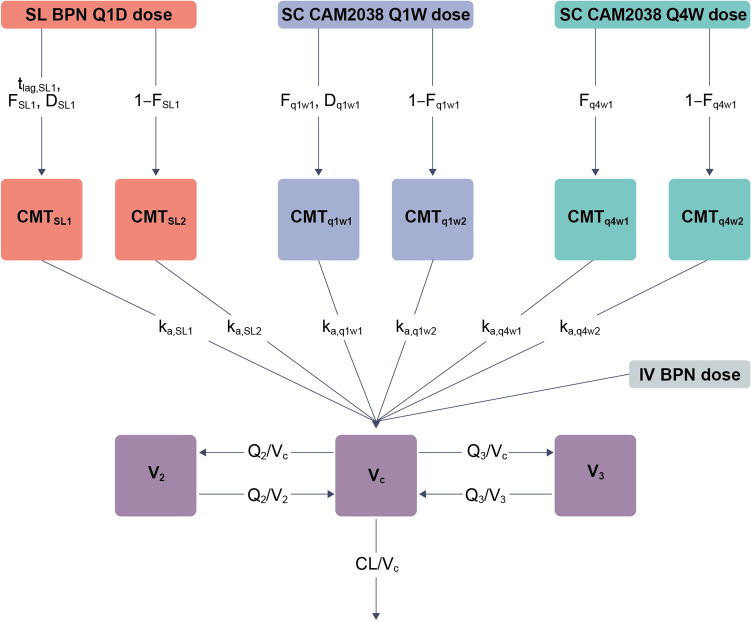
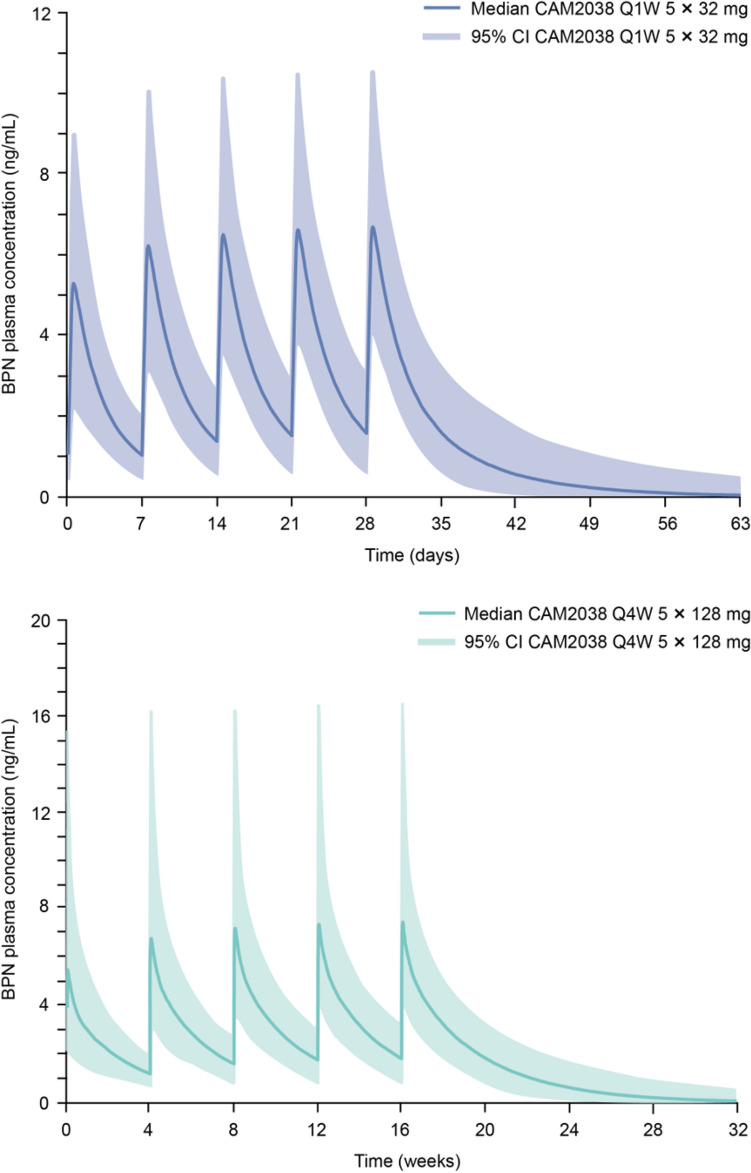
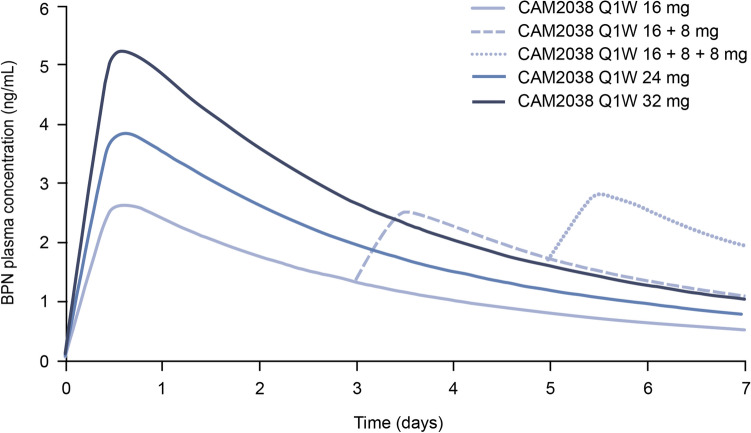
The disposition of BPN was best described by a three-compartment model with first-order elimination, and absorption of SL BPN and SC CAM2038 weekly and monthly by dual parallel absorption pathways. Model diagnostics indicated good predictive performance of BPN concentrations. Buprenorphine plasma concentration-time profiles were simulated for treatment initiation, switching from SL BPN to CAM2038 weekly and monthly, and tapering after interrupting treatment with CAM2038. Simulations predicted CAM2038 weekly and monthly doses that provided BPN plasma maximum concentration (C) and trough concentration (C) values at steady state within those observed following SL BPN administration.
This population PK model supports the use of CAM2038 doses as individualized treatment for OUD across different treatment stages, including initiation, switching from SL BPN according to established dose conversion schedules, and tapering.
ISRCTN41550730 (05/19/2014), ISRCTN24987553 (07/29/2014), NCT02611752 (11/23/2015), NCT02710526 (03/16/2016).
在治疗阿片类药物使用障碍(OUD)时,皮下(SC)缓释丁丙诺啡(BPN)贮库,例如 CAM2038,已被证明可使 BPN 血浆浓度和药效反应的波动更小且更不频繁,改善结局,降低治疗负担,并降低误用和转用的风险,与每日舌下(SL)BPN 相比。本分析描述了静脉内和 SL 给药后 BPN 的药代动力学(PK),以及每周和每月 SC CAM2038 给药后的 PK。
使用来自两项健康参与者和 OUD 参与者的 I 期和 II 期试验的药代动力学数据,使用非线性混合效应建模来开发群体 PK 模型。该分析包括 252 名参与者和 10658 次 BPN 观察值的数据。
BPN 的处置最好通过具有一级消除的三腔室模型来描述,并且 SL BPN 和 SC CAM2038 每周和每月的吸收通过双平行吸收途径来描述。模型诊断表明 BPN 浓度的预测性能良好。模拟了治疗开始、从 SL BPN 切换到每周和每月的 CAM2038 以及中断 CAM2038 治疗后的 BPN 血浆浓度-时间曲线。模拟预测了每周和每月的 CAM2038 剂量,这些剂量可提供在 SL BPN 给药后观察到的稳态时 BPN 血浆最大浓度(C)和谷浓度(C)值。
该群体 PK 模型支持在不同的治疗阶段(包括启动、根据既定剂量转换方案从 SL BPN 切换以及逐渐减少)将 CAM2038 剂量作为 OUD 的个体化治疗。
ISRCTN41550730(2014 年 5 月 19 日),ISRCTN24987553(2014 年 7 月 29 日),NCT02611752(2015 年 11 月 23 日),NCT02710526(2016 年 3 月 16 日)。