Farm Animal Genetic Resources Exploration and Innovation Key Laboratory of Sichuan Province, Sichuan Agricultural University, Chengdu 611130, PR China; Key Laboratory of Livestock and Poultry Multi-omics, Ministry of Agriculture and Rural Affairs, Institute of Animal Genetics and Breeding, Sichuan Agricultural University, Chengdu 611130, PR China.
Farm Animal Genetic Resources Exploration and Innovation Key Laboratory of Sichuan Province, Sichuan Agricultural University, Chengdu 611130, PR China; Key Laboratory of Livestock and Poultry Multi-omics, Ministry of Agriculture and Rural Affairs, Institute of Animal Genetics and Breeding, Sichuan Agricultural University, Chengdu 611130, PR China.
Poult Sci. 2023 Oct;102(10):102963. doi: 10.1016/j.psj.2023.102963. Epub 2023 Jul 26.
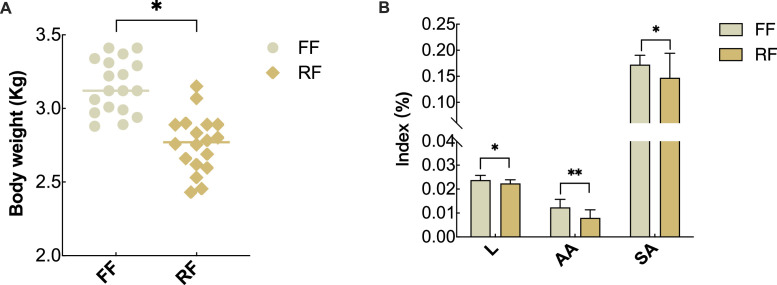
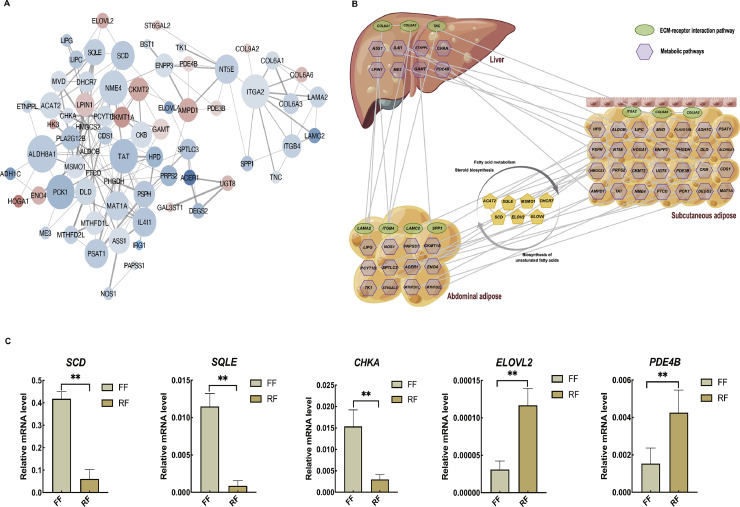
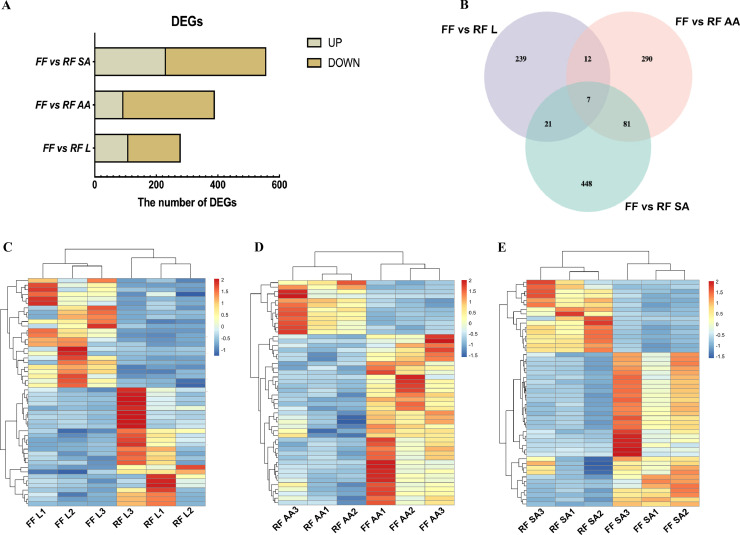
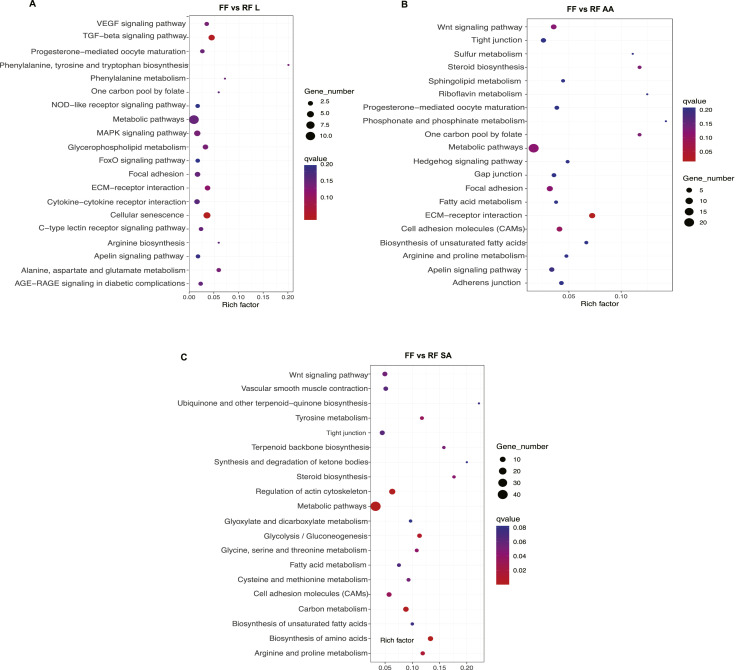
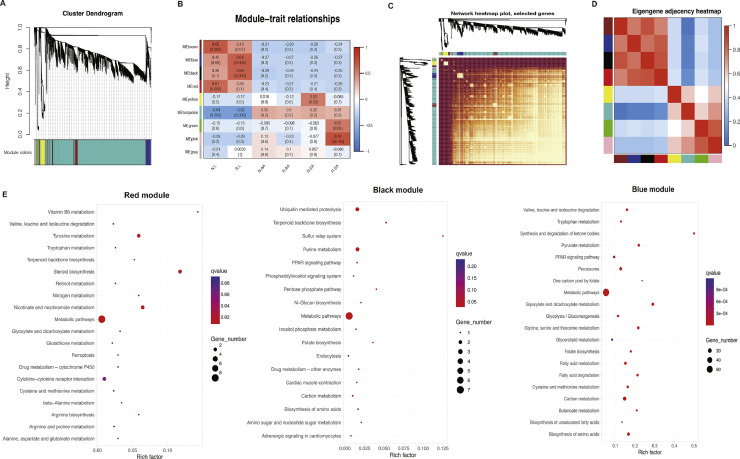
Presently, excessive fat deposition is the main reason to limit the development of duck industry. In the production, the methods of restricted feeding (RF) were widely used to reduce the lipid deposition of ducks. The liver (L), abdominal adipose (AA), and subcutaneous adipose (SA) were the main tissues of lipid metabolism and deposition of ducks. However, the mechanisms of lipid metabolism and deposition of ducks under RF have not been fully clarified. In this study, in order to better understand the mechanisms of lipid metabolism and deposition in ducks under RF, a total of 120 male Nonghua ducks were randomly divided into a free feeding group (FF, n = 60) and RF group (RF, n = 60), then comparative transcriptomic analysis of L, AA, and SA between FF (n = 3) and RF (n = 3) ducks was performed at 56 d of age. Phenotypically, L, AA, and SA index of FF group was higher than that in RF group. There were 279, 390, and 557 differentially expressed genes (DEGs) in L, AA, and SA. Functional enrichment analysis revealed that ECM-receptor interaction and metabolic pathways were significantly enriched in L, AA, and SA. Lipid metabolism-related pathways including fatty acid metabolism, unsaturated fatty acid synthesis, and steroidogenesis were significantly enriched in AA and SA. Moreover, through integrated analysis weighted gene coexpression network (WGCNA) and protein-protein interaction network, 10 potential candidate genes involved in the ECM-receptor interaction and lipid metabolism pathways were identified, including 3-hydroxy-3-methylglutaryl-CoA synthase 2 (HMGCS2), aldolase B (ALDOB), formimidoyltransferase cyclodeaminase(FTCD), phosphoenolpyruvate carboxykinase 1 (PCK1), tyrosine aminotransferase (TAT), stearoyl-CoA desaturase (SCD), squalene epoxidase (SQLE), phosphodiesterase 4B (PDE4B), choline kinase A (CHKA), and elongation of very-long-chain fatty acids-like 2 (ELOVL2), which could play a key role in lipid metabolism and deposition of ducks under RF. Our study reveals that the liver might regulate the lipid metabolism of abdominal adipose and subcutaneous adipose through ECM-receptor interaction and metabolic pathways (fatty acid metabolism, unsaturated fatty acid synthesis, and steroid synthesis), thus to reduce the lipid deposition of ducks under RF. These results provide novel insights into the avian lipid metabolism and will help better understand the underlying molecular mechanisms.
目前,脂肪过度沉积是限制鸭产业发展的主要原因。在生产中,限制饲养(RF)方法被广泛用于减少鸭子的脂质沉积。肝脏(L)、腹部脂肪(AA)和皮下脂肪(SA)是鸭子脂质代谢和沉积的主要组织。然而,RF 下鸭子脂质代谢和沉积的机制尚未完全阐明。在这项研究中,为了更好地了解 RF 下鸭子的脂质代谢和沉积机制,共选用 120 只雄性肉鸭,随机分为自由采食组(FF,n=60)和 RF 组(RF,n=60),然后在 56 日龄时分别对 FF(n=3)和 RF(n=3)鸭的 L、AA 和 SA 进行比较转录组分析。表型上,FF 组的 L、AA 和 SA 指数均高于 RF 组。在 L、AA 和 SA 中分别有 279、390 和 557 个差异表达基因(DEGs)。功能富集分析表明,ECM-受体相互作用和代谢途径在 L、AA 和 SA 中显著富集。脂质代谢相关途径,包括脂肪酸代谢、不饱和脂肪酸合成和类固醇生成,在 AA 和 SA 中显著富集。此外,通过整合加权基因共表达网络(WGCNA)和蛋白质-蛋白质相互作用网络分析,鉴定出 10 个潜在候选基因,这些基因参与 ECM-受体相互作用和脂质代谢途径,包括 3-羟-3-甲基戊二酰基辅酶 A 合酶 2(HMGCS2)、醛缩酶 B(ALDOB)、亚氨甲酰基转移酶环脱氨酶(FTCD)、磷酸烯醇丙酮酸羧激酶 1(PCK1)、酪氨酸转氨酶(TAT)、硬脂酰辅酶 A 去饱和酶(SCD)、鲨烯环氧化酶(SQLE)、磷酸二酯酶 4B(PDE4B)、胆碱激酶 A(CHKA)和超长链脂肪酸延伸酶 2(ELOVL2),它们可能在 RF 下的鸭子脂质代谢和沉积中发挥关键作用。本研究表明,肝脏可能通过 ECM-受体相互作用和代谢途径(脂肪酸代谢、不饱和脂肪酸合成和类固醇合成)调节腹部脂肪和皮下脂肪的脂质代谢,从而减少 RF 下鸭子的脂质沉积。这些结果为禽类脂质代谢提供了新的见解,并有助于更好地理解潜在的分子机制。