Mor Nachiket
Banyan Academy of Leadership in Mental Health, India.
One Health. 2023 Aug 7;17:100611. doi: 10.1016/j.onehlt.2023.100611. eCollection 2023 Dec.
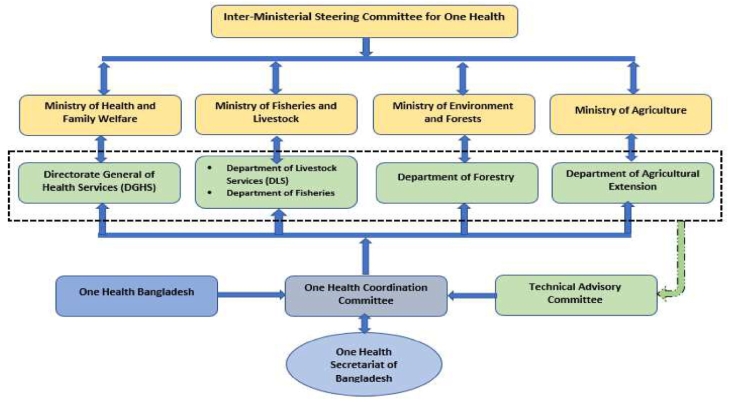
Globally, zoonotic diseases pose an enormous and growing public health challenge, and developing countries like India are at the epicentre of it. Although there is general recognition of this reality, governments around the world have struggled to organise appropriately to respond to it. The widely held view is that organising for One Health requires effective cross-sectoral collaboration, but the prerequisites to enable such collaboration appear almost unattainable. Perhaps an entirely different approach is needed, which is over and above effective collaborations between competing government ministries. The approach would have to recognise that while any organisational response will need to be able to address identified zoonotic diseases and respond effectively to them in times of crises, it would also be required to have the ability to shape the response to such as climate change, deforestation, and the underlying development models of the country. The paper analyses the success and failures associated with the way in which India, Bangladesh, Kenya, and Rwanda have organised for One Health. It also studies the underlying pathways through which zoonotic spillovers take place, and epidemics gather momentum. Based on these critical analyses, the paper concludes that attempts to build single overarching units to address these challenges have only been partially effective. Given the scale and complexity of the challenge, it recommends that, even at the risk of duplication and the very real possibility that unaddressed gaps will remain, an approach, which builds multiple sharply focused units, would have a greater chance of success.
在全球范围内,人畜共患疾病构成了巨大且日益严峻的公共卫生挑战,像印度这样的发展中国家处于这一挑战的中心。尽管人们普遍认识到这一现实,但世界各国政府在组织相应应对措施方面仍面临困难。普遍观点认为,开展“同一健康”行动需要有效的跨部门合作,然而实现这种合作的先决条件似乎几乎无法达成。或许需要一种截然不同的方法,这种方法超越了相互竞争的政府部门之间的有效合作。该方法必须认识到,任何组织性回应不仅需要能够应对已确定的人畜共患疾病,并在危机时刻对其做出有效反应,还需要有能力塑造对气候变化、森林砍伐以及国家潜在发展模式等问题的应对方式。本文分析了印度、孟加拉国、肯尼亚和卢旺达在组织开展“同一健康”行动方面的成败。它还研究了人畜共患疾病溢出以及疫情发展的潜在途径。基于这些批判性分析,本文得出结论,试图建立单一的总体单位来应对这些挑战仅取得了部分成效。鉴于挑战的规模和复杂性,本文建议,即使存在重复工作的风险以及未解决差距仍将存在的切实可能性,建立多个重点突出的单位的方法成功的机会更大。