Service of Endocrinology and Nutrition, Foundation for the Promotion of Health and Biomedical Research in the Valencian Region (FISABIO), University Hospital Doctor Peset, Valencia, Spain.
Service of Endocrinology and Nutrition, Foundation for the Promotion of Health and Biomedical Research in the Valencian Region (FISABIO), University Hospital Doctor Peset, Valencia, Spain; Cancer Research @UCC, College of Medicine and Health, University College Cork, Ireland.
Redox Biol. 2023 Oct;66:102849. doi: 10.1016/j.redox.2023.102849. Epub 2023 Aug 14.
Type 2 diabetes (T2D) is linked to metabolic, mitochondrial and inflammatory alterations, atherosclerosis development and cardiovascular diseases (CVDs). The aim was to investigate the potential therapeutic benefits of GLP-1 receptor agonists (GLP-1 RA) on oxidative stress, mitochondrial respiration, leukocyte-endothelial interactions, inflammation and carotid intima-media thickness (CIMT) in T2D patients.
Type 2 diabetic patients (255) and control subjects (175) were recruited, paired by age and sex, and separated into two groups: without GLP-1 RA treatment (196) and treated with GLP-1 RA (59). Peripheral blood polymorphonuclear leukocytes (PMNs) were isolated to measure reactive oxygen species (ROS) production by flow cytometry and oxygen consumption with a Clark electrode. PMNs were also used to assess leukocyte-endothelial interactions. Circulating levels of adhesion molecules and inflammatory markers were quantified by Luminex's technology, and CIMT was measured as surrogate marker of atherosclerosis.
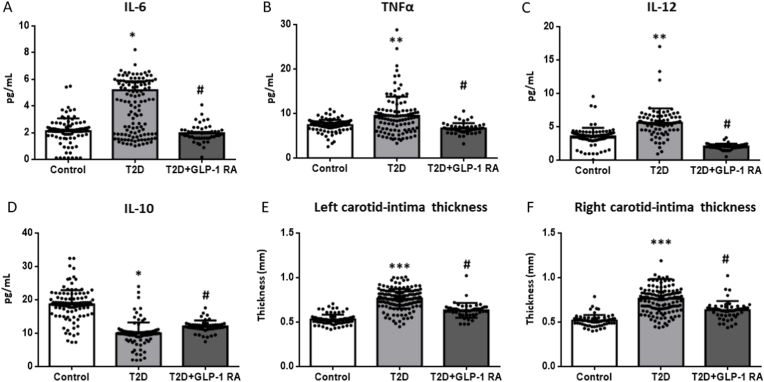
Treatment with GLP-1 RA reduced ROS production and recovered mitochondrial membrane potential, oxygen consumption and MPO levels. The velocity of leukocytes rolling over endothelial cells increased in PMNs from GLP-1 RA-treated patients, whereas rolling and adhesion were diminished. ICAM-1, VCAM-1, IL-6, TNFα and IL-12 protein levels also decreased in the GLP-1 RA-treated group, while IL-10 increased. CIMT was lower in GLP-1 RA-treated T2D patients than in T2D patients without GLP-1 RA treatment.
GLP-1 RA treatment improves the redox state and mitochondrial respiration, and reduces leukocyte-endothelial interactions, inflammation and CIMT in T2D patients, thereby potentially diminishing the risk of atherosclerosis and CVDs.
2 型糖尿病(T2D)与代谢、线粒体和炎症改变、动脉粥样硬化发展和心血管疾病(CVDs)有关。本研究旨在探讨 GLP-1 受体激动剂(GLP-1 RA)对 T2D 患者氧化应激、线粒体呼吸、白细胞-内皮相互作用、炎症和颈动脉内膜中层厚度(CIMT)的潜在治疗益处。
招募了 255 名 2 型糖尿病患者和 175 名对照受试者,按年龄和性别配对,并分为两组:无 GLP-1 RA 治疗组(196 名)和 GLP-1 RA 治疗组(59 名)。分离外周血多形核白细胞(PMNs),通过流式细胞术测量活性氧(ROS)的产生,并使用克拉克电极测量耗氧量。还使用 PMNs 评估白细胞-内皮相互作用。通过 Luminex 技术定量测定循环黏附分子和炎症标志物的水平,并将 CIMT 作为动脉粥样硬化的替代标志物进行测量。
GLP-1 RA 治疗可降低 ROS 产生,并恢复线粒体膜电位、耗氧量和 MPO 水平。GLP-1 RA 治疗患者的 PMNs 中白细胞滚动速度增加,而滚动和黏附减少。GLP-1 RA 治疗组的 ICAM-1、VCAM-1、IL-6、TNFα 和 IL-12 蛋白水平也降低,而 IL-10 增加。与未接受 GLP-1 RA 治疗的 T2D 患者相比,接受 GLP-1 RA 治疗的 T2D 患者的 CIMT 更低。
GLP-1 RA 治疗可改善 T2D 患者的氧化还原状态和线粒体呼吸,减少白细胞-内皮相互作用、炎症和 CIMT,从而降低动脉粥样硬化和 CVDs 的风险。