Toraih Eman A, Alenezy Awwad, Hussein Mohammad H, Hashmat Shahmeer, Mummadi Saitej, Alrawili Nawaf Farhan, Abdelmaksoud Ahmed, Fawzy Manal S
Department of Surgery, School of Medicine, Tulane University, New Orleans, LA 70112, USA.
Department of Cardiovascular Perfusion, Interprofessional Research, College of Health Professions, Upstate Medical University, New York, NY 13210, USA.
Biomedicines. 2025 Apr 26;13(5):1049. doi: 10.3390/biomedicines13051049.
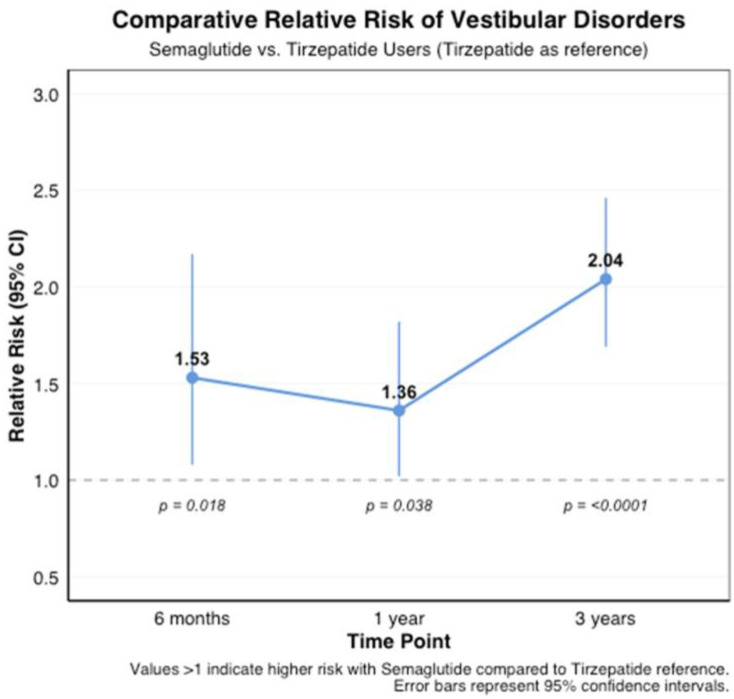
: Glucagon-like peptide-1 receptor agonists (GLP-1RAs) have revolutionized the treatment of type 2 diabetes and obesity. While their metabolic benefits are well-established, their potential effects on vestibular function remain unexplored. This study investigated the association between GLP-1RA use and the risk of vestibular disorders. : Using the TriNetX research network (accessed 3 November 2024), we conducted a retrospective cohort study of adults prescribed semaglutide ( = 419,497) or tirzepatide ( = 77,259) between January 2018 and October 2024. Cases were matched 1:1 with controls using propensity scores based on demographics and comorbidities. The primary outcome was new-onset vestibular disorders, analyzed at 6 months, 1 year, and 3 years after treatment initiation. : Both medications were associated with an increased risk of vestibular disorders. Semaglutide users showed a higher cumulative incidence (0.12% at 6 months to 0.41% at 3 years) compared to controls (0.03% to 0.16%, < 0.001), with hazard ratios ranging from 4.02 (95% CI: 3.33-4.86) at 6 months to 4.95 (95% CI: 4.51-5.43) at 3 years. Tirzepatide users demonstrated similar patterns but lower absolute rates (0.10% at 6 months to 0.19% at 3 years vs. controls 0.04% to 0.15%), with hazard ratios from 3.19 (95% CI: 2.11-4.81) to 4.55 (95% CI: 3.43-6.03). The direct comparison showed a higher risk with semaglutide versus tirzepatide (RR 1.53-2.04, < 0.001). : GLP-1RA therapy is associated with an increased risk of vestibular disorders, with a higher risk observed with semaglutide compared to tirzepatide. These findings suggest the need for vestibular symptom monitoring in patients receiving these medications and warrant further investigation into underlying mechanisms.
胰高血糖素样肽-1受体激动剂(GLP-1RAs)彻底改变了2型糖尿病和肥胖症的治疗方式。虽然它们的代谢益处已得到充分证实,但其对前庭功能的潜在影响仍未得到探索。本研究调查了使用GLP-1RA与前庭疾病风险之间的关联。使用TriNetX研究网络(于2024年11月3日访问),我们对2018年1月至2024年10月期间开具司美格鲁肽(n = 419,497)或替尔泊肽(n = 77,259)的成年人进行了一项回顾性队列研究。根据人口统计学和合并症,使用倾向得分将病例与对照进行1:1匹配。主要结局是新发前庭疾病,在治疗开始后的6个月、1年和3年进行分析。两种药物均与前庭疾病风险增加相关。与对照组(0.03%至0.16%)相比,司美格鲁肽使用者的累积发病率更高(6个月时为0.12%,3年时为0.41%,P < 0.001),风险比在6个月时为4.02(95%置信区间:3.33 - 4.86),3年时为4.95(95%置信区间:4.51 - 5.43)。替尔泊肽使用者表现出类似模式,但绝对发生率较低(6个月时为0.10%,3年时为0.19%,而对照组为0.04%至0.15%),风险比为3.19(95%置信区间:2.11 - 4.81)至4.55(95%置信区间:3.43 - 6.03)。直接比较显示,司美格鲁肽的风险高于替尔泊肽(相对风险1.53 - 2.04,P < 0.001)。GLP-1RA治疗与前庭疾病风险增加相关,与替尔泊肽相比,司美格鲁肽的风险更高。这些发现表明,接受这些药物治疗的患者需要监测前庭症状,并且有必要进一步研究潜在机制。