Research Center, Institut universitaire de gériatrie de Montréal.
Psychology Department, Université de Montréal.
Curr Opin Neurol. 2023 Oct 1;36(5):491-497. doi: 10.1097/WCO.0000000000001192. Epub 2023 Aug 13.
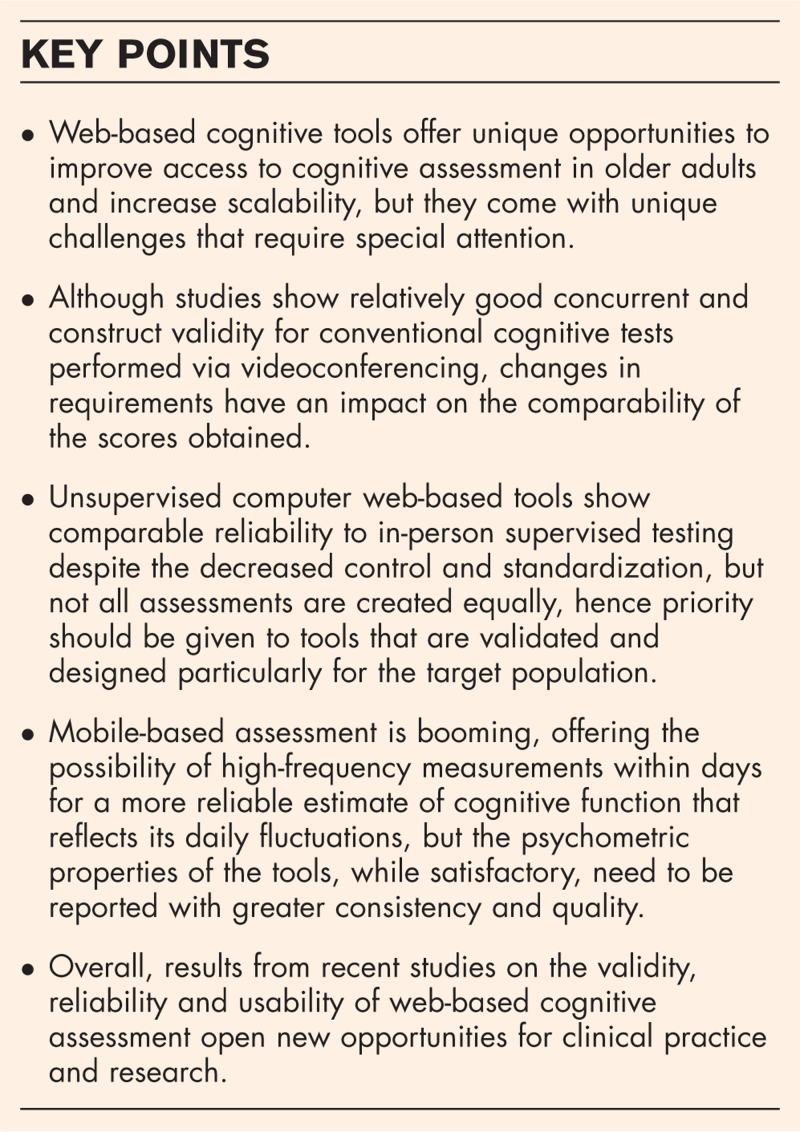
The use of digital tools for remote cognitive measurement of older adults is generating increasing interest due to the numerous advantages offered for accessibility and scalability. However, these tools also pose distinctive challenges, necessitating a thorough analysis of their psychometric properties, feasibility and acceptability.
In this narrative review, we present the recent literature on the use of web-based cognitive assessment to characterize cognition in older adults and to contribute to the diagnosis of age-related neurodegenerative diseases. We present and discuss three types of web-based cognitive assessments: conventional cognitive tests administered through videoconferencing; unsupervised web-based assessments conducted on a computer; and unsupervised web-based assessments performed on smartphones.
There have been considerable progress documenting the properties, strengths and limitations of web-based cognitive assessments. For the three types of assessments reported here, the findings support their promising potential for older adults. However, certain aspects, such as the construct validity of these tools and the development of robust norms, remain less well documented. Nonetheless, the beneficial potential of these tools, and their current validation and feasibility data, justify their application [see Supplementary Digital Content (SDC), http://links.lww.com/CONR/A69 ].
由于数字工具在可及性和可扩展性方面具有诸多优势,远程认知测量在老年人中的应用越来越受到关注。然而,这些工具也带来了独特的挑战,需要对其心理测量特性、可行性和可接受性进行全面分析。
在这篇叙述性综述中,我们介绍了最近关于使用基于网络的认知评估来描述老年人认知能力以及为年龄相关性神经退行性疾病诊断提供信息的文献。我们提出并讨论了三种基于网络的认知评估方法:通过视频会议进行的常规认知测试;在计算机上进行的无监督的基于网络的评估;以及在智能手机上进行的无监督的基于网络的评估。
有大量文献记录了基于网络的认知评估的特性、优势和局限性。对于这里报告的三种评估方法,研究结果支持它们在老年人中的应用前景。然而,这些工具的结构有效性以及稳健的规范制定等方面的信息仍不够充分。尽管如此,这些工具的有益潜力以及它们目前的验证和可行性数据证明了其应用的合理性[参见补充数字内容(SDC),http://links.lww.com/CONR/A69]。